Case study - Pain (acute): Nursing
Introduction0:00–0:35
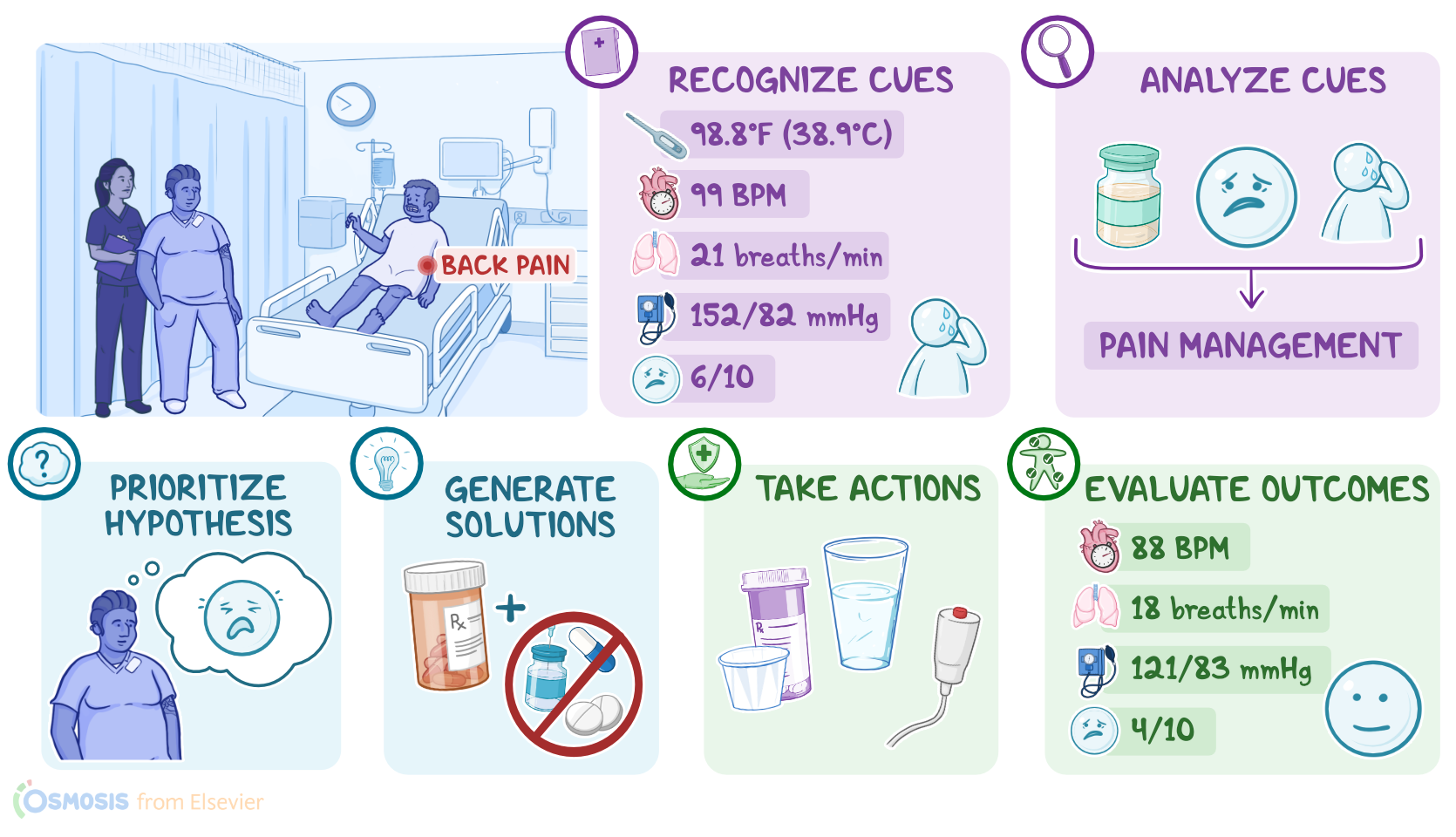
Nurse. Nadia works on an orthopedic unit and is caring for Brian a 51 year old with a history of degenerative joint disease who was admitted for intractable back pain.
In collaboration with the registered nurse, RN Ky. Nurse, Nadia goes through the steps of the clinical judgment measurement model to make clinical decisions about Bryan's care by recognizing and analyzing cues, prioritizing hypotheses, generating solutions, taking action and evaluating outcomes.
First, nurse, Nadia recognizes important cues including Bryan's vital signs which are temperature 98.8 °F or 38.9 °C heart rate, 99 BPM respirations, 21 breaths per minute and BP 152/82 millimeters of mercury.
Recognizing and Analyzing Cues0:35–1:32
She also notices Bryan is slightly diaphoretic and grimacing when asked about his pain. He reports a current pain level of six out of 10 and that his tolerable level of pain is three out of 10.
Next. Nurse, Nadia analyzes these cues.
She reviews the electronic health record or EHR and notes that Bryan is prescribed IV ketorolac every six hours PRN and he received his last dose two hours ago.
Nurse, Nadia compares her findings to Bryans assessment conducted by RNK D and realizes Bryan needs effective pain management.
Now using the information she has gathered along with Bryan's medical history, nurse Nadia reports her findings to RNK who chooses a priority hypothesis of acute pain.
Prioritizing Hypotheses, Generating Solutions, and Taking Action1:32–3:33
Then nurse Nadia collaborates with RNK D to generate solutions to address Bryan's pain that will include pharmacologic and nonpharmacologic interventions.
And they established the expected outcome that after intervening, Bryan will report a pain level of three or less out of 10 within one hour.
Nurse, Nadia then takes action to implement these solutions. She knows that since Bryan's most recent dose of ketorolac was two hours ago, he can't receive his next dose for four more hours.
Since Bryan is in moderate pain, she verifies that Bryan isn't allergic to any medications and then calls the health care provider reporting.
Bryan's current pain assessment and vital signs. The provider prescribes a one time dose of oral traMADol while waiting for the pharmacist to approve this new medication order.
Nurse Nadia dims the lights in Brians room plays relaxing music from the television and applies a cold pack to his lower back.
Once the pharmacist approves the order, nurse, Nadia gathers supplies and re enters Bryans room. Hi, Brian, the healthcare provider prescribed a dose of traMADol for your pain.
I just had pain medicine through my IV. Isn't it too soon to take something else earlier?
She informs Bryan that she'll allow him to rest for a while and places his call light at the bedside. One hour later, nurse Nadia enters the room to evaluate the outcome of her actions.
Evaluating Outcomes3:33–5:05
She takes B Brian's vital signs and asks about his pain. His temperature is 98.4 °F or 38.7 degrees.
Celsius. Heart rate is 88 BPM.
Respirations are 18 breaths per minute. BP is 121/83 millimeters of mercury and his pain is four out of 10.
Bryan appears more comfortable and is no longer grimacing or sweating. Although Bryans vital signs have returned to normal.
Hes still reporting moderate pain. Nurse, Nadia recognizes the expected outcome of a pain rating of three or less out of 10 hasn't been met.
So she asks Bryan what she can do to address his pain more thoroughly. I feel better but I'm still uncomfortable.
The ice music and medicine really seemed to help, but I keep waking up from the noises in the hallway and people coming in and out of my room, nurse, Nadia documents Bryans response to the pharmacologic and nonpharmacologic pain interventions and notes that the noise disruptions in the hallway, impaired Bryans comfort and relaxation.
Then she discusses her findings with RNK D and they revise the plan of care to ensure Brian receives more rest. Next, nurse, Nadia freshens and reapplies.
Bryan's ice pack provides him with ear plugs and closes the door to his room. She places a sign on the door that says, please see the nurse before entering.
All right, as a quick recap, nurse, Nadia recognized and analyzed cues related to Brian's intractable back pain. And in collaboration with the registered nurse, RN Katie prioritized hypotheses and generated solutions to address this problem.
Review5:05–5:39
Nurse, Nadia and RN Ky then implemented pharmacologic and nonpharmacologic pain measures and evaluated Bryans outcomes and compared them to the expected outcome since Bryan's pain remained four out of 10 following interventions.
They revised the plan of care to minimize noise and disruptions to promote Bryan's rest and
| CASE STUDY - PAIN (ACUTE) | ||
| KEY POINTS | MY NOTES | |
| INTRODUCTION |
| |
| RECOGNIZING AND ANALYZING CUES |
| |
| PRIORITIZING HYPOTHESES, GENERATING SOLUTIONS, AND TAKING ACTION |
| |
| EVALUATING OUTCOMES |
| |
- "Foundations of nursing. (9th ed.). " Elsevier. ISBN: 9780323827119 (2023)
- "Fundamental concepts and skills for nursing. (6th ed.). " Elsevier. ISBN: 9780323694780 (2022)
No notes for this video yet
Try adding a note below