Case study - Pediatric urinary tract infection: Nursing
Introduction0:00–0:34
Nurse Michelle works at a pediatrician’s office and is caring for Emma, a fully toilet trained, 5-year-old female brought in by her father, Jim, for urinary frequency and crying when urinating.
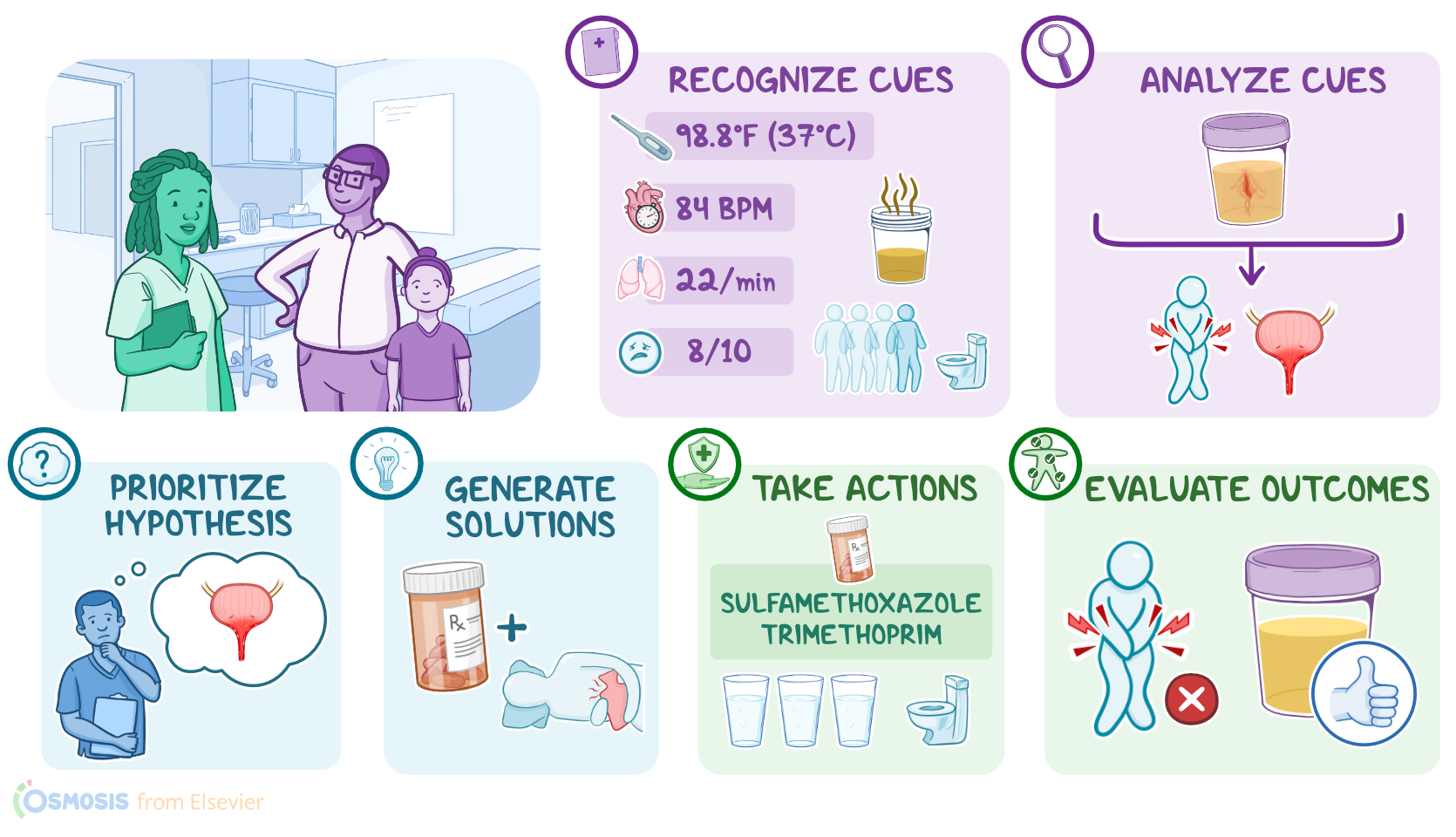
After settling Emma and her father in a room, Nurse Michelle goes through the steps of the Clinical Judgment Measurement Model to make clinical decisions about Emma’s care by recognizing and analyzing cues, prioritizing hypotheses, generating solutions, taking action, and evaluating outcomes.
Recognizing and analyzing cues0:34–1:55
First, Nurse Michelle recognizes important cues, including vital signs, which are temporal temperature 98.8 F or 37 C, heart rate 84 beats per minute, and respirations 22 breaths per minute; as well as Jim’s description of Emma’s dark, amber-colored, and foul-smelling urine.
Then, Nurse Michelle obtains a clean catch urine sample from Emma for dipstick urinalysis and assesses for suprapubic and flank pain, which revealed mild discomfort with palpation over the suprapubic area.
Next, Nurse Michelle analyzes these cues. She reviews the results of the urinalysis which shows positive for leukocytes, nitrites, and blood.
Nurse Michelle recognizes that normal urinary elimination involves a controlled, painless release of urine that's typically light to dark yellow in color, transparent, with a slight odor, with no evidence of bacteria or blood.
Nurse Michelle realizes Emma is experiencing altered urinary elimination. She shares her assessments with the health care provider who diagnoses a urinary tract infection.
Prioritizing hypotheses, generating solutions, and taking action1:55–4:09
Using information she's gathered along with Emma’s medical history, Nurse Michelle chooses a priority hypothesis of urinary tract infection.
Then, she generates solutions to address Emma’s infection that will include pharmacologic and nonpharmacologic interventions, and she establishes the expected outcome that after intervening: My patient will urinate without pain or frequency within one week.
Nurse Michelle then takes action to implement these solutions. She gathers information on the prescribed antibiotic as well as educational materials about preventing urinary tract infections, and re-enters Emma’s room.
Nurse Michelle: Emma, your health care provider is giving you some medicine that'll make it stop hurting to use the bathroom, okay?
I’m also going to talk with you and your dad about ideas to help keep this from happening again. Does that sound good?
Emma: Yes. Nurse Michelle: Okay, great.
So, the medication Emma’s prescribed is called sulfamethoxazole trimethoprim. It'll clear up the urinary tract infection that’s causing her pain and frequency symptoms, but it can cause nausea, so you should give it with food.
Give her 5 milliliters twice each day for 10 days. You’ll use this little measuring cup to make sure you measure out the exact amount.
Emma should start to feel better in a few days, but it’s important to finish all 10 days of the medicine so the infection doesn’t return.
Father: Okay, I understand. Nurse Michelle: Great!
Now, let’s discuss some things you can do to help prevent Emma from getting another infection. Make sure she always wipes from front-to-back after using the bathroom.
This will help prevent germs from getting into her urethra. Also, check that she's drinking plenty of water and using the restroom regularly instead of holding her urine.
Father: Sure, we can do those things. Nurse Michelle ensures Emma and her father have no further questions before the appointment ends.
Then, she documents her interventions and Jim’s understanding of the education in the electronic health record. One week later, Emma and her father return for a follow-up visit, and Nurse Michelle evaluates the outcomes of her interventions.
Evaluating outcomes4:09–5:06
Nurse Michelle: Good to see you both again! Emma, I hope you’re feeling better.
Tell me about how it feels when you’re using the bathroom now. Emma: All better!
It doesn’t hurt anymore. Father: Yes, she is back to normal.
I’ve been reminding her about correct wiping and not waiting if she needs to use the bathroom. And we are giving her more opportunities to drink water throughout the day.
Nurse Michelle reinforces the importance of continuing these measures to prevent another urinary tract infection, and documents that Emma’s father has helped incorporate these changes into Emma's routine.
Nurse Michelle also notes Emma’s pain with urination and frequency has subsided. She obtains a clean catch specimen, which shows no signs of infection.
Nurse Michelle determines the desired outcomes have been met. Alright, as a quick recap....
Review5:06–5:38
Nurse Michelle recognized and analyzed cues related to Emma's painful urination and urinary frequency; and she prioritized hypotheses, and generated solutions to address this problem.
Nurse Michelle took action to educate Emma and her father about their prescription and ways they can prevent urinary tract infections.
She evaluated Emma’s outcomes by comparing them to the expected outcome. Since Emma’s pain and frequency improved, Nurse Michelle determined that the plan of care was successful.
| CASE STUDY - PEDIATRIC URINARY TRACT INFECTION (UTI) | ||
| KEY POINTS | NOTES | |
| INTRODUCTION |
| |
| RECOGNIZING AND ANALYZING CUES |
| |
| PRIORITIZING HYPOTHESES, GENERATING SOLUTIONS, AND TAKING ACTIONS |
| |
| EVALUATING OUTCOMES |
| |
- "Fundamentals of nursing (11th ed.)" Elsevier (2023)
- "Fundamentals of nursing: Active learning for collaborative practice (3rd ed.)" Elsevier (2022)
No notes for this video yet
Try adding a note below