Case study - Schizophrenia: Nursing
Introduction0:00–0:33
Nurse. George works on an inpatient psychiatric unit and is caring for kit a 31 year old with a history of schizophrenia, paranoid type who was recently admitted for psychotic symptoms.
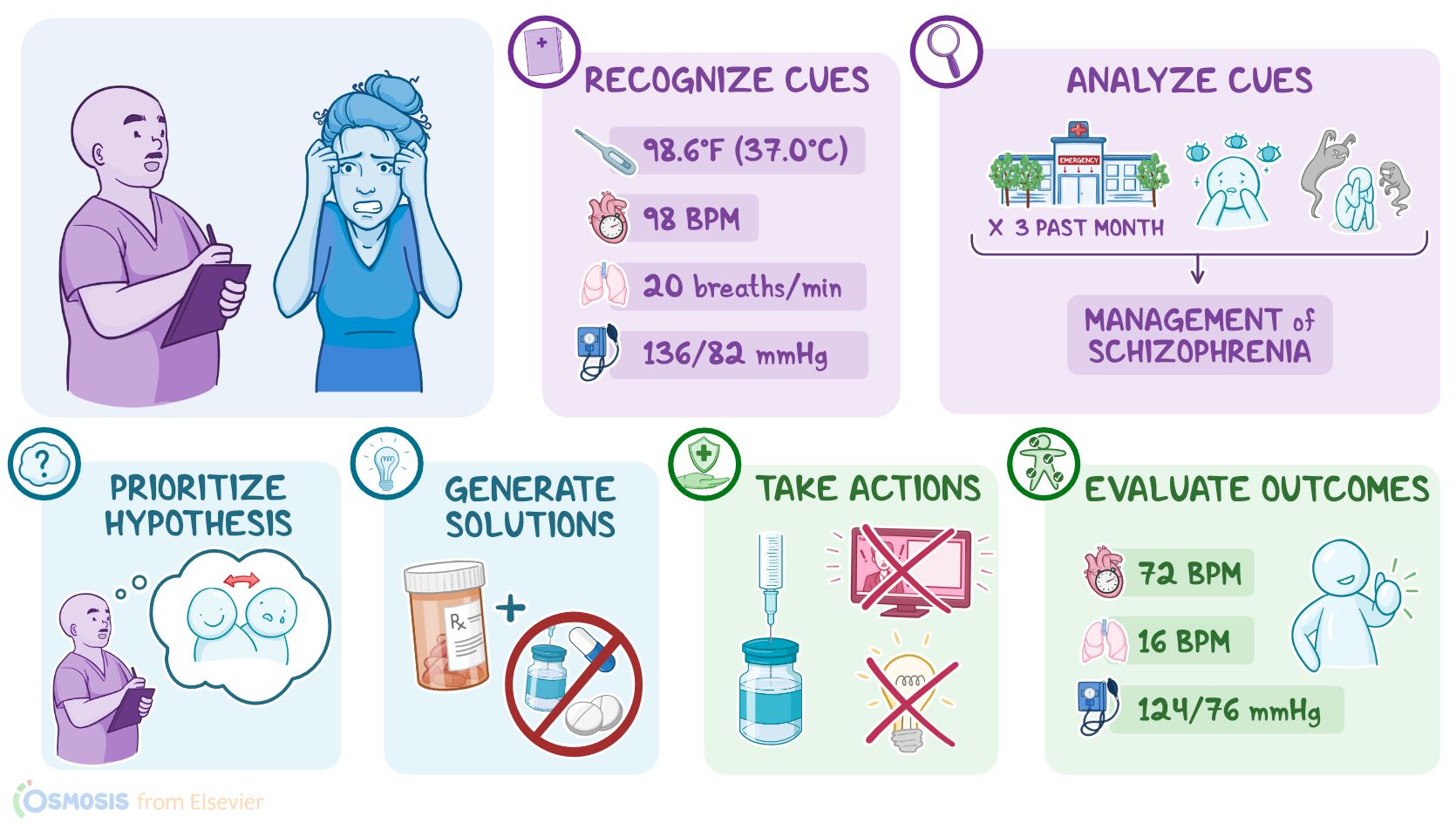
In collaboration with the registered nurse, ARN Juanita nurse George goes to the steps of the clinical judgment measurement model to make clinical decisions about kits care by recognizing and analyzing cues, prioritizing hypotheses, generating solutions, taking action and evaluating outcomes.
Recognizing and Analyzing Cues0:33–2:08
First, nurse George recognizes important cues including kitt's vital signs which are a temperature of 37 °C or 98.6 °F heart rate, 98 BPM, respirations, 20 breaths per minute and BP.
1 36/82 millimeters of mercury. Nurse George notices that kit appears disheveled, restless and is looking back and forth suspiciously across the room.
Hi, Kit, how are you doing today? There's a man coming after me.
I've seen him watching me from inside the closet. Nurse George turns to look inside the closet which is empty.
That sounds scary. Although I don't see anyone else here with us.
I'm here to support you and keep you safe. Next.
Nurse George analyzes these cues. They reviewed the electronic health record or EHR and note that kit has visited the emergency department three times in the past month for symptoms associated with her schizophrenia.
Nurse George knows the development of schizophrenia is related to both genetic and environmental factors that disturb the brain's structure and balance of neurotransmitters like dopamine and glutamate.
This leads to disabling alterations in behavior, emotions, thinking and perception, like delusions and hallucinations. Nurse George realizes that Kit needs management of her acute episode of schizophrenia.
Now using the information they have gathered along with Kitt's medical history. Nurse George reports, their findings to RN Juanita and together they choose a priority hypothesis of altered perception.
Prioritizing Hypotheses, Generating Solutions, and Taking Action2:08–4:10
Then nurse George collaborates with our and Juanita to generate solutions to address Kit's altered perception that will include pharmacologic and non pharmacologic interventions.
And they established the expected outcome that after intervening kit will report feeling safe in her environment. By the end of the shift.
Nurse George then takes action to implement these solutions. ARN Juanita reports their assessment findings to the health care provider who orders OLANZapine by intramuscular or im injection.
As nurse George prepares the OLANZapine, they ask a Juana to stand out of sight near Kit's door in case she becomes agitated or violent.
Nurse George then gathers the supplies and re enters the room. Hi, Kit I'm back and I have some medicine, your health care provider ordered that'll help you feel safe and more comfortable.
I'm scared that man is coming for me. He's right there behind you.
I understand that must be very frightening. I don't see a man behind me so you're safe here and no one is going to hurt you.
Hello, sir? Yes, I am.
I'm going to give you this medicine as a shot in your leg. Is that ok?
Ok. I've had those before.
Please don't let them get me nurse George then administers the injection according to the principles of safe medication administration and stays by kit's bedside to monitor her response.
Several minutes later, kit becomes drowsy and falls asleep while kit sleeps, nurse George takes measures to decrease stimulation in the room by dimming the lights and turning off the television at the end of their shift.
Evaluating Outcomes4:10–5:01
Nurse George checks kit to evaluate the outcome of their actions. Nurse George takes Kit's vital signs which are temperature 37 °C or 98.6 °F heart rate, 72 BPM, respirations, 16 breaths per minute and BP.
1 24/76 millimeters of mercury kit appears tired but comfortable and is no longer fixated on the closet. Hi kit.
Are you feeling any better? Yeah, I'm just groggy.
Ok. Do you see anything or anyone in the room that's making you feel unsafe?
No, I don't think so. That man who was in the closet is gone.
I'm safe now. Yes, you are.
And that's good to hear all right. As a quick recap, nurse George recognized and analyzed cues related to kitt's altered perception and in collaboration with our Juanita prioritized hypotheses and generated solutions to address this problem.
Review5:01–5:39
Nurse George and our Juanita then implemented pharmacologic and non pharmacologic measures to help manage kit's acute episode of schizophrenia and evaluated kit's outcomes and compared them to the expected outcome.
Since kit reported feeling safe in her environment. By the end of the shift, they determined that the plan of care was successful.
| CASE STUDY - SCHIZOPHRENIA | ||
| KEY POINTS | MY NOTES | |
| INTRODUCTION |
| |
| RECOGNIZING AND ANALYZING CUES |
| |
| PRIORITIZING HYPOTHESES, GENERATING SOLUTIONS, AND TAKING ACTION |
| |
| EVALUATING OUTCOMES |
| |
- "Foundations of mental health care. (8th ed.)" Elsevier (2023)
No notes for this video yet
Try adding a note below