Case study - Sickle cell anemia: Nursing
Introduction0:00–0:30
Nurse Maggie works in a pediatric hematology unit and is caring for Marcus, a 9-year-old with a history of sickle cell disease who was admitted for a vaso-occlusive crisis, or VOC.
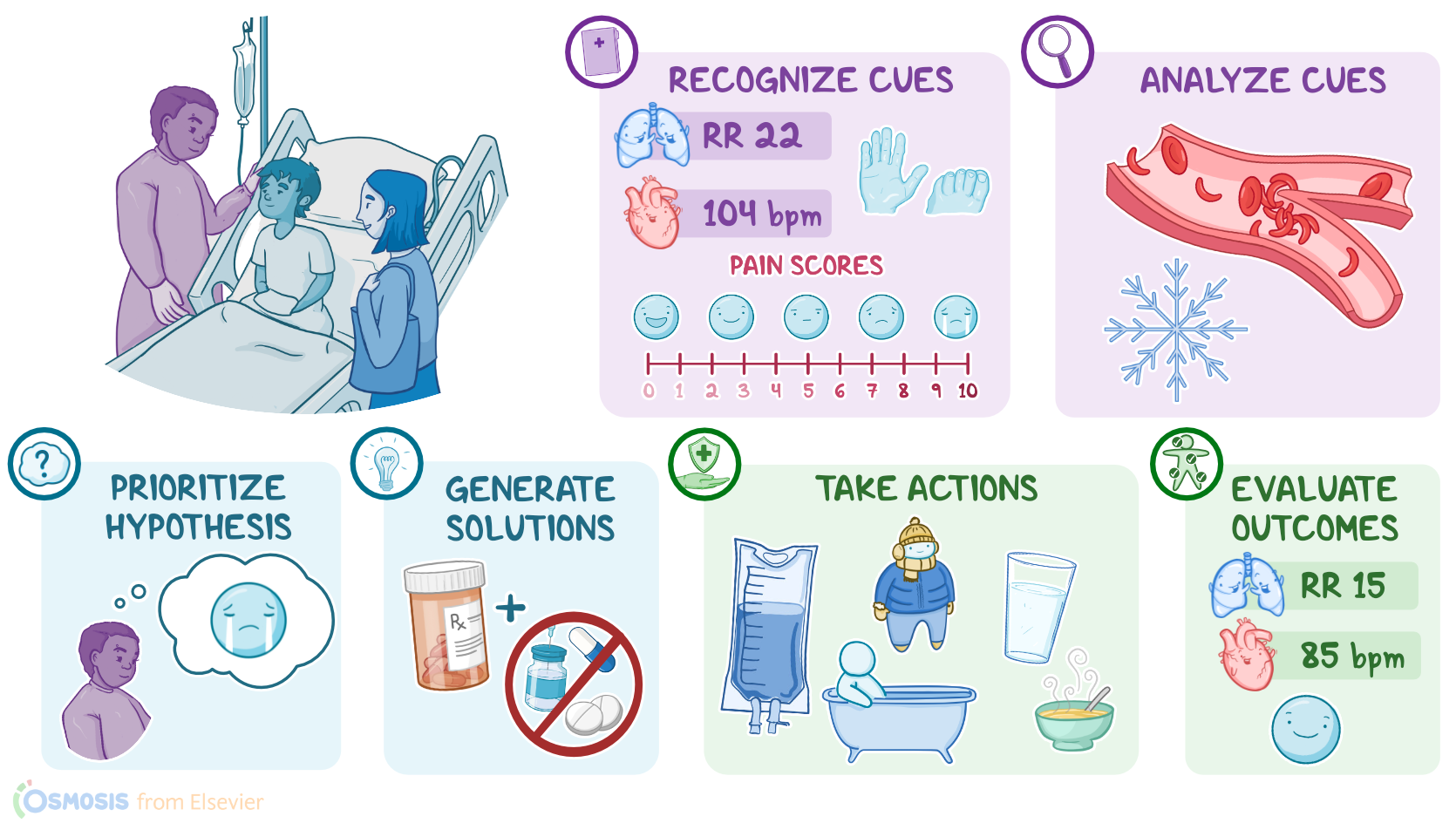
After settling Marcus in his room, Nurse Maggie goes through the steps of the Clinical Judgment Measurement Model to make clinical decisions about Marcus’ care by recognizing and analyzing cues, prioritizing hypotheses, generating solutions, taking action, and evaluating outcomes.
First, Nurse Maggie recognizes important cues, including Marcus’ vital signs which are temperature 99.0 F or 37.2 C, heart rate 104 beats per minute, respiratory rate 22 breaths per minute, blood pressure 122/72 mmHg, and oxygen saturation 97 percent on room air.
Recognizing and Analyzing Cues0:30–1:56
She notices that Marcus’ hands and feet are edematous, and that he’s grimacing. Nurse Maggie: Marcus, you look uncomfortable.
Can you rate your pain from zero to ten, zero being no pain and ten being the worst pain you’ve ever felt? Marcus: It’s about an eight in my hands and feet.
Nurse Maggie: When did your pain start? Marcus: It started yesterday when I was playing in the snow, and it got worse this morning.
Nurse Maggie then speaks with Marcus’ mother, who’s at the bedside. Nurse Maggie: Has Marcus taken any medications to help with the pain?
Marcus’ mother: Not since we were in the emergency department a few hours ago. Nurse Maggie then analyzes these cues.
She understands that VOC occurs when rigid, sickled red blood cells tangle together, adhere to blood vessel endothelium, and block vascular blood flow, causing inflammation, tissue ischemia, and necrosis, as well as pain and swelling in Marcus’ hands and feet.
She understands that the cold temperature likely triggered the episode. Nurse Maggie recognizes that Marcus needs effective pain management.
Now, using the information she's gathered, Nurse Maggie develops a priority hypothesis of acute pain. Then, Nurse Maggie generates solutions to address Marcus’ pain that will include pharmacologic and nonpharmacologic interventions; and she establishes the expected outcome that after intervening, Marcus will report a tolerable pain level within one hour.
Prioritizing Hypotheses, Generating Solutions, and Taking Action1:56–4:10
Then Nurse Maggie enters Marcus’ room. Nurse Maggie: Hi Marcus.
I’m going to give you a medication called morphine to help with your pain. It's given through your IV and usually starts to work within 5 minutes.
Marcus: And will that medicine make my pain go away? Nurse Maggie: It may not make the pain go away completely, but it should make it better.
If it doesn’t work, I’ll talk with your health care provider to see what else we can try. In the meantime, I’ll also give you some IV fluids, which will make your blood less sticky and improve blood flow to your fingers and toes.
Marcus: Okay. Nurse Maggie then administers the morphine using the principles of safe medication administration and hangs the prescribed fluids.
Next, Nuse Maggie reviews strategies with Marcus’ mother to avoid triggers of VOC. She stresses the importance of Marcus wearing warm clothing when playing in the cold and to limit his time outside in order to prevent vasoconstriction and sickling.
Nurse Maggie also lets her know that she can promote circulation of Marcus’ extremities by applying warm compresses or having him take warm baths.
Then Nurse Maggie reminds Marcus and his mother about the importance of maintaining hydration to reduce blood viscosity and recommends that Marcus drink 8 to 10 glasses of water throughout the day and eat foods that contain fluids such as soups, gelatins, and puddings.
Before exiting the room, Nurse Maggie provides Marcus with warm compresses for his hands and feet as well as warm blankets.
Then she dims the lights and encourages him to rest, letting him know that she'll be back to check on him. Thirty minutes later, Nurse Maggie enters the room to evaluate the outcome of her actions.
Evaluating Outcomes4:10–4:39
Marcus’ vital signs are temperature 98.7 F or 37.0 C, heart rate 85 beats per minute, respiratory rate 15 breaths per minute, blood pressure 112/72 mmHg, and oxygen saturation 97 percent on room air.
He reports a pain level of 2 out of 10 and states this is tolerable. Alright, as a quick recap .
Review4:39–5:05
. .
Nurse Maggie recognized and analyzed cues related to Marcus’ VOC and prioritized hypotheses and generated solutions to address this problem.
Nurse Maggie then implemented pharmacologic and nonpharmacologic measures to manage Marcus’ pain and evaluated the outcomes and compared them to the expected outcome.
Since Marcus’ pain was tolerable following interventions, Nurse Maggie determined that the plan of care was
| CASE STUDY - SICKLE CELL ANEMIA | ||
| KEY POINTS | NOTES | |
| INTRODUCTION |
| |
| RECOGNIZING AND ANALYZING CUES |
| |
| PRIORITIZING HYPOTHESES, GENERATING SOLUTIONS, AND TAKING ACTIONS |
| |
| EVALUATING OUTCOMES |
| |
- "Wong’s essentials of pediatrics. (11th ed.)" Elsevier (2022)
- "Wong’s nursing care for infants and children. (11th ed.)" Elsevier (2019)
No notes for this video yet
Try adding a note below