Case study - Stroke: Nursing
Introduction0:00–0:32
Nurse Darius works on a neurology unit and is caring for Calvin, a 67-year-old male with a history of hyperlipidemia who was recently admitted following a stroke.
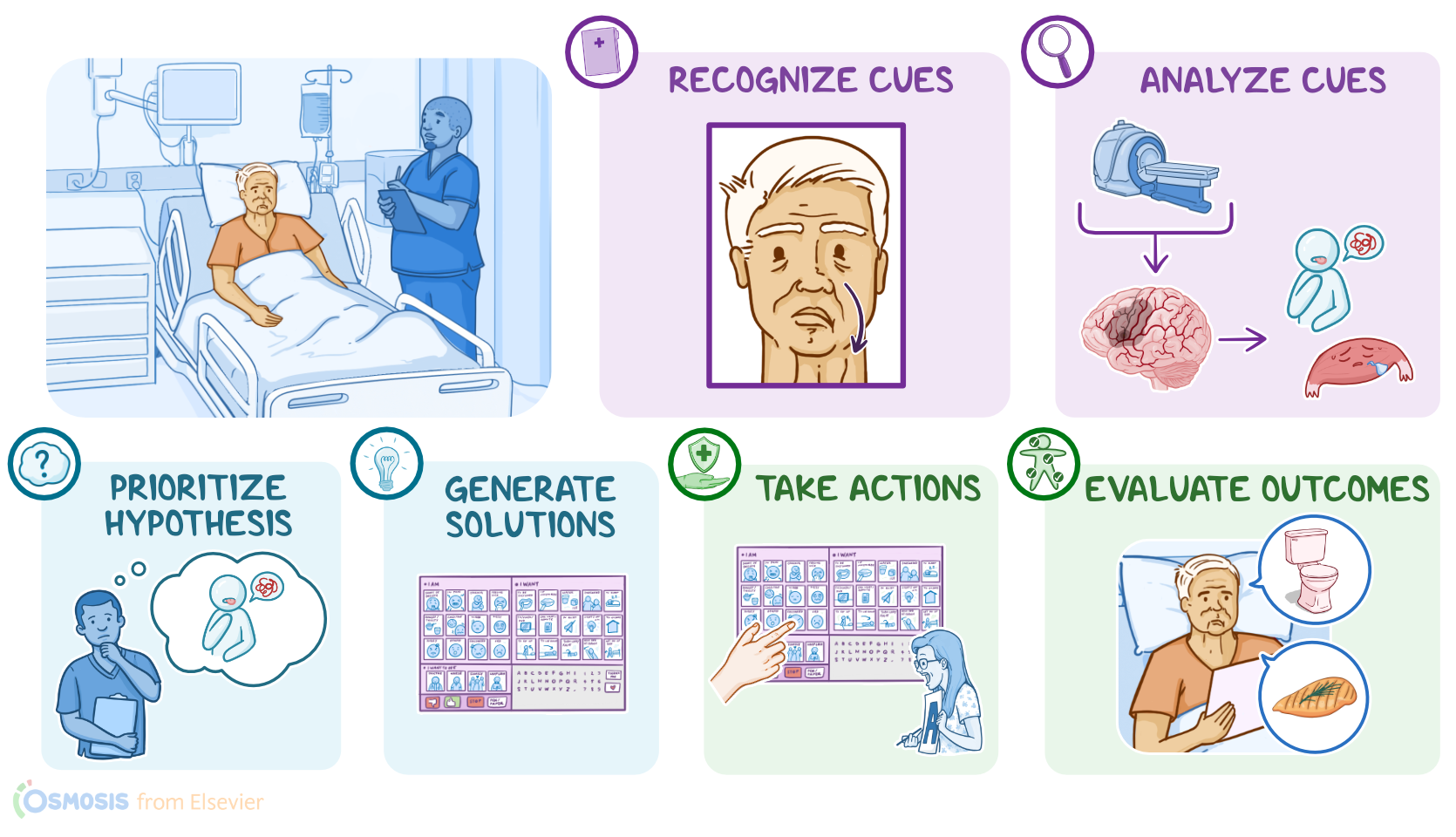
After settling Calvin in his room, Nurse Darius goes through the steps of the Clinical Judgment Measurement Model to make clinical decisions about Calvin’s care by recognizing and analyzing cues, prioritizing hypotheses, generating solutions, taking action, and evaluating outcomes.
First, Nurse Darius recognizes important cues including Calvin’s vital signs which are temperature 98.8 F, or 37.1 C, heart rate 98 beats per minute, respirations 16 breaths per minute, blood pressure 146/92 mmHg, and oxygen saturation 96 percent on room air.
Recognizing and Analyzing Cues0:32–1:56
He rates his pain level is 0 out of 10. Nurse Darius also notes that the left side of Calvin’s face is drooping and sees that he favors his right hand.
He reviews the electronic health record, or EHR, and sees Calvin has undergone an MRI of his head. The results show that Calvin had an ischemic stroke, where an occlusion in his artery caused inadequate blood flow to his brain.
Nurse Darius knows Calvin’s hyperlipidemia was likely a contributing factor to his stroke, since it can lead to atherosclerosis and blockage of arteries.
He also knows the loss of oxygenated blood flow to the brain can cause damage to areas that control language and motor functions and lead to muscle weakness and aphasia.
Prioritizing Hypotheses, Generating Solutions, and Taking Action1:56–3:11
Then, he generates solutions to address Calvin’s impaired communication that will include nonpharmacologic interventions; and he establishes the outcome that after intervening, Calvin will effectively communicate his needs by the end of the shift.
Nurse Darius then takes action to implement these solutions. First, he collaborates with the speech therapist to use a communication board to compensate for Calvin’s new communication limitations.
I’ll try to keep my questions simple so you can use the board to answer. Is that okay with you?
Calvin: …...Yes. Nurse Darius: Feel free to use hand gestures if the board isn’t telling me what you want to say.
At the end of his shift, Nurse Darius evaluates the outcome of his interventions. He reassesses Calvin’s vital signs, which are temperature 98.0 F, or 36.7 C, heart rate 78 beats per minute, respirations 15 breaths per minute, blood pressure 130/90 mmHg, and oxygen saturation 98 percent on room air.
Evaluating Outcomes3:11–3:52
Nurse Darius plans to teach Calvin’s family how to use the communication board when they come to visit the next day. Alright, as a quick recap…Nurse Darius recognized and analyzed cues related to Calvin’s impaired communication from his stroke and prioritized hypotheses, and generated solutions to address this problem.
Review3:52–4:21
Nurse Darius then took action and implemented nonpharmacologic measures to address Calvin’s impaired communication and evaluated outcomes by comparing them to the expected outcomes.
Since Calvin was able to effectively communicate his needs, Nurse Darius determined his plan of care was successful.
| CASE STUDY - STROKE | ||
| KEY POINTS | NOTES | |
| INTRODUCTION |
| |
| RECOGNIZING AND ANALYZING CUES |
| |
| PRIORITIZING HYPOTHESES, GENERATING SOLUTIONS, AND TAKING ACTIONS |
| |
| EVALUATING OUTCOMES |
| |
- "Lewis's medical-surgical nursing: Assessment and management of clinical problems. (12th ed.)" Elsevier (2022)
- "Medical-surgical nursing: Concepts for interprofessional and collaborative care. (10th ed.)" Elsevier (2021)
- "Lewis’s medical-surgical nursing in Canada: Assessment and management of clinical problems. (5th ed.)" Elsevier (2023)
No notes for this video yet
Try adding a note below