Case study - Suicidal ideation: Nursing
Introduction0:00–0:31
Nurse Iris works on an inpatient psychiatric unit and is caring for Dee, a 30-year-old patient with a history of depression and previous suicide attempts, who was recently admitted for suicidal ideation.
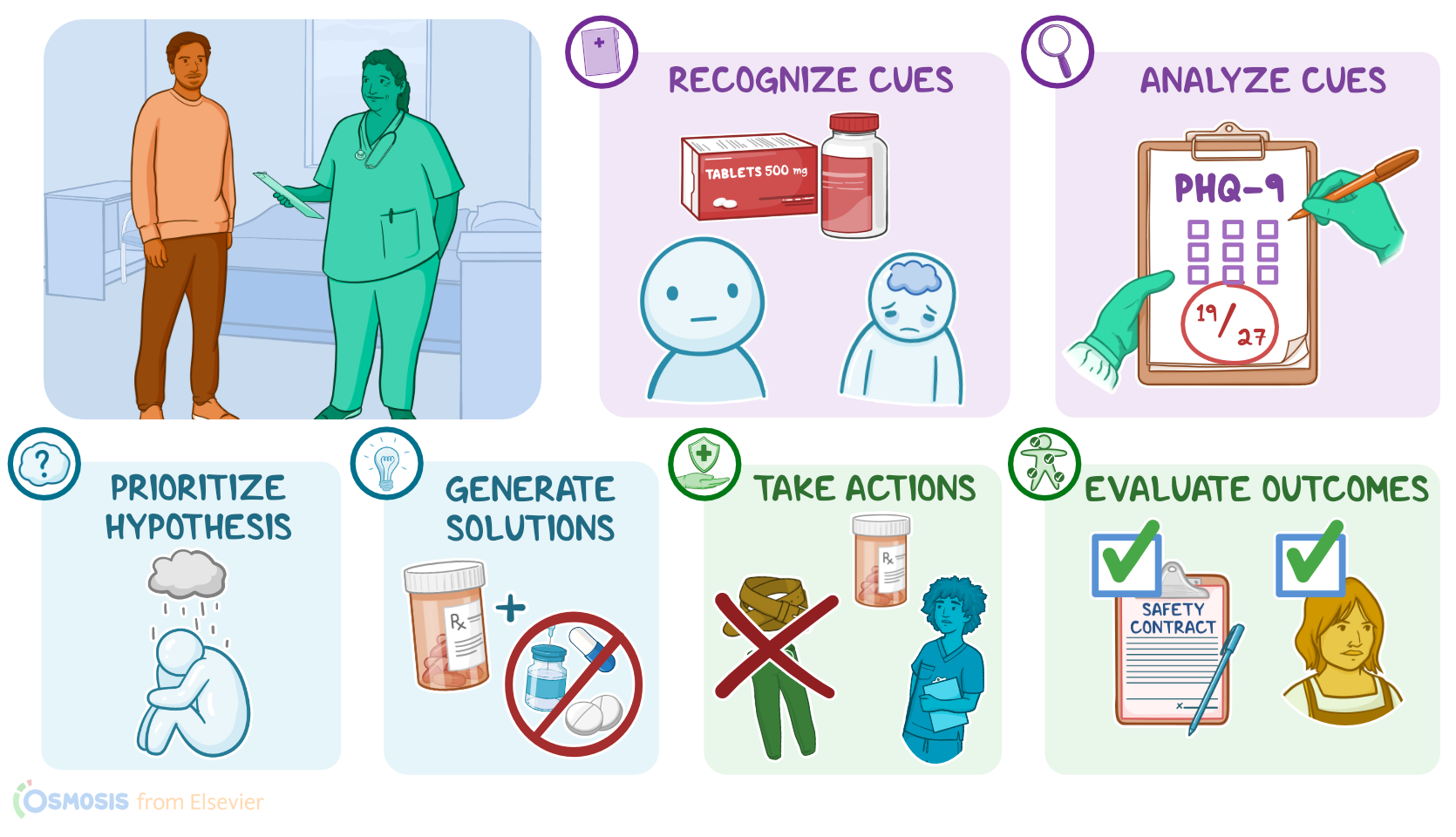
After settling Dee in his room, Nurse Iris goes through the steps of the Clinical Judgment Measurement Model to make clinical decisions about Dee’s care by recognizing and analyzing cues, prioritizing hypotheses, generating solutions, taking action, and evaluating outcomes.
First, Nurse Iris recognizes important cues, including Dee’s vital signs, which are temperature 98.9 F or 37.1 C, heart rate 65 beats per minute, respirations 16 breaths per minute, and blood pressure 116/70 mmHg.
Recognizing and Analyzing Cues0:31–2:00
She also notices Dee looks straight ahead during the assessment and has a flat affect. Nurse Iris: Hi Dee, I’ll be your nurse today.
How are you feeling? Dee: I’m upset.
I wanted to take all my pills at home, but my friend brought me to the hospital before I could. I don’t want to be here anymore.
I wish I was dead. Nurse Iris: I’m sorry to hear that.
I want you to know that I and the rest of your medical team care about you. We're here to support you and keep you safe.
Next, Nurse Iris analyzes these cues. She reviews the electronic health record, or EHR, and notes that Dee is prescribed fluoxetine for depression and has been hospitalized in the past year for suicidal ideation.
She also notes that Dee scored a 19 out of 27 on his PHQ-9 assessment, which is a nine-question, self-reporting depression survey, indicating a moderately severe level of depression.
Nurse Iris recognizes that Dee needs a safe environment while he receives treatment for his depression and suicidal ideation.
Prioritizing Hypotheses, Generating Solutions, and Taking Action2:00–4:10
Then, she generates solutions to address Dee’s suicidal ideation that will include pharmacologic and nonpharmacologic interventions; and she establishes the expected outcome that after intervening, Dee will take part in a safety contract and will remain safe from self-harm.
Nurse Iris then takes action to implement these solutions. First, she confirms that items Dee could use to harm himself have been removed from his room, like belts, shoelaces, and drawstring pants.
She then assigns an unlicensed assistive personal, or UAP, to sit with Dee to prevent self-harming behaviors. Next, she checks the EHR, and notes Dee is prescribed a new antidepressant.
She gathers the supplies and enters Dee’s room. Nurse Iris: Dee, I have an antidepressant medication for you called sertraline.
I noticed in the progress notes that you stopped taking your fluoxetine at home. Dee: I hate fluoxetine; it gives me headaches.
It doesn’t matter though; I won’t be here much longer anyways. Nurse Iris: I’m sorry that medication made you feel sick.
Would you be willing to try the sertraline instead? Dee: I guess so.
Nurse Iris then administers the sertraline according to the principles of safe medication administration. Nurse Iris: It must be overwhelming and tiring to feel depressed all the time.
Your friend who took you to the hospital must care a lot about you. If you want, I can ask them to visit when you’re feeling ready.
Dee: Sure. Nurse Iris: Now I want to talk with you about something called a safety contract.
It’s a document we’ll work on together so you can identify feelings that make you want to harm yourself. Dee: Okay.
At the end of her shift, Nurse Iris re-enters Dee’s room to evaluate the outcome of her actions. She takes Dee’s vital signs, which are temperature 98.4 F or 36.9 C, heart rate 62 beats per minute, respirations 16 breaths per minute, and blood pressure 120/78 mmHg.
Evaluating Outcomes4:10–4:43
Dee has continued to work on the safety contract and remained free from harm and tells Nurse Iris that his friend will be visiting him tomorrow.
Review4:43–5:09
Nurse Iris then implemented pharmacologic and nonpharmacologic measures and evaluated Dee’s outcomes and compared them to the expected outcome.
Since Dee took part in a safety contract and remained free from self-harm,
| CASE STUDY - SUICIDAL IDEATION | ||
| KEY POINTS | NOTES | |
| INTRODUCTION |
| |
| RECOGNIZING AND ANALYZING CUES |
| |
| PRIORITIZING HYPOTHESES, GENERATING SOLUTIONS, AND TAKING ACTIONS |
| |
| EVALUATING OUTCOMES |
| |
- "Varcarolis’s Canadian psychiatric mental health nursing." Elsevier (2023)
- "Keltner’s psychiatric nursing. " Elsevier (2023)
No notes for this video yet
Try adding a note below