Case study - Ventricular septal defect (VSD): Nursing
Introduction0:00–0:38
Nurse Antoinette works on a pediatric cardiac unit and is caring for Mabel, a 1-year-old female with a history of ventricular septal defect, or VSD, who was admitted for a surgical repair.
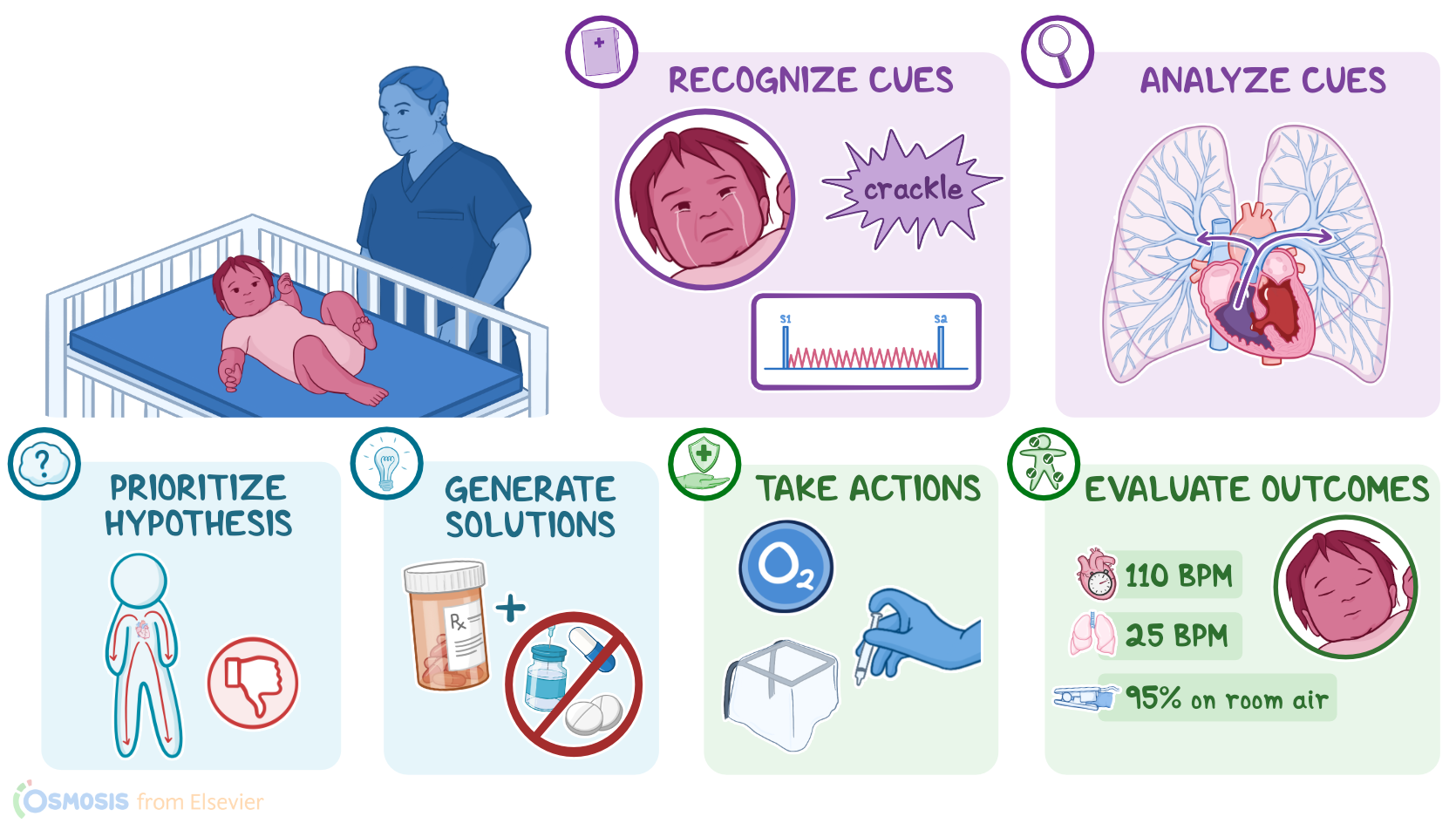
After settling Mabel in her room, Nurse Antoinette goes through the steps of the Clinical Judgment Measurement Model to make clinical decisions about Mabel’s care by recognizing and analyzing cues, prioritizing hypotheses, generating solutions, taking action, and evaluating outcomes.
First, Nurse Antoinette recognizes important cues, including Mabel's vital signs, which are temperature 98.6 F or 37 C, heart rate 142 beats per minute, respirations 35 breaths per minute, and oxygen saturation 92 percent on room air.
Recognizing and Analyzing Cues0:38–2:20
Upon assessment, Nurse Antoinette notes a systolic heart murmur and crackles in the bases of her lungs. She also notices that Mabel appears to be irritable.
Next, Nurse Antoinette analyzes these cues. She reviews the electronic health record, or EHR, and sees that Mabel was diagnosed with a VSD as a newborn.
The health care provider recommended close monitoring of the condition rather than immediate surgical correction because she was hemodynamically stable and asymptomatic.
Nurse Antoinette knows that a VSD causes a left-to-right shunting of blood in the heart, causing a mixture of deoxygenated and oxygenated blood to go back to the right side of the heart and then into the lungs, creating fluid overload in the lungs and increased pulmonary vascular resistance.
She also understands that the shunting of blood is causing Mabel’s systolic murmur, and that the pulmonary congestion is causing the crackles in her lungs.
Additionally, Nurse Antoinette knows that less oxygen is being delivered to the tissues, so Mabel’s impaired perfusion is causing tachycardia and decreased oxygen saturation.
Nurse Antoinette recognizes that Mabel needs effective perfusion management. Now, using the information she’s gathered, Nurse Antoinette chooses a priority hypothesis of impaired tissue perfusion.
Prioritizing Hypotheses, Generating Solutions, and Taking Action2:20–4:04
Then, she generates solutions to address Mabel’s impaired tissue perfusion that will include pharmacologic and nonpharmacologic interventions; and she establishes the expected outcome that after intervening, Mabel will demonstrate a decreased heart rate before being transferred to the preoperative unit.
Nurse Antoinette then takes action to implement these solutions. She reviews the plan of care with Mabel’s caregiver, Martha, who’s at the bedside.
Nurse Antionette: The health care provider has ordered oxygen, as well as a medication to help Mabel relax and decrease the work of her heart.
Martha: Mabel is breathing so fast, I’m worried! Nurse Antoinette: Right now, Mabel’s body is working very hard to get all the oxygen it needs.
I’m going to attach an oxygen tent to help her breathe better and administer medication to help her calm down. Once she’s more relaxed, it’ll help slow down her breathing.
Nurse Antoinette then places the oxygen tent over Mabel’s head and administers the prescribed sedative medication according to the principles of safe medication administration.
She then elevates the head of the crib to semi-Fowler position to help promote chest expansion, and she decreases environmental stimuli, by dimming the lights and turning the television off.
Before leaving the room, Nurse Antoinette goes over the plan of care with Martha and what to expect before surgery.A few hours later, Mabel is ready to go to surgery and Nurse Antoinette evaluates the outcome of her actions.
Evaluating Outcomes4:04–4:30
She takes Mabel’s vital signs, which are heart rate 110 beats per minutes, respirations 25 breaths per minute, and oxygen saturation 95 percent on 10 liters per minute via oxygen tent.
Nurse Antoinette notes that Mabel is calm and resting in her crib. Alright, as a quick recap...Nurse Antoinette recognized and analyzed cues related to Mabel’s impaired tissue perfusion, prioritized hypotheses, and generated solutions to address this problem.
Review4:30–4:57
Nurse Antoinette then implemented pharmacologic and nonpharmacologic measures and evaluated Mabel’s outcomes, comparing them to the expected outcome.
Since Mabel’s heart rate decreased, Nurse Antoinette determined that the
| CASE STUDY - VENTRICULAR SEPTAL DEFECT (VSD) | ||
| KEY POINTS | NOTES | |
| INTRODUCTION |
| |
| RECOGNIZING AND ANALYZING CUES |
| |
| PRIORITIZING HYPOTHESES, GENERATING SOLUTIONS, AND TAKING ACTIONS |
| |
| EVALUATING OUTCOMES |
| |
- "Wong’s essentials of pediatrics. (11th ed.)" Elsevier (2022)
- "Wong’s nursing care for infants and children. (11th ed.)" Elsevier (2019)
No notes for this video yet
Try adding a note below