Case study - Wound infection: Nursing
Introduction0:00–0:28
Nurse Jess works at an urgent care clinic and is caring for Roger, a 56-year-old male, who arrived with a wound on his lower arm.
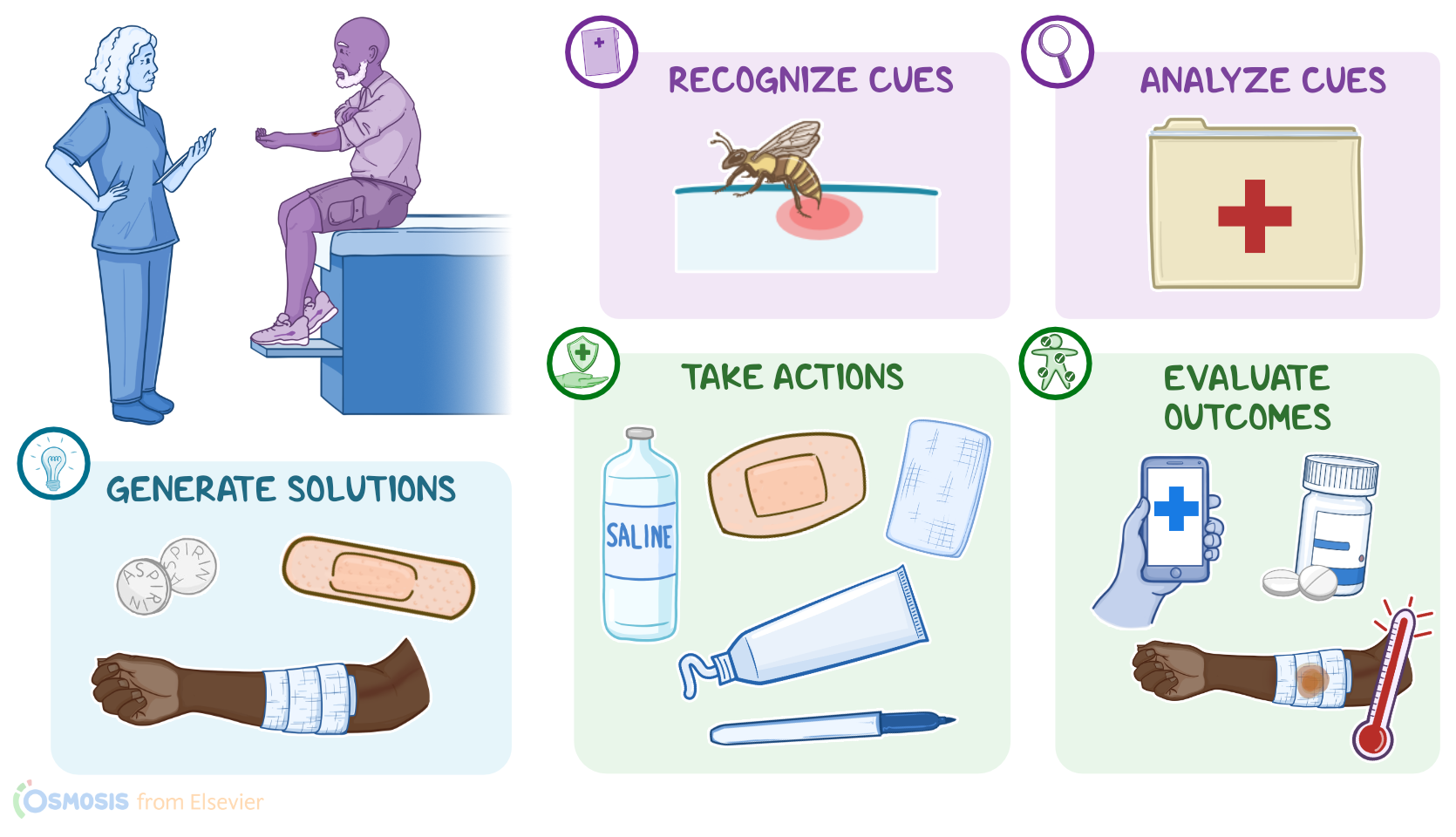
After settling Roger in his room, Nurse Jess goes through the steps of the Clinical Judgment Measurement Model to make clinical decisions about Roger’s care by recognizing and analyzing cues, prioritizing hypotheses, generating solutions, taking action, and evaluating outcomes.
Recognizing and analyzing cues0:28–1:44
First, Nurse Jess recognizes important cues, including Roger’s vital signs, which are temperature 101 F, or 38.3 C, heart rate 98 per minute, respirations 14 per minute, and blood pressure 125/85 mmHg.
She completes a skin assessment on Roger’s arm, and notes his wound is 1 centimeter across, open, and draining a small amount of purulent drainage.
She also notices superficial erythema 2 centimeters around the wound. Extending from the wound towards his upper arm is a red streak, which Nurse Jess recognizes is a sign of lymphangitis, or inflammation of the lymph channels.
When asked about the wound, Roger says he thinks it started with a bug bite he got while boating 3 days ago. Next, Nurse Jess analyzes cues.
While reviewing the electronic health record, or EHR, she notes Roger was treated for a similar wound in the past. She also notes he’s been taking steroids prescribed for rheumatoid arthritis for the past 3 months, which can suppress the immune system.
Prioritizing hypotheses, generating solutions, and taking action1:44–4:49
Next, she generates solutions to address Roger’s wound that will include pharmacologic and nonpharmacologic interventions.
She establishes the expected outcome that after intervening, Roger will correctly demonstrate how to apply a dressing to his wound.
Nurse Jess then takes action to implement these solutions. She begins by notifying the health care provider of Roger’s elevated temperature, purulent drainage, erythema, and lymphangitis on his lower arm wound.
The health care provider orders a 7-day course of PO cephalexin, wound care including a topical antibiotic, and acetaminophen for fever.
After collecting normal saline, a sterile bandage, gauze wrap, a surgical marker, and a topical antibiotic, Nurse Jess performs hand hygiene, and reenters the room.
Nurse Jess: I talked with the health care provider, and you’ve been prescribed a 7-day course of cephalexin, which is an antibiotic, for your infected wound.
It’s important you take it for 7 days, even if it seems like it's getting better. Roger: Okay, I can do that.
Nurse Jess: Now, let’s get your wound cleaned and bandaged. I’m going to walk you through each step and give you supplies so you can do it at home, okay?
Roger: I don’t know if I’m comfortable with that. Nurse Jess: That’s understandable, Roger.
I’ll walk through each step with you slowly; and be sure to ask any questions if you’re confused, okay? Roger nods and agrees.
Then, using the surgical marker, Nurse Jess marks a circle around the erythema. She informs Roger that marking where the redness extends will help his health care provider see if the infection is improving at the next appointment.
Next, Nurse Jess applies a topical antibiotic to the sterile bandage and places it over Roger’s wound . She teaches Roger that the ointment will help target the infection and that she’ll send Roger home with some.
It’s important to remember to first cleanse the wound with normal saline, apply a small amount of the ointment to the bandage, and then wrap it with a gauze.
I’ll send you home with the supplies you’ll need, and some written instructions. Roger: Okay that’s not so bad, I think I can do that, but when should I see my health care provider again?
Nurse Jess: You should follow up with your health care provider in 2 to 3 days. But, if you notice signs the infection isn’t improving, like the wound is draining more, the redness is moving beyond the circle I marked, or if your fever increases, notify your health care provider right away.
Evaluating outcomes4:49–5:16
He states he will take the full course of antibiotics and will follow-up with his health care provider in 2 to 3 days. He also tells Nurse Jess how he’ll know if the wound isn’t healing or if the infection is getting worse.
Review5:16–5:37
Alright, as a quick recap... Nurse Jess recognized and analyzed cues related to Roger’s traumatic wound and prioritized hypotheses and generated solutions to address this problem.
Nurse Jess then took action by providing wound care and patient education. She compared Roger’s outcome with the expected outcome, and she determined the plan of care
| CASE STUDY - WOUND INFECTION | ||
| KEY POINTS | NOTES | |
| INTRODUCTION |
| |
| RECOGNIZING AND ANALYZING CUES |
| |
| PRIORITIZING HYPOTHESES, GENERATING SOLUTIONS, AND TAKING ACTIONS |
| |
| EVALUATING OUTCOMES |
| |
- "Fundamentals of nursing (11th ed.)" Elsevier (2023)
- "Fundamentals of nursing: Active learning for collaborative practice (3rd ed.)" Elsevier (2022)
No notes for this video yet
Try adding a note below