Clubfoot: Nursing
Clubfoot, also called talipes equinovarus, is a complex congenital deformity that involves the ankle and foot. Let’s start by looking at the anatomy and physiology of the newborn’s foot. The foot is essential for stability, locomotion, balance and development of motor skills, so it’s important that the structures comprising the foot are well-developed. There are 3 regions of the newborn foot: hindfoot, also called rearfoot; midfoot; and forefoot. The hindfoot includes two bones: the talus and calcaneus. The midfoot includes the navicular bone, the cuboid bone and the cuneiform bones. Finally, the forefoot consists of metatarsals, which are the long foot bones; and the phalanges, which are the toe bones. Unlike the adult foot, the newborn arch is flat; has a greater range of motion and consists of more subcutaneous fat. The ankle is a synovial joint that results from interaction between the ends of the tibia and fibula, which are the bones of the lower leg, that allows the foot to move up and down.
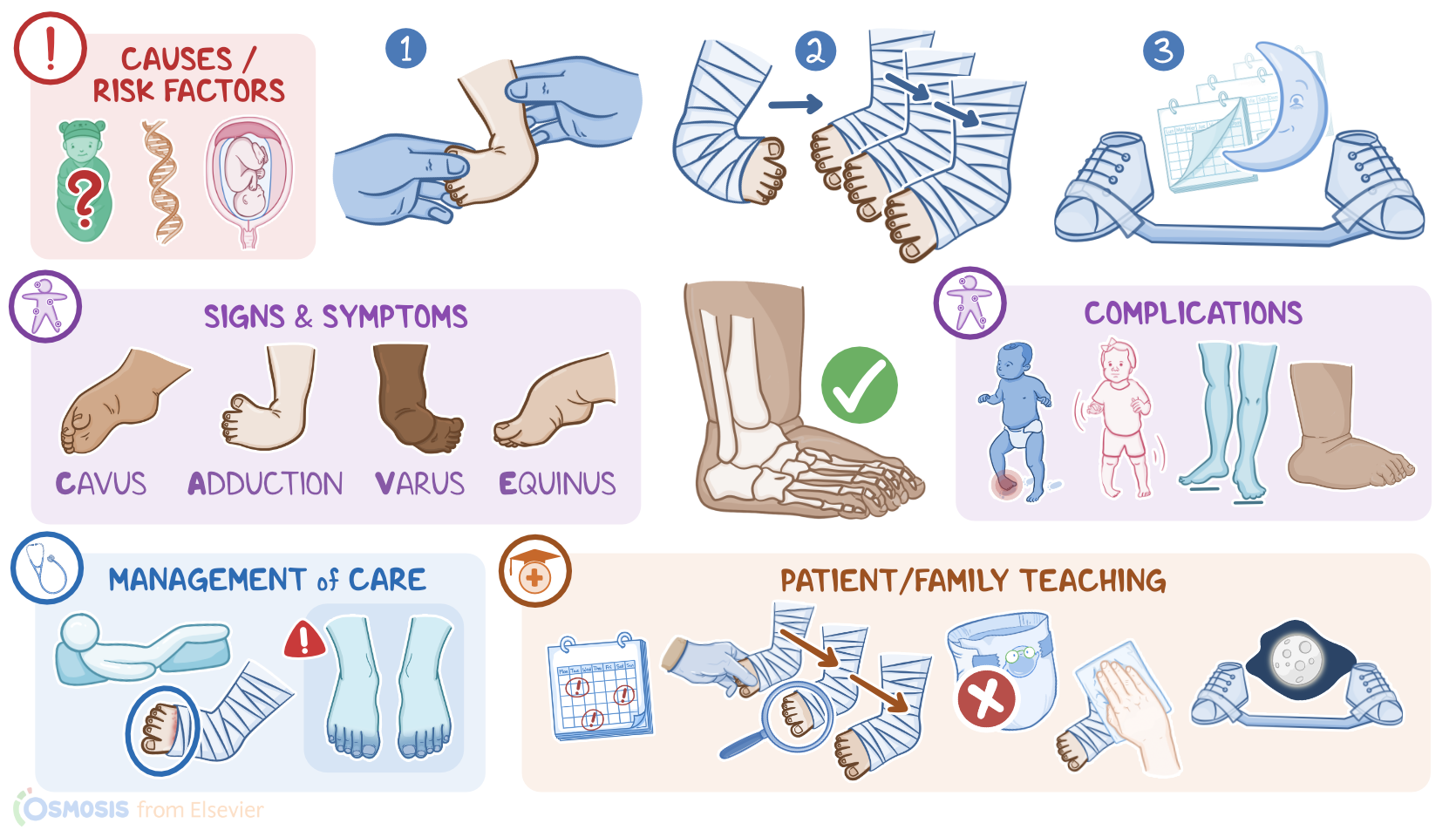
Now, the ultimate cause of clubfoot isn’t fully known, but causes can be classified as idiopathic, syndromic, or positional. If clubfoot is an isolated anomaly in an otherwise healthy neonate, it’s considered to be idiopathic. Sometimes, though, clubfoot can be syndromic, which means it’s associated with other genetic or anatomic abnormalities. Other times, the cause is positional, like with oligohydramnios, where there’s not enough amniotic fluid, or because of changes within the uterine environment that creates pressure on the fetal extremity during critical periods of development. All right, now, when it comes to pathology, clubfoot is associated with bone deformities and soft tissue contractures. There are four main components, which can be remembered by the acronym CAVE. The first one is an exaggerated arch, also known as Cavus. Second, there’s forefoot Adduction with supination, meaning that the forefoot is inverted and turned upwards.Third, inversion of the heel and hindfoot, which is called talipes Varus. Finally, there’s plantar flexion of the foot, meaning the heel is raised and the ankle is in a pointed-toe position, which is called talipes Equinus. All these components together create clubfoot, which can be unilateral or bilateral.
| CLUBFOOT | ||
| KEY POINTS | NOTES | |
| DEFINITION |
| |
| PHYSIOLOGY |
| |
| CAUSES AND RISK FACTORS |
| |
| PATHOPHYSIOLOGY |
| |
| SIGNS AND SYMPTOMS |
| |
| DIAGNOSIS |
| |
| TREATMENT |
| |
| MANAGEMENT OF CARE |
| |
| PATIENT AND FAMILY TEACHING |
| |
No notes for this video yet
Try adding a note below