Conjunctivitis: Nursing process (ADPIE)
Client Report0:00–0:26
Leilani Flores is a 3 year old client who was brought to the primary care clinic by her father Alvin. Yesterday.
Leilani's older sister was diagnosed with bacterial conjunctivitis and was started on antibiotic eye drops. Today, Alvin is concerned that the infection has spread to Leilani.
He reports that she woke up with her right eye crusted shut with yellow drainage, and she has been rubbing the eye frequently.
Pathology0:26–4:25
Conjunctivitis, commonly known as pink eye, refers to the inflammation of the conjunctiva, which is the clear membrane that covers the sclera and the inner surface of the eyelids in response to an infection, allergen, or irritant.
As a result, there's dilation of conjunctival blood vessels, which typically causes the eye to look pink or red. So there are two main causes of conjunctivitis infectious and non-infectious.
Infectious conjunctivitis can be further divided into viral and bacterial conjunctivitis. Viral conjunctivitis is the most common one and is typically caused by adenovirus, but can be also due to herpes simplex virus or varicella zoster virus.
On the other hand, bacterial conjunctivitis is most often caused by Staphylococcus aureus, streptococcus pneumonia, or Haemophilus influenza, but less commonly, it can also be caused by neisseria gonorrhea or chlamydia trachomatis.
Both viral and bacterial conjunctivitis are highly contagious and spread through direct hand to eye contact with contaminated objects or with an infected person's secretions like tears or eye discharge.
So, the main risk factors include close contact with someone who has conjunctivitis, as well as attending crowded places like schools or daycare.
Other factors that increase the risk of conjunctivitis include poor hand hygiene and improper use of contact lenses. There is also non-infectious conjunctivitis, which includes allergic and irritant conjunctivitis.
Allergic conjunctivitis is usually caused by airborne allergens like pollen, grass, or dust, and an important risk factor is the season, especially during spring.
On the other hand, irritant conjunctivitis can be caused by a mechanical irritant such as a foreign body or chemical irritants found in smoke, fumes, powders, and liquids like chlorine or alcohol.
In terms of symptoms, conjunctivitis presents with unilateral or bilateral pink or red eyes, which can be associated with mild eyelid and conjunctival edema, as well as sensitivity to light and excessive lachrymation.
In viral and non-infectious conjunctivitis, there's watery discharge, while in bacterial conjunctivitis, the discharge is purulent, white, yellow, or green, and clients may often wake up with crusted or sticky eyelids.
For allergic conjunctivitis, a telltale sign is excessive eye itchiness, and it's usually associated with a runny nose or sneezing.
Most cases of conjunctivitis are usually self-limited, but severe cases of infectious conjunctivitis can lead to complications if the infection spreads to other structures of the eye.
Bacteria can also spread to the lacrimal sac, causing dacryocystitis. Now, diagnosis of conjunctivitis is usually clinical based on history and physical examination.
For infectious conjunctivitis, laboratory tests of the eye discharge, such as rapid antigen detection tests for viruses or gram stain and culture for bacteria, might be necessary to detect the causative pathogen.
For treatment, viral conjunctivitis is typically self-resolving, but lubricant drops or ointments might help with symptoms.
On the other hand, bacterial conjunctivitis generally requires antibiotic drops or ointments. Additionally, applying warm and wet compresses can help clear the sticky discharge.
Allergic conjunctivitis is usually treated with antihistamines, either orally or as eye drops, as well as by avoiding the allergen.
Finally, irritant conjunctivitis is usually self-resolving, but flushing the eyes, removing and avoiding the irritant, and applying lubricant eye drops can be helpful.
Assessment4:25–5:40
As you enter the room, you begin your assessment. Leilani's father, Alvin is holding her in his lap, and she appears irritable and uncomfortable.
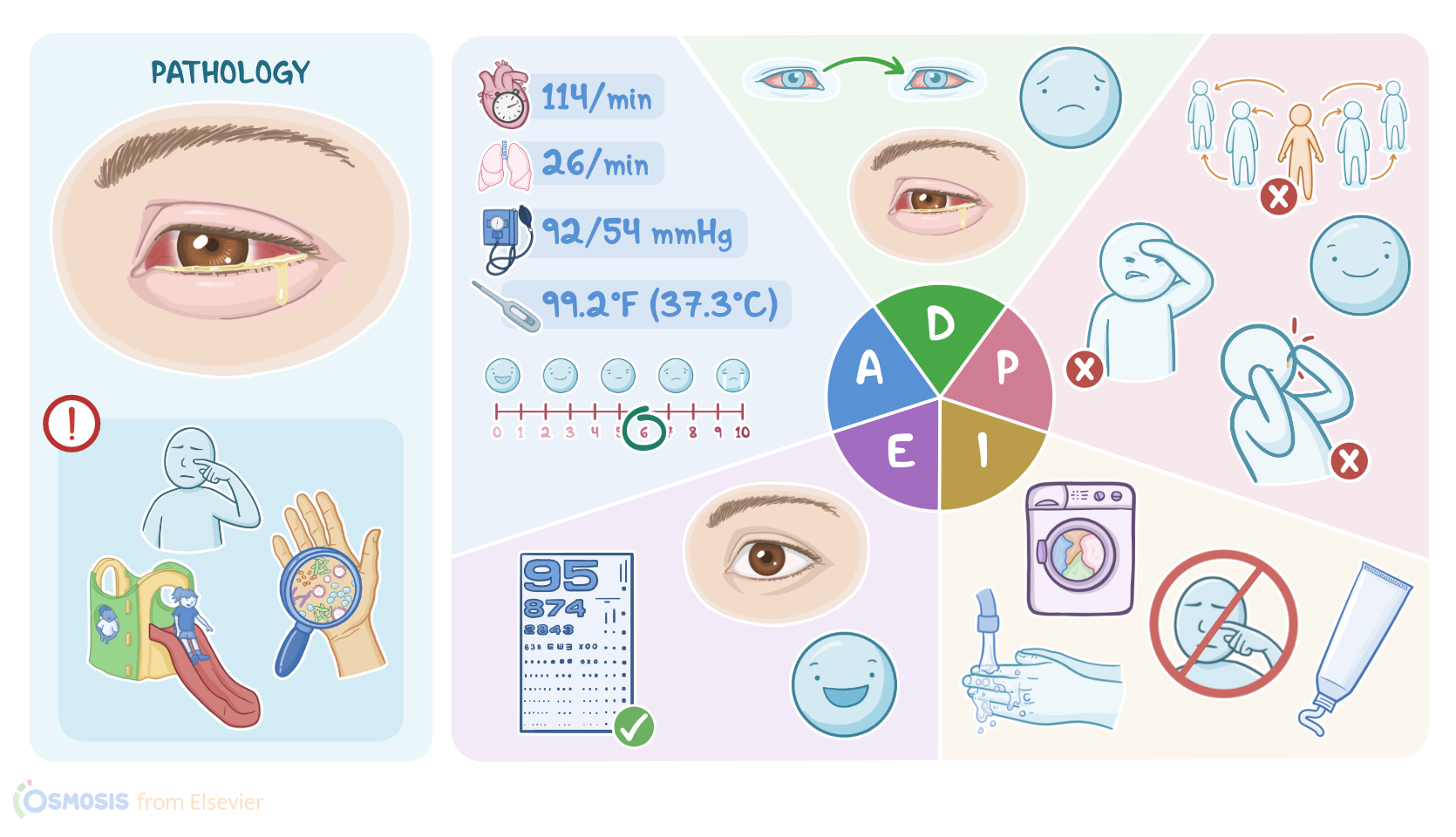
When you ask Leilani how her eye feels, she tells you it itches and hurts. Her right conjunctiva is bright red, her sclera is pink, her eyelid is swollen, and her eyelashes are clumped together with a small amount of purulent yellow drainage.
Leilani's left eye has no drainage or erythema. You examine her eyes with a pen light, noting that both pupils are 3 millimeters in diameter, round, and equally reactive to light.
You assess Leilani's visual acuity with a picture chart, and she is able to identify different shapes with both eyes separately without difficulty.
Leilani's vital signs are temporal temperature, 99.2 °F or 37.3 °C. Heart rate 114 BPM, respiratory rate 26 breaths per minute, BP 92/54 millimeters of mercury, SPO 2 100% on room air, and eye pain is 6 out of 10 using the face's pain rating scale.
After documenting your findings, you let Alvin and Leilani know that the pediatrician will be in shortly to examine her.
Diagnosis5:40–5:57
The nursing diagnoses you identify for Leilani are risk for infection transmission to the left eye related to potential contact with exudate, risk for altered visual perception related to presence of swelling and exudate, and impaired comfort related to inflammatory processes.
Next, you collaborate with the healthcare team and plan goals for Leilani, which include Leilani's infection won't spread to her left eye or to other members of the household.
Planning5:57–6:14
She will not experience any permanent loss in vision, and she will verbalize improved comfort. Now it's time to implement Leilani's plan of care.
Implementation6:14–7:40
Leilani's pediatrician has diagnosed her with bacterial conjunctivitis. First, you obtain a sample of the drainage around Leilani's right eye for culture.
Then you gently clean the drainage away from the eye and administer the ordered antibiotic ointment. You instruct Alvin to apply a 0.5 inch or a 1.25 centimeter ribbon of ointment to Leilani's right eye 4 times each day for the next 5 to 7 days.
Then you explain that because the fluid from the eye is infectious for 24 to 48 hours after beginning antibiotic treatment, Leilani should be kept at home during this time to prevent infecting others.
You encourage Alvin to wash any discharge from around Leilani's eye as needed using a clean cotton ball, and to help prevent the spread of infection by practicing good hand hygiene, assisting Leilani in washing her hands several times per day, and reminding her not to touch her eyes or face.
You also advise Elvin to wash her pillowcases, bed linens, towels, and clothes separately, and not to share them with others.
To prevent Leilani's discomfort, you encourage Elvin to use warm compresses on her eye as needed. Finally, you ask Elvin to bring Leilani back to the office if her symptoms do not improve over the next 2 days, if her other eye shows signs of conjunctivitis, or if she develops a fever, swelling around the eye, increased eye pain, or vision changes.
A week later, Alvin brings Leilani to the primary care clinic for a follow-up evaluation. Leilani is sitting on her dad's lap.
Evaluation7:40–8:38
She is looking around the room and appears cheerful. She tells you my eye is all better and it doesn't hurt anymore.
Leilani happily identifies the shapes on the vision chart with each eye. Her vital signs are temporal temperature, 97.8 °F or 36.6 °C.
Heart rate 110 BPM, respiratory rate 20 breaths per minute, BP 98/45 millimeters of mercury, SPO 2 100% on room air, and pain 0 out of 10.
Alvin tells you that they were able to prevent the infection from spreading to anyone else in the household. All right, as a quick recap, your client Leilani was brought by her father, Alvin to the primary care clinic for signs of bacterial conjunctivitis.
Summary8:38–9:23
Conjunctivitis or pink eye is inflammation of the conjunctiva and can be caused by infection, allergens, or irritants. Your assessment of Leilani revealed purulent drainage around the eye, conjunctival erythema, pink sclera, and discomfort.
Your nursing diagnoses for Leilani were risk for infection transmission, risk for altered visual perception, and impaired comfort.
You planned goals for Leilani to minimize the spread of infection, prevent complications, and improve comfort. You implemented strategies to reach these goals and evaluated that these goals were met at Leilani's follow-up
| CONJUNCTIVITIS | ||
| KEY POINTS | NOTES | |
| PATIENT REPORT |
| |
| PATHOPHYSIOLOGY |
| |
| ASSESSMENT |
| |
| NURSING DIAGNOSES |
| |
| PLANNING |
| |
| IMPLEMENTATION |
| |
| EVALUATION |
| |
- "Conjunctivitis: A Systematic Review" J Ophthalmic Vis Res (2020)
- "Harrison’s Principles of Internal Medicine, 21st edition" McGraw Hill / Medical (2022)
- "Viral Conjunctivitis" Viruses (2023)
- "Critical Care Nursing: Diagnosis and Management, 9th edition" Elsevier (2021)
- "Bacterial conjunctivitis" Visual Journal of Emergency Medicine (2023)
- "A Review of the Differential Diagnosis of Acute Infectious Conjunctivitis: Implications for Treatment and Management" Clin Ophthalmol (2020)
No notes for this video yet
Try adding a note below