Defense mechanisms: Nursing
Introduction0:00–0:24
Defense mechanisms are conscious or unconscious psychological processes that individuals can use to protect themselves from anxious, inconvenient, or unpleasant feelings and thoughts.
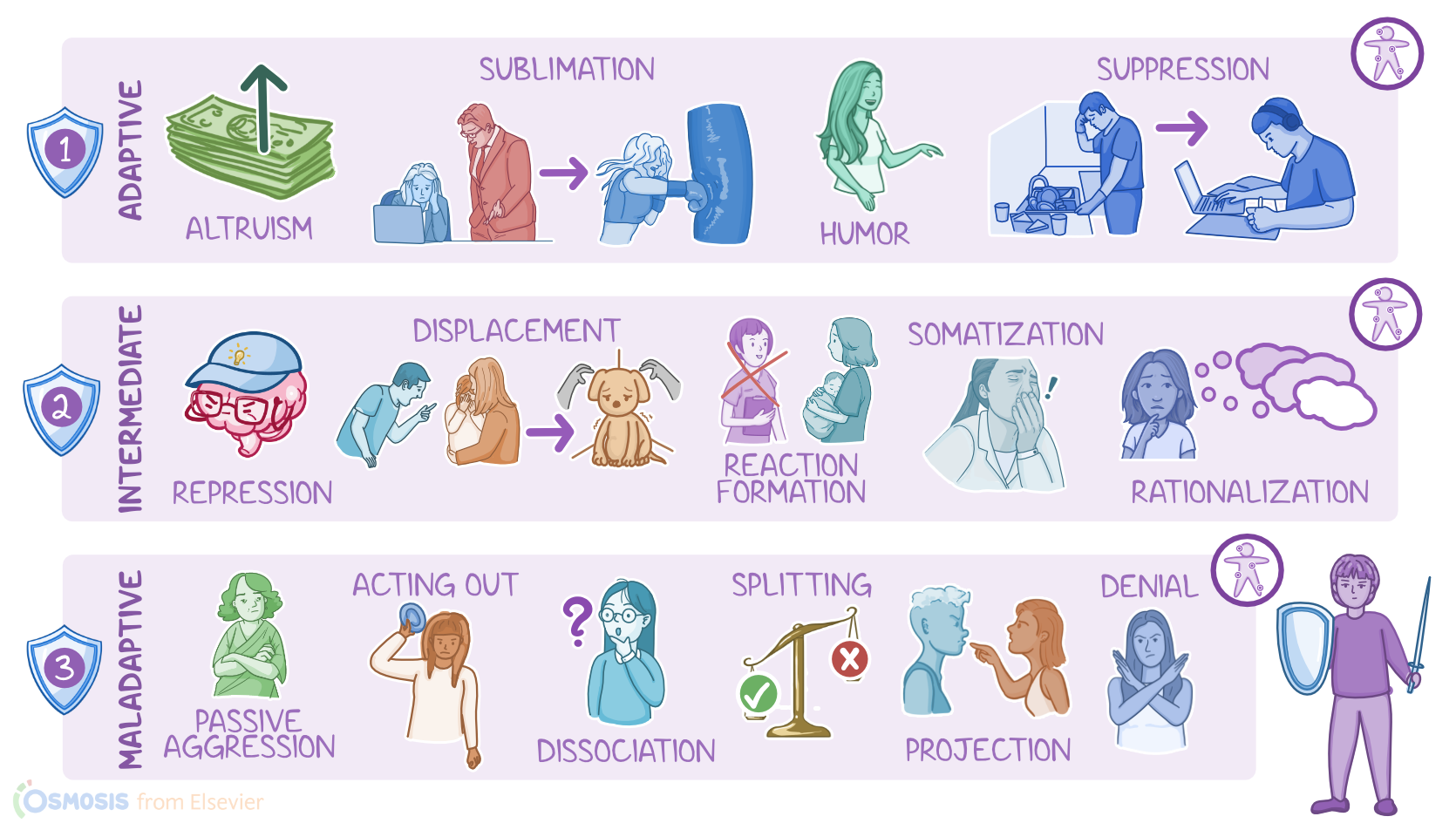
These mechanisms can be classified as adaptive, intermediate, or maladaptive depending on how much they help or harm an individual or the people in their lives.
Let’s start with the adaptive, also known as healthy or mature defense mechanisms, which include altruism, sublimation, humor, and suppression.With altruism, an individual will provide help to others to help relieve feelings of anxiety.
Adaptive defense mechanisms0:24–2:17
So for example, a billionaire makes a large donation to a hospital. So they can either derive gratification from doing the good deed itself, or from the responses from the receiver or others, such as having a hospital wing named after them.
Altruism shouldn’t be confused with self-sacrificing behavior, where they deny their own needs or interests in order to help others.With sublimation, the person replaces strong and suppressed impulses, such as sexual or aggressive ones, with an activity that is considered more socially acceptable and constructive.
So for example, a person who’s very angry about his boss can channel that energy through physical labor or contact sports such as boxing.
Next, humor is commonly used to express uncomfortable feelings, lighten up stressful situations, and relieve tension. An example of using humor as a defense mechanism is when someone trips when entering the room.
Feeling embarrassed, they say, “ ’” Finally, there’s suppression. This is where the individual consciously forces negative and undesirable feelings, ideas, and impulses out of their awareness.
An example of suppression would be a student being angry with their roommate about leaving dirty dishes in the sink. Since they need to study for a big exam, they stop thinking about the dishes and focus on studying instead.
In this case, suppression is useful for allowing them to focus on more important matters in the present. In other cases, suppression can delay addressing the negative thoughts or feelings until they are ready to process them.
Moving on to intermediate defense mechanisms, these can be helpful or harmful based on their severity and the situation in which they occur.
Intermediate defense mechanisms2:17–5:10
Intermediate defense mechanisms include repression, displacement, reaction formation, somatization, and rationalization.Now, with repression, the individual unconsciously pushes away negative feelings, memories, and thoughts out of their awareness.
An example of repression is when the person has no recollection of the time they were attacked as a child by a stray dog.
Situations that might trigger and pull back the repressed content are commonly avoided as well, like they might avoid going to the dog park or avoid visiting homes with a pet dog.
However, excluding and keeping content away from the mind requires a lot of energy, which is why repression may lead to health problems over time, such as depression, high blood pressure, heart disease, fatigue, digestive problems, and chronic pain.
Displacement refers to the transfer of negative and undesirable emotions from their original source to another unrelated subject.
An example is someone who gets yelled at by their boss at work. After coming home, they shout at their wife and kids for minor perceived faults when they actually want to yell at their boss.
In less extreme cases, it could be something relatively harmless like punching a pillow, but in extreme cases, they may even become hostile and start abusing their family members or animals.In reaction formation, inappropriate feelings and impulses are dealt with by developing a totally opposite and exaggerated emotional response or behavior.
For example, the mother of a newborn might feel no attachment to the baby, and this causes her to feel guilt and stress, so she becomes overprotective to the point where she refuses to let anyone else hold the child.
Somatization occurs when psychological distress manifests as a physical symptom without an apparent organic cause. An example of somatization is throwing up from anxiety before an important interview.
This can be a way to evade a situation that would otherwise cause even more anxiety, but it can also represent a way of asking for help.Finally, rationalization is a form of deceiving oneself by finding a rational, plausible, and socially acceptable explanation to justify their behavior or emotion.
One example is someone who promised to hangout with their friends but cancels at the last second without good reason. They then justify it by rationalizing that their friends probably didn’t want to be bothered and they were probably busy.
By doing so, they avoid self-blame and the negative emotions associated with their behavior. Now, there are also maladaptive, also known as unhealthy or immature defense mechanisms, which include passive aggression, acting out, dissociation, splitting, projection, and denial.
Maladaptive personality disorders are often encountered in individuals with certain personality disorders or other mental health conditions.Starting with passive aggression, this is where an individual expresses their dissatisfaction, annoyance, anger, and aggression covertly without direct confrontation.
Maladaptive defense mechanisms5:10–8:56
An example of passive aggression is when a person is upset that their coworker got promoted instead of them, so they deliberately ignore all emails sent by that coworker.
Passive aggression is also often seen in individuals with borderline personality disorder.Next is acting out, where a person performs often socially unacceptable verbal or physical acts in order to avoid unresolved emotions and urges.
An example of acting can be when a couple is having an argument. Instead of talking about the issue, one of them decides to start smashing plates on the floor.
Acting out temporarily boosts self-confidence and creates the illusion of having control over a situation, but ultimately they are using a destructive coping mechanism.
Acting out is especially common in individuals with antisocial personality disorder. In dissociation, the person separates their consciousness from a negative or painful memory, emotion, identity, or environment.
An example of this is a person who just survived a train crash. They might detach themself from reality and feel like it’s happening to someone else.
They could also detach from their identity to form an alternate one where they didn’t experience the traumatic event at all.
In severe cases, this may develop into a dissociative disorder. Now, splitting is characterized by the inability to conceptualize both positive and negative qualities of others or oneself.
For example, if a man thinks the person he just met at a bar is perfect in every way with no flaws whatsoever, this is called idealization.
The next day, if the person won’t answer his call, he now thinks they’re the worst person ever with no positive traits or redeeming characteristics.
This is called devaluation. Individuals who use splitting see the world as either black or white, either all good or all bad, and they tend to exaggerate those attributes and ignore contradicting attributes.
This defense mechanism is often used by those with borderline or narcissistic personality disorders. Okay, projection occurs when an individual attributes their unacceptable and uncomfortable emotions or thoughts to other people or situations.
An example of projection is when a person who has been unfaithful to their partner wrongfully accuses them of having an affair.
By doing so, the unresolved inner conflict is transferred to the outside world, where it is easier to control or avoid. Projection can often lead to blaming, scapegoating, stigmatization, and racial, religious and other prejudices.
This defense mechanism is associated with a paranoid personality disorder.Finally, denial involves ignoring or rejecting facts and evidence in order to avoid the negative emotions associated with facing reality.
An example of this is when someone who’s in a lot of debt might ignore their bills and continue spending large sums of money.
Although this can provide short term escape from the stressor, it prevents addressing or fixing the underlying cause of stress.
Alright, as a quick recap… Defense mechanisms are conscious or unconscious ways of protecting oneself from anxiety arising from inconvenient or unpleasant feelings, memories, or thoughts.
There are adaptive, also known as healthy or mature defense mechanisms, which include altruism, sublimation, humor, and suppression.
Those that can be both adaptive and maladaptive are referred to as intermediate defense mechanisms and include repression, displacement, reaction formation, somatization, and rationalization.
Review8:56–9:37
Finally, maladaptive, also known as unhealthy or immature defense mechanisms include passive aggression, acting out, dissociation, splitting, projection, and denial.
mature defense mechanisms, which include altruism sublimation, humor, and suppression those that candy bowls. Adaptive in maladaptive are referred to, as intermediate defense, mechanisms and include repression.
Displacement, reaction formation somatization and rationalization, finally maladaptive also known its unhealthy or immature, defense mechanisms, include passive-aggression acting out dissociation,
| DEFENSE MECHANISMS | ||
| KEY POINTS | NOTES | |
| DEFINITION |
| |
| ADAPTIVE DEFENSE MECHANISMS |
| |
| IMMEDIATE DEFENSE MECHANISMS |
| |
| MALADAPTIVE DEFENSE MECHANISMS |
| |
No notes for this video yet
Try adding a note below