Drug reconstitution: Nursing pharmacology
Introduction0:00–0:27
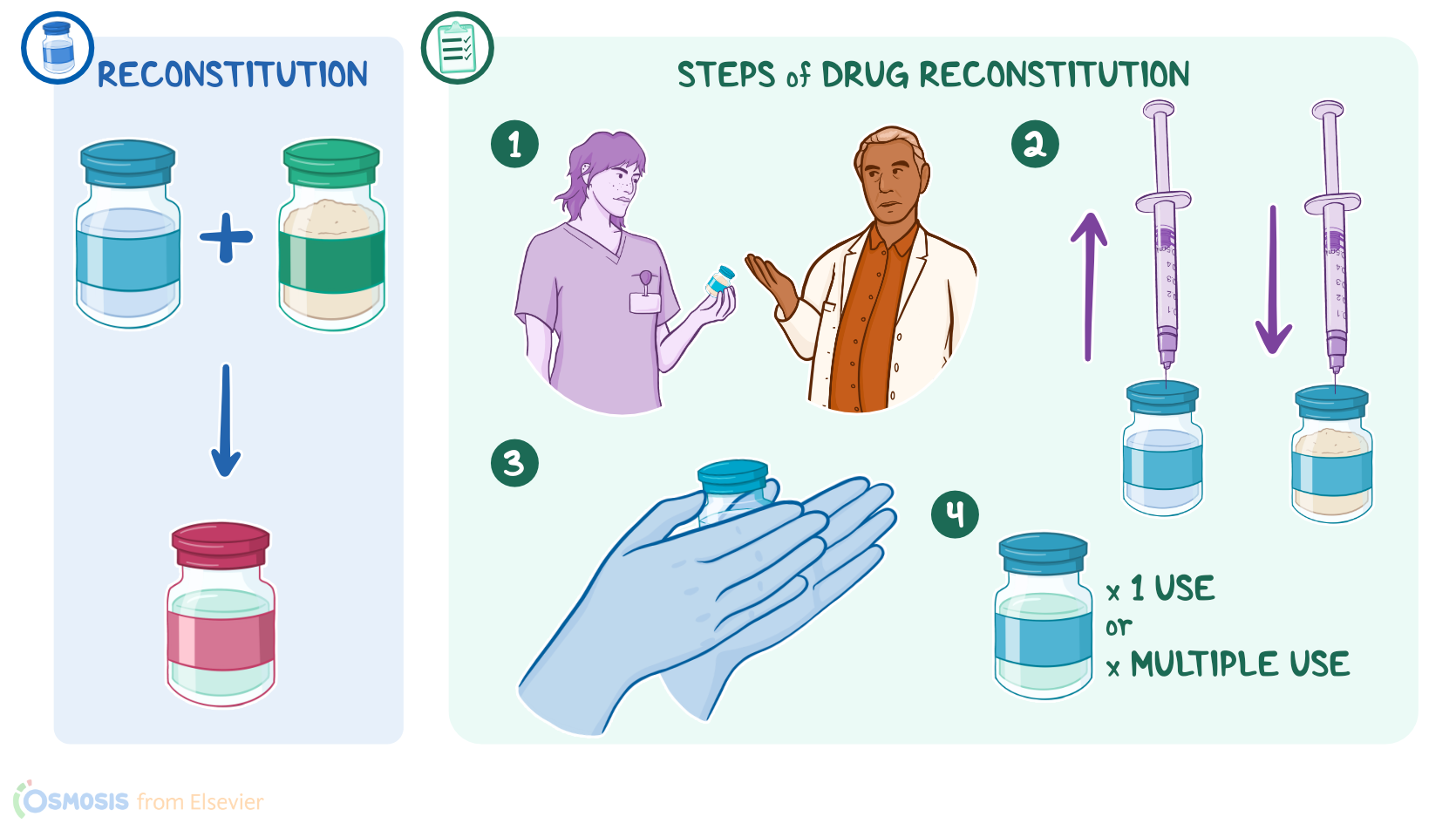
Reconstitution is the process of adding a liquid diluent, or solvent, to a powdered medication, or solute, and then dissolving the medication to form a solution.
In some cases, reconstitution is necessary because a medication doesn't remain stable long enough to be distributed in solution form, so it comes from the manufacturer in a powdered form and must be reconstituted with a liquid prior to administration.
Now, if your patient is prescribed a medication that requires reconstitution, you’ll follow the steps of drug reconstitution to perform safe medication administration.
Medication Reconstitution0:27–1:51
First, read the directions on the medication label or medication insert; or you can consult the pharmacist at your facility.
This information will tell you the type and amount of solvent to add to the powdered medication. Commonly used solvents include sterile water, bacteriostatic water, or sterile normal saline.
Next, you’ll use a syringe and needle to draw up the desired volume of solvent from its vial and inject the solvent into the vial of powdered medication.
After disposing of the syringe and needle according to your facility’s policy, you’ll typically roll the vial between your hands to mix it, unless the label specifies that you can shake it, making sure the medication dissolves completely, forming a solution.
Some reconstituted medications are packaged in single-dose vials, meaning the vial and its contents should be disposed of following administration.
Other reconstituted medications are packaged in multi-dose vials, meaning the contents can be stored and used later for additional doses.
For multi-dose vials, be sure to label the vial with the date and time it was reconstituted, the expiration date and time, the dosage strength, and your initials.
Okay, let’s look at some drug reconstitution examples. Let’s take a look at this label for methylprednisolone.First, read the directions on the label, which instruct you to use 2 mL of bacteriostatic water for reconstitution.
Drug Reconstitution - Example 11:51–2:43
Use a syringe and needle to draw up 2 mL of bacteriostatic water and inject the entire 2 mL into the vial of powdered methylprednisolone.
After injecting the water, remove and properly dispose of the syringe and needle. Then, to mix the medication and water, roll the vial in your hands until there’s no visible powder in the vial.
You’ll also notice the label indicates that the resulting solution contains 125 mg of methylprednisolone per 2 mL. Also, you’ll see that you’ll need to administer the dose within 48 hours of reconstitution, and that it’s a single-dose vial, so it should be discarded after the prescribed dose is administered.
Let’s look at another example.Starting with the label, you’ll see it contains a total of 5 million units of penicillin G potassium, and the directions indicate the different amounts of solvent you'll add based on the desired concentration.
Drug Reconstitution - Example 22:43–3:44
So, let’s say the health care provider ordered a concentration of 500,000 units per mL. In this case, you’ll add 8.2 mL of sterile normal saline into the vial of penicillin G potassium.
After injecting the saline, remove and properly dispose of the syringe and needle. Then, to mix the medication and water, roll the vial in your hands until there’s no visible powder in the vial.
Then, you’ll label the vial indicating its reconstituted concentration of 500,000 units per mL. Since this is a multi-dose vial, you’ll also label it with the date and time it was reconstituted, along with your initials.
Also, write the date and time the medication expires, which, according to the instructions, is seven days after reconstitution; and keep the unused solution in your unit’s refrigerator.
Okay, now let’s look at reconstituting an oral medication. For this medication, the reconstitution instructions say to add a total of 72 mL of water split into two portions, which should be shaken well after each portion is added to the amoxicillin.
Drug Reconstitution - Example 33:44–4:43
In other words, first, add half the water to the powdered medication and shake to mix it; then, add the other half and shake the entire mixture.
The label states the resulting concentration will be 250 mg of amoxicillin per 5 mL. You’ll note the solution expires 14 days after reconstitution, so be sure to label the container with the reconstitution date along with your initials and the date and time the medication expires.
Finally, store the remaining medication either at room temperature or in the refrigerator, and shake the bottle well before administering additional doses.
Alright, as a quick recap...Reconstitution is the process of adding a liquid solvent to a powdered medication in order to dissolve the medication.
Review4:43–5:01
The result is a solution with the medication in liquid form. To safely perform medication administration, the nurse must carefully read and follow the instructions for
| DRUG RECONSTITUTION | ||
| KEY POINTS | NOTES | |
| INTRODUCTION |
| |
| MEDICATION RECONSTITUTION |
| |
| EXAMPLE 1 |
| |
| EXAMPLE 2 |
| |
| EXAMPLE 3 |
| |
- "Calculate with confidence. (8th ed.)" Elsevier (2022)
- "Calculation of drug dosages: A work text. (12th ed.)" Elsevier (2023)
- "Clinical calculations: With applications to general and specialty areas. (10th ed.)" Elsevier (2022)
- "Gray Morris's calculate with confidence, Canadian edition. (2nd ed.)" Elsevier (2022)
- "Mulholland's: The nurse, the math, the meds. (5th ed.)" Elsevier (2023)
No notes for this video yet
Try adding a note below