Ethics: Nursing
Introduction0:00–1:10
Nurse Hailey works in the intensive care unit. During today’s shift, she is assigned to care for Mr.
Lee, a client with diabetes who was hospitalized for ketoacidosis. Mr.
Lee is on an insulin drip to help control his blood glucose. During the change of shift report, Nurse Hailey is reviewing the insulin titrations with Nurse James who cared for Mr.
Lee the night before. While they are looking over the documentation Nurse Hailey notices a potential error and says, “It seems like there was a protocol error.
Mr. Lee’s insulin dose was increased but the blood glucose was never checked.” Nurse James responds, “Oh no!
I don’t know how I could have made this mistake.Nurse Hailey tries to comfort Nurse James by saying, “It’s okay. He’s fine now so at least there were no adverse effects from the error.” Nurse James agrees, “You’re right.
No need to make this a big deal. Let’s keep it to ourselves.” Nurse Hailey knows that any medication error should be reported to the charge nurse immediately but she doesn’t want to get her friend, Nurse James, in trouble.
She is feeling conflicted about what to do and is experiencing an ethical dilemma.Ethics are moral principles that guide a person’s behavior and choices.
Ethics1:10–2:10
Since ethics are determined by social standards, they are referred to as being externally driven, meaning they are not decided by any single person.
Ethics help us to figure out what is “right” and what is “wrong.” Usually, ethical principles are not written down; they are considered common knowledge within a community.
For example, stealing is considered “wrong” for most people. But professional groups, like doctors and nurses, often have a more formal, written summary of ethical guidelines.
This is called a code of ethics and is used to inform the moral decision making of those in the group.So for Nurse Hailey, she is having an ethical dilemma.
She doesn't want to betray her co-worker, Nurse James. But ethically, she knows that lying, or withholding important information, is wrong.
She also knows that she could be placing Mr. Lee in danger by not reporting the error.For members of the healthcare team, including nurses, ethical practice is guided by seven principles.
Ethical Principles2:10–5:10
These principles were first introduced by the Greeks during the time of Hippocrates and have evolved over time to reflect modern-day ethical standards.
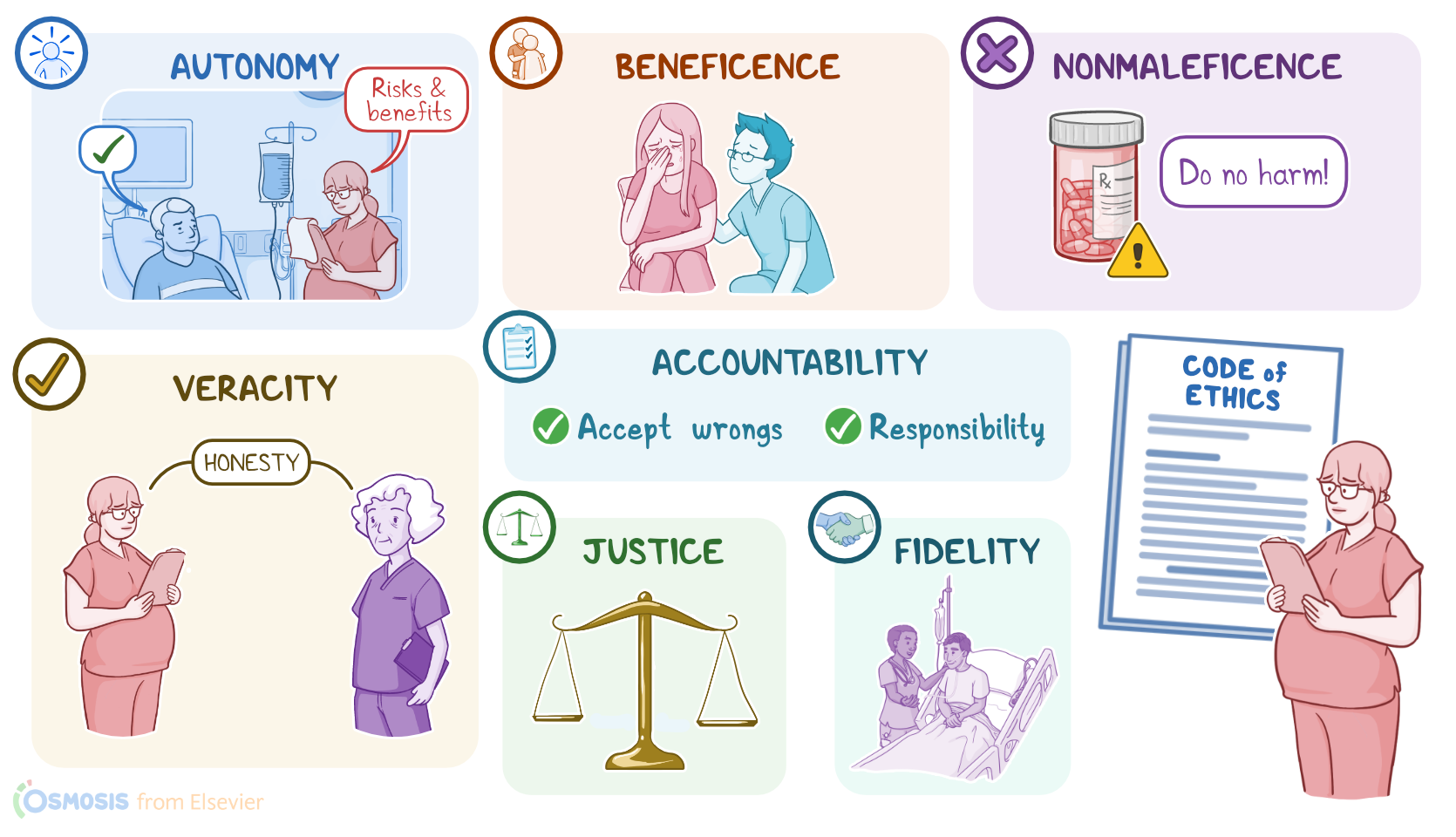
The seven main ethical principles are autonomy, beneficence, nonmaleficence, veracity, justice, accountability, and fidelity.Autonomy describes the client’s right to self-determination which means the freedom for them to make choices for themselves.
This ethical principle is the basis for practices like informed consent before treatment and client-centered decision making.
An example of autonomy would be discussing the risks and benefits of insulin therapy with Mr. Lee before starting treatment so that he could make an informed decision on whether or not he would like to move forward with treatment.Beneficence means to act with good intention and include being kind and compassionate to the client.
An example of beneficence is holding the hand of a dying client or consoling a client who has received a serious diagnosis.Nonmaleficence is avoiding actions that bring harm to the client.
This is based on the Hippocratic Oath that says healthcare providers will “do no harm.” When Nurse James made an error with Mr.
Lee’s insulin titration, he violated the principle of nonmaleficence because he created an opportunity for potential harm from the medication error.Veracity means acting truthfully.
This includes being truthful to the client, their family, and other healthcare professionals. For Nurse Hailey to show veracity, she must tell the truth about the medication error to her charge nurse.Justice involves the fair and equitable delivery of care.
This means that high-quality care should be given equally to all clients regardless of their income, skin color, gender, or religious beliefs.Accountability means accepting responsibility for your actions.
This can be admitting to making a medication error or even accepting responsibility for being late to a shift. Nurse James is not being accountable because he has decided not to report his medication error even though he knows it happened.Finally, fidelity means you are loyal in the delivery of care to clients.
In the nurse-client relationship, this can include remaining truthful or keeping promises. An example might be staying with a client during a bedside procedure after they asked you to be there for support.After thinking about the situation, Nurse Hailey pulls Nurse James aside.
She says, “ I really think you should report the medication error.” Nurse James agrees, “I’ve been thinking about it too and it’s the right thing to do.” Together, they inform the charge nurse of the error and Nurse James informs Mr.
Lee before clocking out for the day. Mr.
Lee says, “Thank you. I appreciate your honesty.”Alright, as a quick recap… Ethics refers to the socially accepted rules of what is “right” and “wrong”.
Review5:10–5:51
There are seven ethical principles: Autonomy, Beneficence, Nonmaleficence, Veracity, Justice, Accountability, and Fidelity.
Beneficence means to act with good intention. Nonmaleficence is avoiding actions that bring harm to the client.
Veracity means acting truthfully. Justice involves the fair and equitable delivery of care.
Accountability means accepting responsibility for your actions. Lastly, Fidelity means being loyal in the delivery of care.
A code of ethics is a written summary of ethical
| ETHICS | ||
| KEY POINTS | NOTES | |
| INTRODUCTION |
| |
| ETHICS |
| |
| ETHICAL PRINCIPLES |
| |
No notes for this video yet
Try adding a note below