Genomics - Mendelian genetics: Nursing
Introduction0:00–0:42
Genetics is the science that studies inheritance patterns, or the different ways parents transmit certain traits to their descendants.
And Mendelian genetics refers to the discoveries of Gregor Mendel, an Austrian monk, who studied inheritance by experimenting on pea plants.
He cross-pollinated the flowers of different plants, took the seeds he developed from the pairing, planted those seeds, and took careful notes on the types of peas that resulted in the subsequent generations.
Now, in addition to having lots and lots of peas in his garden, he rhelped to lay the foundation for understanding how traits are passed from one generation to another.
So to start out, Mendel took plants with two different traits, purple flowers and white flowers. He called this original group of flowers the “P” generation, as in “parent.” Then, he crossbread the flowers, and called their offspring generation F1, or filial one.
Inheritance Patterns0:42–5:13
It turned out that F1 consisted of all purple flowers, so he called the purple trait dominant, while the white trait which appeared to be lost in the F1 generation, was called recessive.Next, Mendel let the purple flowers in the F1 generation cross-pollinate amongst themselves, and he called the offspring generation from these plants F2 or filial two.
It turned out that some of the plants in this F2 generation had white flowers, while most of the other plants had purple flowers!
Mendel didn’t know this at the time, but the traits he was studying were genes, which are regions of DNA that carry information for specific features like flower color.
For human traits, genes carry information for traits like eye color or blood type. Single gene traits have just one single pair of genes encode a trait, while polygenic traits have 2 or more genes influence a trait.
Now, our genes are scattered among 23 pairs of chromosomes, with one pair supplied by one parent and the other pair supplied by the other parent.
The 22 of these pairs are somatic, or autosomic pairs, while the 23rd is a sex chromosome pair. In females, the sex chromosomes are two X chromosomes, whereas in males, there is one X and one Y chromosome.
Alright, now each chromosome has a lot of different genes, but it can also carry different versions of the same gene, called alleles, which can be either dominant or recessive.
A helpful way to visualize this is to use something called a Punnett square to predict the probability that a certain gene will be inherited.
We’ll use the example of the gene that codes for a taste receptor found in our tongues that allows us to taste bitterness.
Individuals who recoil when they sense a bitter taste when tasting leafy greens or grapefruit juice are referred to as “tasters,” while those who don’t are called “nontasters.” So, there seems to be a genetic reason why some people dislike broccoli!
Now, to make a Punnett square, imagine a box with four squares within it, where we can input the genetic information of the parents, called a genotype, on the horizontal row.
First, we put each of the alleles of one parent on the horizontal row, and the alleles of the other parent on the vertical column.
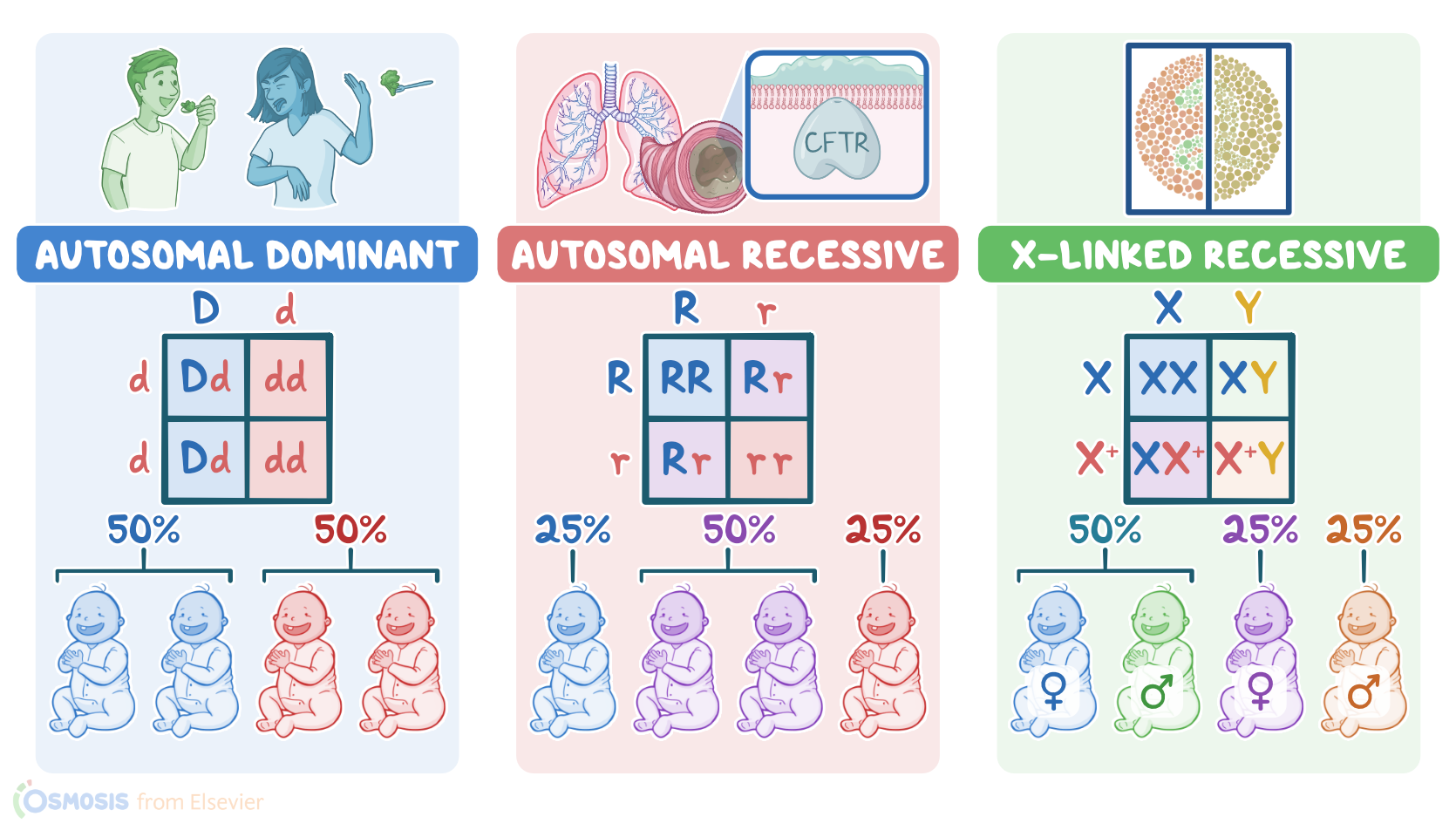
So, each parent supplies one allele of a gene, which can be dominant, represented with a capital letter “T” which codes for being a taster; or recessive, represented with a lowercase letter “t” which codes for being a nontaster.So, let’s say that one parent has two alleles for being a nontaster, or tt.
This parent is homozygous for this genetic trait because both alleles are the same type. Then let’s say that the other parent has one taster allele and one nontaster allele, or Tt.
This parent is heterozygous for this genetic trait because there are two different types of alleles. Now, we can fill out the Punnett square by taking one letter from the top and one from the side and filling in each of the squares, like this.
When we’re finished, we can see all the possible genotypes of their offspring. There's a 2 out of 4 or a 50% chance that their offspring will have Tt alleles, and a 2 out of 4 or a 50% chance that their offspring will have tt alleles.Moreover, the genotypes can tell us about the observable physical traits, or phenotypes, that we can see in each of the offspring.
Keep in mind that it only takes one dominant allele for the physical trait to be expressed, whereas it takes two recessive alleles for the trait to be expressed.
So in this scenario, we can say that there’s a 50 percent chance that their offspring will be tasters, and a 50% chance that their offspring will be nontasters.
We can also say that the taster trait is not only dominant, but it has an autosomal dominant pattern of inheritance, because the genes for tasting are found on one of the somatic chromosomes.
And, we can further say that the nontaster trait has an autosomal recessive pattern of inheritance. Now, a Punnett square can also be used to predict the probability of a disease, like cystic fibrosis, which is an autosomal recessive disorder, caused by a mutation in the gene that produces a protein called the cystic fibrosis transmembrane conductance regulator, or CFTR.
Inherited Disorders5:13–7:50
The mutation disrupts the normal functioning of the CFTR protein that’s found in the cells of the lungs and other parts of the body, causing a buildup of thick, sticky mucus that can damage the affected organs.
So, if we have a situation where both parents are heterozygous carriers of the mutant allele, the Punnett square will look like this.
Note that since the mutant allele is recessive, both parents will be unaffected by the disease. Now we can predict that there’s a 25 percent chance that their offspring will inherit 2 mutant alleles, one from each parent, and have cystic fibrosis; and a 75 percent chance their offspring will have no disease.
We can also say that there is a 50 percent chance that their offspring will carry the mutant allele but be unaffected by the disease, exactly like their parents!
Okay, let's look at what happens in disorders where the mutant allele is on the sex chromosomes, and more specifically on the X chromosome.
These are called X-linked disorders. Now, with male XY chromosomes, there’s only one X chromosome, so in males, any mutation in the X chromosome is sufficient to cause the disease.
On the other hand, females have two X chromosomes, so they can have either homozygous or heterozygous genotypes. This causes X-linked inheritance patterns to behave in slightly different ways between genetic males and females.
As an example, let’s look at red-green color deficiency, which is inherited in an X-linked recessive pattern. So, if we have a situation where one parent has one mutant allele on the XX chromosome pair, so X+, and the other parent has no mutant alleles on the XY chromosome pair, the Punnett square will look like this.
Now, we can predict that there’s a 50 percent chance that a male XY offspring will inherit the mutant allele and so, will end up having red-green color deficiency, and a 50 percent chance that a female XX offspring will inherit one mutant allele.
However, as the mutant allele is recessive, although the female XX offspring will be a carrier of the mutation, they will remain unaffected by the disease.
Looking at the Punnett square, we can also say that 75 percent of the offspring will have vision unaffected by color deficiency.Alright, as a quick recap….
Summary7:50–8:45
Genetics is the science that studies inheritance patterns, and Mendelian genetics refers to the discoveries of Gregor Mendel that helped to lay the foundation for understanding how traits are passed from one generation to another through inheritance of genes.
Each chromosome carries different genes but can also carry different versions of the same gene, called alleles, which can be either dominant or recessive.
If an individual inherits the same two alleles, we say they are homozygous for this trait, whereas if the alleles are different, they are called heterozygous.
Genotypes are expressed in observable physical traits called phenotypes. A Punnett square can be used to predict the probability of having a specific phenotype like the ability to taste bitterness or a disease like cystic fibrosis or red-green
| GENOMICS - MENDELIAN GENETICS | ||
| KEY POINTS | NOTES | |
| DEFINITION |
| |
| INHERITANCE PATTERNS |
| |
| INHERITED DISORDERS |
| |
No notes for this video yet
Try adding a note below