Growth and development - Preschool-age: Nursing

1,864views

Growth and development - Preschool-age: Nursing

N120-Peds

N120-Peds

Cystic fibrosis: Nursing
Acid-base map and compensatory mechanisms
Sickle cell disease (NORD)
Crisis intervention: Nursing
Hydrocephalus: Nursing process (ADPIE)
Autism spectrum disorder (ASD): Nursing
Heart defects that decrease pulmonary blood flow - Nursing considerations & client education: Nursing
Neural tube defects: Nursing
Congenital heart defects - Acyanotic: Nursing
Case study - Ventricular septal defect (VSD): Nursing
Hypoplastic left heart syndrome: Year of the Zebra 2024
Juvenile idiopathic arthritis: Nursing
Case study - Autism spectrum disorder: Nursing
Hemophilia: Nursing process (ADPIE)
Sickle cell disease: Nursing process (ADPIE)
Case study - Sickle cell anemia: Nursing
Otitis media: Nursing
Conjunctivitis: Nursing process (ADPIE)
Appendicitis: Nursing process (ADPIE)
Case study - Pediatric appendicitis: Nursing
Hirschsprung disease: Nursing
Intussusception
Pyloric stenosis: Nursing process (ADPIE)
Cleft lip and palate: Nursing
Down syndrome (Trisomy 21)
Physical assessment - Pediatric: Nursing
Vital signs - Pediatric pain: Nursing skills
Case study - Pediatric asthma: Nursing
Case study - Pediatric diabetes mellitus type 1: Nursing
Using an inhaler: Information for patients and families
Corticosteroids - Inhaled: Nursing pharmacology
Mast cell stabilizers - Inhaled: Nursing pharmacology
Bronchiolitis and respiratory syncytial virus (RSV): Nursing process (ADPIE)
Medications for respiratory syncytial virus (RSV): Nursing pharmacology
Medication administration - Insulin: Nursing pharmacology
Asthma: Information for patients and families (The Primary School)
Pancreatic enzyme replacements: Nursing pharmacology
Hirschsprung disease: Year of the Zebra
Movement of water between body compartments
Diarrhea: Nursing
Hemophilia: Year of the Zebra
Case study - Child maltreatment: Nursing
Case study - Accidental ingestion: Nursing
Growth and development theories: Nursing
Growth and development - Infant: Nursing
Growth and development - Preschool-age: Nursing
Growth and development - Toddler: Nursing
Growth and development - Adolescent: Nursing
Failure to thrive (FTT): Nursing
Childhood nutrition and obesity: Information for patients and families (The Primary School)
Childhood oral health: Information for patients and families (The Primary School)
Medication administration - Pediatric: Nursing pharmacology
Pediatric psychosocial needs during illness and hospitalization: Nursing
Epiglottitis: Nursing process (ADPIE)
Nephrotic syndrome: Nursing
Glomerulonephritis: Nursing
Poststreptococcal glomerulonephritis
Intestinal obstruction: Nursing
Immunodeficiency disorders - Primary: Nursing

Notes

GROWTH AND DEVELOPMENT - PRESCHOOL AGE

KEY POINTS
NOTES
DEFINITION
  • Lasts between 3 and 6 years of age
  • Characterized by
    • Slow physical growth
    • Remarkable cognitive, language and psychosocial development 

GROWTH
  • Physical changes in height, weight, and body appearance 
  • Height 
    • Average increase: 6.5–7.5 cm per year 
    • By age 5: 110 cm 
  • Weight 
    • Average gain: 2.25 kg per year 
    • By age 5: 18 kg 
  • Slight increase in skull length 
  • Lower jaw becomes more pronounced 
  • Upper jaw widens to accommodate permanent teeth 
  • First permanent teeth typically emerge around 6 years old
  • Growth variability between children of same age

DEVELOPMENT
  • Acquisition of complex motor, cognitive, psychosocial, and moral skills
  • Development
    • Motor
      • Improved coordination, balance, and rhythm 
      • Capable of 
        • Holding good posture 
        • Tying shoelaces 
        • Hopping, skipping, running smoothly 
        • Participating in sports and physical play
    • Cognitive
      • Piaget's preoperational stage
      • Use of symbols to represent words and ideas 
      • Engages in symbolic/fantasy play 
      • Animism 
      • Interest in 
        • Puzzles 
        • Drawing and painting 
      • Associative play 
        • Skills 
          • Count to 10 or more 
          • Name at least four colors 
          • Recognize common objects  
          • By age 6 
            • Vocabulary ~2100 words 
            • Can form 6-word sentences
    • Psychosocial
      • Erikson's initiative vs. guilt
      • Can
        • Plan activities 
        • Develop new skills 
        • Take initiative 
        • Outcomes 
          • Success → sense of accomplishment 
          • Failure or discouragement → sense of guilt
    • Moral
      • Kohlberg's preconventional level
      • Developing a conscience 
      • Adopts moral standards from caregivers 
      • Behaves to 
        • Gain rewards 
        • Avoid punishment 
        • Begins learning to manage 
          • Anger 
          • Conflict 

PHYSIOLOGIC CHANGES
  • Nervous system 
    • Improved coordination and motor control 
    • Can balance on one foot 
    • Climb and descend stairs efficiently 
    • Increased myelination of spinal cord: 
      • Better bowel and bladder control (by age 3)
  • Respiratory system 
    • Alveoli number increases 
    • Respiratory rate 16–22 breaths/min 
    • Short eustachian tube  
      • Increases risk of otitis media
  • Cardiovascular system 
    • Heart rate decreases 
    • Blood pressure increases 
    • Innocent murmurs may be heard 
  • Gastrointestinal system 
    • 20 deciduous teeth present by early preschool years 
    • Small bowel lengthens → decreased stool frequency 
    • Emphasis on balanced nutrition 
      • Use MyPlate model 
      • Supplements 
        • Iron-fortified cereals 
        • Vitamin D & C-fortified juice 
        • Fluoride (if water not fluoridated)
  • Genitourinary system 
    • Short urethra → higher risk of UTIs 
    • Daytime bladder control by age 5 
    • Occasional bedwetting may still occur 
  • Musculoskeletal system 
    • Bone length increases 
    • Muscle strength improves 
    • Still immature → prone to frequent injuries 
  • Immune & hematologic system 
    • Hemoglobin: 12 mg/dL 
    • WBC count: 5,000–15,000/μL 
    • Immunizations recommended 
      • DTaP 
      • IPV 
      • MMR 
      • Varicella 
      • Annual influenza vaccine

PATIENT AND FAMILY TEACHING
  • Safety  
    • Car  
      • Use a rear-facing car seat until the child reaches the manufacturer’s height/weight limit 
      • Transition to a forward-facing car seat, then to a booster seat as appropriate 
    • Home  
      • Cover electrical outlets and secure cords 
      • Store medications and chemicals out of reach 
      • Lock up guns and ammunition 
      • Set water heater to 120°F (49°C) or lower 
      • Never leave child unattended near water 
    • Personal and emergency
      • Teach child to 
        • Stay away from the street unless with a caregiver 
        • Wear a helmet when using wheeled toys 
        • Know how to call emergency services 
        • Respond to a fire emergency
        • Recite full name, address, caregiver’s name and phone number
  • Nutrition 
    • Offer 3 meals and 2 healthy snacks daily 
      • Fruits and vegetables 
      • Whole grains 
      • Lean proteins 
      • Dairy 
      • Limit 
        • Fruit juice
        • Soda
        • Foods high in sugar and saturated fat 
    • Expect picky eating phases 
    • Offer healthy choices without pressure to clean the plate 
    • Serve meals at consistent times 
    • Minimize distractions  
  • Immunizations 
    • Ensure child is up to date on recommended vaccines

Transcript

Watch video only

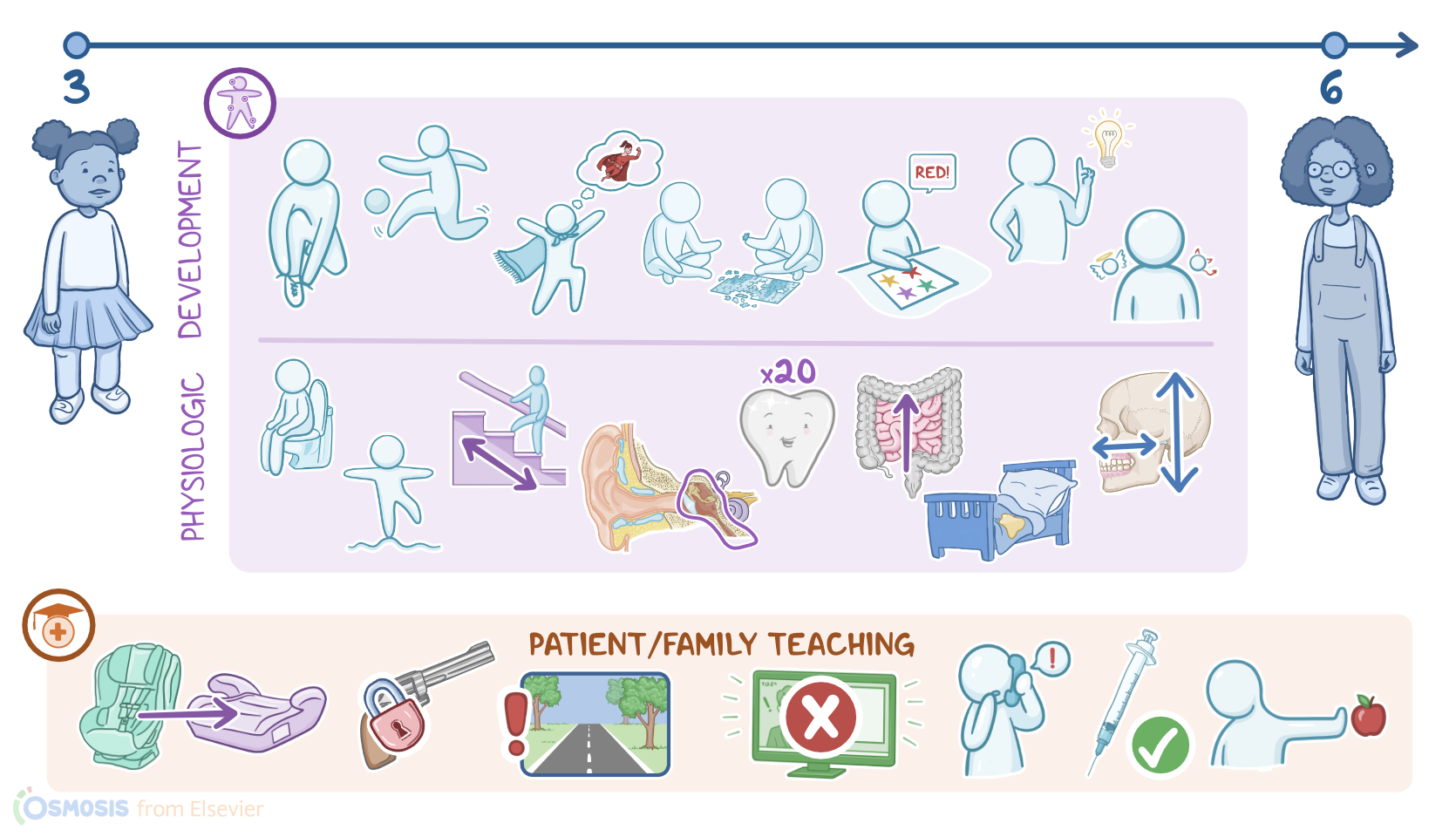
The preschool-age period lasts between 3 and 6 years of age, and is characterized by slow physical growth, but remarkable cognitive, language and psychosocial development compared to earlier stages. Preschool-age children are naturally inquisitive and start to explore and interact with the world around them. This ensures that they continue to learn all the skills that will lead to later success in the school age. Now, developmental psychologists involved in studying development during the preschool period include Jean Piaget, Erik Erikson, and Lawrence Kohlberg. Now let’s quickly take a look at two important terms here, which are growth and development. Growth refers to physical changes in height, weight, and the appearance of the body; whereas development refers to the acquisition of complex motor, cognitive, psychosocial, and moral skills, such as walking, speaking, turning a page in a book, understanding the concept of time, or smiling at familiar faces.

All right, when it comes to growth, preschool-age children gain an average of 6.5 to 7.5 cm each year, with an expected increase of 2.25 kg per year in weight. So, an average 5-year-old is about 110 cm tall and weighs about 18 kg. However, it’s important to note that children of the same age are frequently at different points in their growth during childhood. Other growth features include a slight increase in the length of the skull, with the lower jaw becoming more pronounced. The upper jaw also widens to make space for the emergence of permanent teeth, which usually start to appear at around 6 years of age. All right, let’s now take a quick look at the motor, cognitive, psychosocial, and moral development of preschoolers. Starting with motor development, this is a period where children improve their motor skills, and they become able to do certain things, like hold a good posture and tie their shoelaces. During preschool-age years, coordination, balance, and rhythm improve as well, allowing children to hop, skip, and run smoothly, and participate in a variety of sports.

Now, Piaget explains how the preschooler’s cognitive development is in the preoperational stage, meaning they tend to use symbols to represent words and ideas, which is why they tend to engage in symbolic or pretend play, called fantasy play, like playing dress-up; and they start developing magical thinking, and creating imaginary friends. At the same time, they can easily switch between fantasy and reality throughout the day. Preschool-age children may also attribute life-like characteristics to inanimate objects, the concept known as animism. They also begin showing interest in different toys such as puzzles, and displaying expressive creation skills with paints, paper, and crayons. During this period, preschoolers also become much more cooperative and engage in associative play with other preschoolers, where they play together while doing the same activity, like doing a puzzle together. Preschoolers should be able to count up to 10 or even more objects, can correctly name at least four colors, and know about things that are used in everyday life, such as home appli­ances, food, and money. By 6 years of age, they should have developed a vocabulary of about 2100 words, and be able to form a 6 word sentence.

Moving on to psychosocial development. According to Erikson, this is the period called initiative vs guilt, where children begin to take initiative by planning activities and developing new skills, which can give them a sense of accomplishment. However, if the preschooler is unable to accomplish these developmental tasks , or caregivers discourage these tendencies, children may develop a sense of guilt. In terms of moral development, Kohlberg places toddlers in the preconventional level of morality, where they continue to develop a sense of right and wrong; they start developing a conscience and adopting moral standards from their parents or other adults who influence them. They tend to adhere to those standards and behave obediently to gain rewards or avoid punishment. Toddlers also start to learn how to deal with anger, and problems like fighting with others, and lying. All right, now let’s switch the gears, and take a look at the physiologic changes that take place during the preschool years. Starting with the nervous system, its development enables improved coordination, such as being able to balance on one foot, as well as climb and descend stairs efficiently. Also, as more nerves in the spinal cord have become myelinated, there’s better bowel and bladder control, usually at 3 years of age.

Next, the respiratory system also continues to mature as the number of alveoli increases. Also, the respiratory rate decreases to about 16 to 22 breaths per minute. The Eustachian tube remains short, which makes it easier for pharyngeal germs to reach the middle ear, increasing the risk for otitis media. Changes in the cardiovascular system involve an increase in blood pressure and a decrease in heart rate. It’s important to note that on auscultation, preschoolers can present with an innocent murmur, mainly because the chest wall is thin enough to allow the heart to be close to the stethoscope. Regarding the gastrointestinal system, by the beginning of the preschool period, there are typically about 20 deciduous teeth. In addition, the small bowel length continues to increase, resulting in a decrease in stool frequency. Note that it’s important that preschoolers eat a nutritious and balanced diet consisting of a variety of different foods, to help support their ongoing growth. One model to help prepare a balanced diet is “MyPlate” food guide, which recommends vegetables and fruits to make up over half of the plate; and grains and proteins to occupy the other half of the plate, with grains taking a slightly larger portion. A balanced diet should also include dairy products, such as milk or yogurt, which provide the recommended daily amount of calcium. Major supplements may also be important, such as Iron-fortified cereals, vitamin D and C fortified juice, and fluoride for teeth reinforcement if the water is not fluoridated.