Incident reports: Nursing
Introduction0:00–1:20
Nurse Kevin has just started his lunch time rounds on the unit. As he approaches room 3B, he’s shocked to see his client, Mrs.
Baron, laying on the floor. Nurse Kevin moves quickly to reach Mrs.
Baron, and immediately assesses the situation. “Mrs.
Baron, are you alright?”. “Oh, I’m just fine”, she says, “I fell out of bed trying to reach my meal tray.” After ensuring Mrs.
A safety event can occur when evidenced-based best practice isn’t followed, resulting in harm or potential harm to a client.
Usually, an incident report is generated from the healthcare worker, like a Nurse Kevin for example, that was either involved in the incident or witnessed it.
Incident reports1:20–4:07
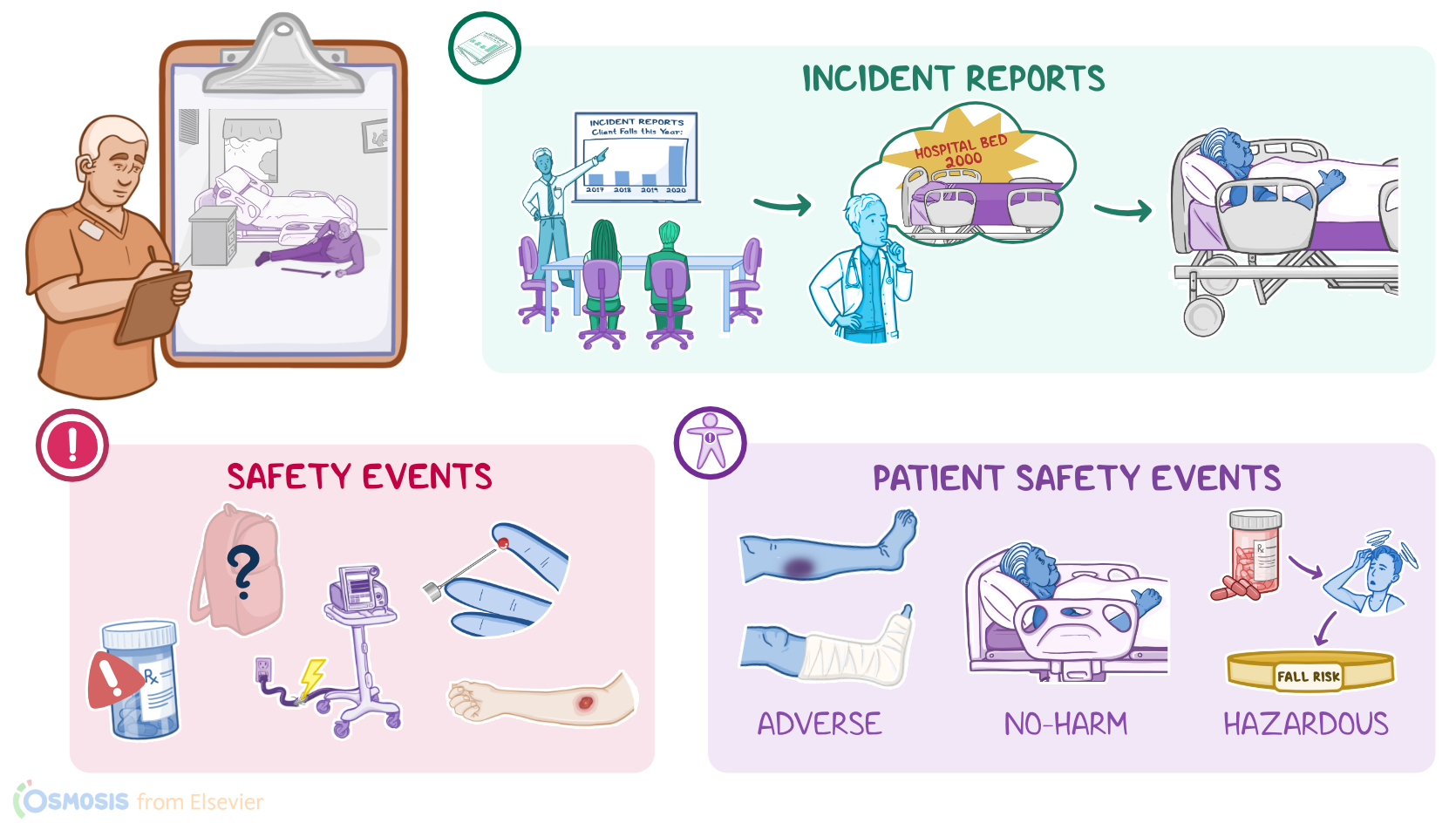
Now, incident reports are an important safety communication tool, and the ultimate goal of this type of reporting is to provide risk management and healthcare administration with information that can help them identify areas that are most prone to error.
For example, if a risk manager recognizes there’s an increase of reports about clients falling out of bed, this can indicate problems with things like bed safety, client monitoring, or the call light system.
With the data collected, risk managers, hospital administration and staff can further research the events and help develop best practices to prevent those events from occurring in the future.
While many facilities encourage and support the reporting of incidents, it’s essential that they also have a solid plan in place for following up on the report, developing solutions, and implementing those actions.
Incident reports are frequently used to document Patient Safety Events. A patient safety event can be an incident, or in some cases a condition, that could result or did result in harm to a client.
If the client actually does fall out of bed and is injured as a result of the side rails not being in the upright position, then this incident did result in harm to the client.
The three main types of Patient safety events include adverse events, no-harm events, and hazardous conditions. Let’s take a closer look at each of these: If Mrs.
Baron was hurt from her fall out of bed, this is an example of an adverse event. Now, if the fall resulted in death, permanent harm or severe temporary harm, this is called a sentinel event.
However, if she wasn’t harmed at all as a result of falling out of bed, this is described as a no-harm event. Simply put, this means that the client was subject to the event, but they were not harmed from it.
Now, let’s imagine that all of Mrs. Baron’s side rails were down.
This is a safety event that increases her risk of falling out of the bed. However, if Mrs.
Baron doesn’t fall out of the bed as a result of this safety event, but the potential is still there, this is referred to as a “near miss”, or a “close call event”.
This means that while the side rails error occurred, the client wasn’t harmed by it. Finally, a hazardous condition is a term used to describe a situation, not including the client’s current condition or illness, that increases their risk of an adverse event happening to them.
For example, if Mrs. Baron receives a pain medication that causes dizziness and fatigue, this increases her risk for falls.
Completing an incident report4:07–7:01
Now, since each facility or institution creates their own policies and procedures around incident reporting, it’s important to understand and follow the system that’s in place at your facility.
Luckily, most incident reports and reporting systems share common elements. When an incident occurs, the priority is to provide care for the individual involved; whether it’s a client, family member, visitor or co-worker; to prevent injury, or further injury, and complications from occurring.
With that said, before completing the incident report, be sure to notify the healthcare provider right away so that any prescriptions or interventions that are needed can be carried out immediately.
Generally when documenting an incident, it’s essential to fill out the form, whether on paper or electronically, fully. An effective incident report is accurate, factual, complete, graphic and valid.An accurate incident report is clearly documented and free of any spelling or grammatical errors, like misspelling a person’s name or accidently inputting the incorrect date.
They should also be very specific, rather than vague about the details. A great practice habit to adopt is to proofread your incident report before submitting it, just to double check that everything is correct.
The details included in an incident report should always be factual. This means you should use objective facts and not your opinions or hypotheses about the event, or placing the blame of what happened on another individual.
A complete incident report includes the who, what, where, when and why or how. So, the individual’s name(s), a clear and concise objective description of what occurred, the place where the incident occured, and the date and time.
When applicable, be sure to include the client’s own account of what happened and any witness statements. When documenting this information, use quotation marks when recording the client’s or witnesses’ own words.
If there were any equipment or medications involved, those specific details should be included in the incident report as well.
If there are any graphics, like supporting photos or images from the incident, those should be included too. Finally, in order to validate the report, it needs to be signed off by the person completing it, unless the facility allows some incident reports to be submitted semi- or fully anonymously.Incident reports or mention of the report should not be placed in the client’s medical record, since incident reports can be used in legal cases.
Keep in mind that incident reports are a risk management tool, so only clinical observations should be recorded in the client’s medical records.
So, while incident reports are a helpful safety tool, they are voluntary in nature, which means it’s up to the discretion of the individual, like Nurse Kevin, to complete one.
Barriers to incident reporting7:01–8:46
In fact, only a small percentage of incidents that occur within healthcare systems are actually reported. Because of this voluntary nature, there are several barriers to reporting.
While some of the barriers to reporting include things such as not knowing how to complete the report, not having the time to complete the report, or not seeing the value in completing the report; one of the most common barriers is fear.
You see, healthcare workers often express being afraid to report an incident for fear of being blamed, receiving discipline, being terminated or even worse; losing their license to practice.
It’s critical that all healthcare workers feel secure in reporting incidents, and facilities should encourage a positive, or “just” culture, of reporting and reducing incidents.
In a just culture healthcare environment, a non blaming incident investigation is the foundation; the emphasis is not to point the finger at who caused the safety event.
To further help decrease fears around reporting, some healthcare facilities and departments have implemented semi-anonymous or fully anonymous reporting systems.
Regardless of which system your facility uses, remember that the goal of incident reports are to protect the safety of clients, healthcare workers and any individuals affected.
Every hospital has a QI/QA team that reviews incidences and tries to prevent them with change. Nurses should be represented on these committees and attend these meetings.OK, as a quick recap ...
Summary8:46–10:46
Incident reports are records of safety events that are not part of the client’s medical record. Incident reports are voluntary, so while they are not required to be completed, they are highly encouraged.
These reports are an important safety communication tool that risk managers and hospital administrators can use to research the event and help develop solutions to prevent those events from occurring again.
While most incident reports share common elements, each healthcare facility or institution creates their own policies and procedures around incident reporting, so it’s important to understand and follow the system that’s in place at your facility.
While incident reports should be completed as soon as possible, the priority is to provide care for the individual affected to prevent injury, or further injury, and complications from occurring.
When completing your report, remember to be accurate, factual and complete, provide graphics if available, and validate it with your signature (unless the facility allows anonymous submission of reports).
Also, keep in mind that copies of incident reports should not be placed in the client’s medical record. Only clinical observations should be included there.
While there are some barriers to reporting, one of the most common barriers is fear. So, it’s of utmost importance that all healthcare workers feel secure in reporting incidents, and that your facility encourages a positive, just culture of reporting and reducing incidents.
Ultimately, remember that the goal of incident reports is to protect the safety of clients, healthcare workers and any individuals affected; and healthcare workers should feel safe and supported by their facility to report all incidents.
| INCIDENT REPORTS | ||
| KEY POINTS | NOTES | |
| DEFINITION |
| |
| INCIDENT REPORTS |
| |
| PATIENT SAFETY EVENTS |
| |
| COMPLETING AN INCIDENT REPORT |
| |
| BARRIERS TO INCIDENT REPORTS |
| |
No notes for this video yet
Try adding a note below