Incident reports: Nursing

Incident reports: Nursing

Watch later

Watch later

Pneumonia: Pathology review
Schizophrenia spectrum disorders: Clinical
Acetaminophen (Paracetamol)
Antigout medications
Non-corticosteroid immunosuppressants and immunotherapies
Osteoporosis medications
Measuring cardiac output (Fick principle)
Rheumatoid arthritis
Hypothesis testing: One-tailed and two-tailed tests
Relative and absolute risk
Sensitivity and specificity
Positive and negative predictive value
Type I and type II errors
Test precision and accuracy
Sample size
Methods of regression analysis
Study designs
Prevention
Respiratory system anatomy and physiology
Lung volumes and capacities
Anatomic and physiologic dead space
Ventilation
Alveolar gas equation
Compliance of lungs and chest wall
Combined pressure-volume curves for the lung and chest wall
Alveolar surface tension and surfactant
Breathing cycle
Odds ratio
Breathing control
Pulmonary chemoreceptors and mechanoreceptors
Systemic lupus erythematosus (SLE): Clinical
Rheumatoid arthritis: Clinical
Joint pain: Clinical
Seronegative arthritis: Clinical
Vasculitis: Clinical
Inflammatory myopathies: Clinical
Sjogren syndrome: Clinical
Staphylococcus aureus
Staphylococcus epidermidis
Staphylococcus saprophyticus
Coronary artery disease: Clinical
Heart failure: Clinical
Syncope: Clinical
Hypertension: Clinical
Pericardial disease: Clinical
Infective endocarditis: Clinical
Valvular heart disease: Clinical
Cardiomyopathies: Clinical
Hypercholesterolemia: Clinical
Aortic aneurysms and dissections: Clinical
Gallbladder disorders: Clinical
Esophagitis: Clinical
Esophageal disorders: Clinical
Gastroesophageal reflux disease (GERD): Clinical
Peptic ulcers and stomach cancer: Clinical
Diarrhea: Clinical
Malabsorption: Clinical
Inflammatory bowel disease: Clinical
Gastroparesis: Clinical
Colorectal cancer: Clinical
Diverticular disease: Clinical
Pancreatitis: Clinical
Gastrointestinal bleeding: Clinical
Viral hepatitis: Clinical
Jaundice: Clinical
Cirrhosis: Clinical
Introduction to biostatistics
Mean, median, and mode
Probability
Range, variance, and standard deviation
Types of data
Pregnancy
Stages of labor
Breastfeeding
Virilization: Clinical
Contraception: Clinical
Breast cancer: Clinical
Postpartum hemorrhage: Clinical
Hypertensive disorders of pregnancy: Clinical
Infertility: Clinical
Gestational trophoblastic disease: Clinical
Sexually transmitted infections: Clinical
Vulvovaginitis: Clinical
Abnormal uterine bleeding: Clinical
Routine prenatal care: Clinical
Premature rupture of membranes: Clinical
Abnormal labor: Clinical
Vaginal versus cesarean delivery: Clinical
Antepartum hemorrhage: Clinical
Introduction to the immune system
Vaccinations
Galactosemia
Hereditary fructose intolerance
Essential fructosuria
Endocrine system anatomy and physiology
Microcirculation and Starling forces
Adrenal cortical carcinoma
Sarcoptes scabiei (Scabies)
Pediculus humanus and Phthirus pubis (Lice)
Venous thromboembolism: Clinical
Non-steroidal anti-inflammatory drugs
Appendicitis: Clinical
Adult brain tumors
Anxiety disorders: Clinical
Disorders of consciousness: Clinical
Edwards syndrome (Trisomy 18)
Fibrous, cartilage, and synovial joints
Metaplasia and dysplasia
Neisseria meningitidis
Lordosis, kyphosis, and scoliosis
Sickle cell disease: Clinical
Skin cancer: Clinical
Thyroid nodules and thyroid cancer: Clinical
Mycobacterium tuberculosis (Tuberculosis)
Yersinia pestis (Plague)
Anatomy and physiology of the male reproductive system
Free water clearance
Renal system anatomy and physiology
Body fluid compartments
Movement of water between body compartments
Renal clearance
Osmoregulation
Kidney countercurrent multiplication
Antidiuretic hormone
Regulation of renal blood flow
Measuring renal plasma flow and renal blood flow
Glomerular filtration
Proximal convoluted tubule
Loop of Henle
Distal convoluted tubule
Potassium homeostasis
Tubular reabsorption of glucose
Urea recycling
Tubular secretion of PAH
Physiologic pH and buffers
Buffering and Henderson-Hasselbalch equation
The role of the kidney in acid-base balance
Plasma anion gap
Acid-base map and compensatory mechanisms
Metabolic acidosis
Metabolic alkalosis
Respiratory acidosis
Respiratory alkalosis
IgA nephropathy (NORD)
Rapidly progressive glomerulonephritis
Goodpasture syndrome
Poststreptococcal glomerulonephritis
Lupus nephritis
Minimal change disease
Diabetic nephropathy
Membranoproliferative glomerulonephritis
Membranous nephropathy
Lower urinary tract infection
Acute pyelonephritis
Chronic pyelonephritis
Kidney stones
Renal tubular acidosis
Renal artery stenosis
Renal cortical necrosis
Prerenal azotemia
Renal azotemia
Postrenal azotemia
Chronic kidney disease
Hyponatremia
Hypernatremia
Hyperkalemia
Hypokalemia
Hypercalcemia
Hypocalcemia
Hypermagnesemia
Hypomagnesemia
Hyperphosphatemia
Hypophosphatemia
Neurogenic bladder
Urinary incontinence
Renal cell carcinoma
Angiomyolipoma
Nephroblastoma (Wilms tumor)
WAGR syndrome
Non-urothelial bladder cancers
Transitional cell carcinoma
Hydronephrosis
Vesicoureteral reflux
Posterior urethral valves
Bladder exstrophy
Hypospadias and epispadias
Polycystic kidney disease
Horseshoe kidney
Renal agenesis
Medullary sponge kidney
Multicystic dysplastic kidney
Medullary cystic kidney disease
Potter sequence
Loop diuretics
Carbonic anhydrase inhibitors
Osmotic diuretics
Potassium sparing diuretics
Thiazide and thiazide-like diuretics
Thyroid hormones
Growth hormone and somatostatin
Adrenocorticotropic hormone
Synthesis of adrenocortical hormones
Cortisol
Glucagon
Insulin
Somatostatin
Dyslipidemias: Pathology review
Candida
Heart failure: Pathology review
Aortic dissections and aneurysms: Pathology review
Cyanotic congenital heart defects: Pathology review
Cardiac and vascular tumors: Pathology review
Endocarditis: Pathology review
Heart blocks: Pathology review
Cardiomyopathies: Pathology review
Deep vein thrombosis and pulmonary embolism: Pathology review
Pericardial disease: Pathology review
Hypertension: Pathology review
Adrenal gland histology
Coronary artery disease: Pathology review
Androgens and antiandrogens
Cardiovascular system anatomy and physiology
Lymphatic system anatomy and physiology
Normal heart sounds
Abnormal heart sounds
Total anomalous pulmonary venous return
Tetralogy of Fallot
Transposition of the great vessels
Persistent truncus arteriosus
Hypoplastic left heart syndrome
Myocardial infarction
Angina pectoris
Stable angina
Unstable angina
Prinzmetal angina
Skeletal system anatomy and physiology
Cartilage structure and growth
Bone remodeling and repair
Muscular system anatomy and physiology
Muscle contraction
Slow twitch and fast twitch muscle fibers
Sliding filament model of muscle contraction
Neuromuscular junction and motor unit
Reactive arthritis
Psoriatic arthritis
Gout
Ankylosing spondylitis
Systemic lupus erythematosus
Raynaud phenomenon
Limited systemic sclerosis (CREST syndrome)
Sjogren syndrome
Fibromyalgia
Polymyalgia rheumatica
Amyloidosis
Dermatomyositis
Polymyositis
Inclusion body myopathy
Osteoarthritis
Slipped capital femoral epiphysis
Paget disease of bone
Osteomalacia and rickets
Osteoporosis
Osgood-Schlatter disease (traction apophysitis)
Legg-Calve-Perthes disease
Septic arthritis
Osteomyelitis
Rotator cuff tear
Meniscus tear
Compartment syndrome
Bone tumors
Developmental dysplasia of the hip
Cleidocranial dysplasia
Achondroplasia
Chest trauma: Clinical
Acid reducing medications
Laxatives and cathartics
Skin anatomy and physiology
Urinary incontinence: Pathology review
Lymphomas: Pathology review
Nephrotic syndromes: Pathology review
Acyanotic congenital heart defects: Pathology review
Compliance of blood vessels
Blood pressure, blood flow, and resistance
Resistance to blood flow
Laminar flow and Reynolds number
Pressures in the cardiovascular system
Cardiovascular changes during hemorrhage
Cardiovascular changes during postural change
Cardiac and vascular function curves
Altering cardiac and vascular function curves
Stroke volume, ejection fraction, and cardiac output
Frank-Starling relationship
Pressure-volume loops
Changes in pressure-volume loops
Cardiac work
Cardiac preload
Cardiac afterload
Law of Laplace
Psoriasis
Lichen planus
Pityriasis rosea
Bullous pemphigoid
Pemphigus vulgaris
Epidermolysis bullosa
Skin cancer
Streptococcus pneumoniae
Streptococcus pyogenes (Group A Strep)
Streptococcus agalactiae (Group B Strep)
Streptococcus viridans
Enterococcus
Clostridium perfringens
Clostridium botulinum (Botulism)
Clostridium tetani (Tetanus)
Listeria monocytogenes
Bacillus anthracis (Anthrax)
Bacillus cereus (Food poisoning)
Corynebacterium diphtheriae (Diphtheria)
Actinomyces israelii
Escherichia coli
Salmonella (non-typhoidal)
Salmonella typhi (typhoid fever)
Pseudomonas aeruginosa
Enterobacter
Bartonella henselae (Cat-scratch disease and Bacillary angiomatosis)
Klebsiella pneumoniae
Proteus mirabilis
Yersinia enterocolitica
Legionella pneumophila (Legionnaires disease and Pontiac fever)
Serratia marcescens
Bacteroides fragilis
Helicobacter pylori
Vibrio cholerae (Cholera)
Campylobacter jejuni
Neisseria gonorrhoeae
Moraxella catarrhalis
Francisella tularensis (Tularemia)
Bordetella pertussis (Whooping cough)
Brucella
Haemophilus ducreyi (Chancroid)
Pasteurella multocida
Mycobacterium leprae
Mycoplasma pneumoniae
Chlamydia trachomatis
Chlamydia pneumoniae
Treponema pallidum (Syphilis)
Leptospira
Borrelia burgdorferi (Lyme disease)
Borrelia species (Relapsing fever)
Rickettsia rickettsii (Rocky Mountain spotted fever) and other Rickettsia species
Gardnerella vaginalis (Bacterial vaginosis)
Abscesses
Class I antiarrhythmics: Sodium channel blockers
Interleaved practice
Autoimmune bullous skin disorders: Clinical
Introduction to pharmacology
Early infantile epileptic encephalopathy (NORD)
Coronavirus Pandemic: Daily Report with Rishi Desai, MD, MPH 4/3/2020
COVID-19: Ask Me Anything Open Forum with Rishi Desai, Md MPH
Estrogen and progesterone
Coronavirus Pandemic, Daily Report with Rishi Desai, MD, MPH: Remdesivir
Amino acids and protein folding
Vasculitis: Pathology review
Peripheral artery disease: Pathology review
Eczematous rashes: Clinical
Physiological changes during exercise
Baroreceptors
Renin-angiotensin-aldosterone system
Chemoreceptors
Cardiac conduction system
Action potentials in pacemaker cells
Action potentials in myocytes
Cardiac conduction velocity
Excitability and refractory periods
Cardiac excitation-contraction coupling
Cardiac contractility
ECG basics
ECG normal sinus rhythm
ECG rate and rhythm
ECG intervals
ECG axis
ECG QRS transition
ECG cardiac hypertrophy and enlargement
ECG cardiac infarction and ischemia
Cerebral circulation
Coronary circulation
Control of blood flow circulation
Multiple sclerosis
Barrett esophagus
Plummer-Vinson syndrome
Zenker diverticulum
Achalasia
Boerhaave syndrome
Mallory-Weiss syndrome
Diffuse esophageal spasm
Gastroesophageal reflux disease (GERD)
Peptic ulcer
Gastritis
Gastroparesis
Cyclic vomiting syndrome
Gastric dumping syndrome
Dental caries disease
Gingivitis and periodontitis
Dental abscess
Ludwig angina
Oral candidiasis
Parotitis
Sialadenitis
Aphthous ulcers
Pulpitis
Temporomandibular joint dysfunction
Familial adenomatous polyposis
Juvenile polyposis syndrome
Peutz-Jeghers syndrome
Gardner syndrome
Colorectal polyps
Crohn disease
Ulcerative colitis
Microscopic colitis
Protein losing enteropathy
Necrotizing enterocolitis
Small bowel ischemia and infarction
Ischemic colitis
Inguinal hernia
Femoral hernia
Intussusception
Volvulus
Intestinal adhesions
Diverticulosis and diverticulitis
Appendicitis
Gastroenteritis
Irritable bowel syndrome
Gallstone ileus
Celiac disease
Tropical sprue
Whipple's disease
Lactose intolerance
Short bowel syndrome (NORD)
Small bowel bacterial overgrowth syndrome
Hemorrhoid
Anal fissure
Anal fistula
Rectal prolapse
Peritonitis
Pneumoperitoneum
Gallstones
Primary sclerosing cholangitis
Ascending cholangitis
Acute cholecystitis
Chronic cholecystitis
Biliary colic
Cirrhosis
Non-alcoholic fatty liver disease
Primary biliary cholangitis
Hepatocellular adenoma
Alcohol-associated liver disease
Fitz-Hugh-Curtis syndrome
Hemochromatosis
Wilson disease
Autoimmune hepatitis
Portal hypertension
Budd-Chiari syndrome
Cholestatic liver disease
Neonatal hepatitis
Viral hepatitis
Gilbert's syndrome
Crigler-Najjar syndrome
Rotor syndrome
Dubin-Johnson syndrome
Biliary atresia
Chronic pancreatitis
Acute pancreatitis
Pancreatic pseudocyst
Imperforate anus
Hirschsprung disease
Meckel diverticulum
Gastroschisis
Omphalocele
Intestinal malrotation
Intestinal atresia
Cleft lip and palate
Pyloric stenosis
Thyroglossal duct cyst
Tracheoesophageal fistula
Congenital diaphragmatic hernia
Esophageal web
Warthin tumor
Oral cancer
Gastric cancer
Colorectal cancer
Pancreatic cancer
Esophageal cancer
Gallbladder carcinoma
Hepatocellular carcinoma
Cholangiocarcinoma
Benign liver tumors
Atrial septal defect
Dr. Daniel Kraft: Founder of Exponential Medicine (Raise the Line)
Rabies virus
COVID-19 vaccine hesitancy
Development of the COVID-19 vaccine
Incident reports: Nursing
Peripheral artery disease
Anatomy clinical correlates: Axilla
Anatomy clinical correlates: Olfactory (CN I) and optic (CN II) nerves

Notes

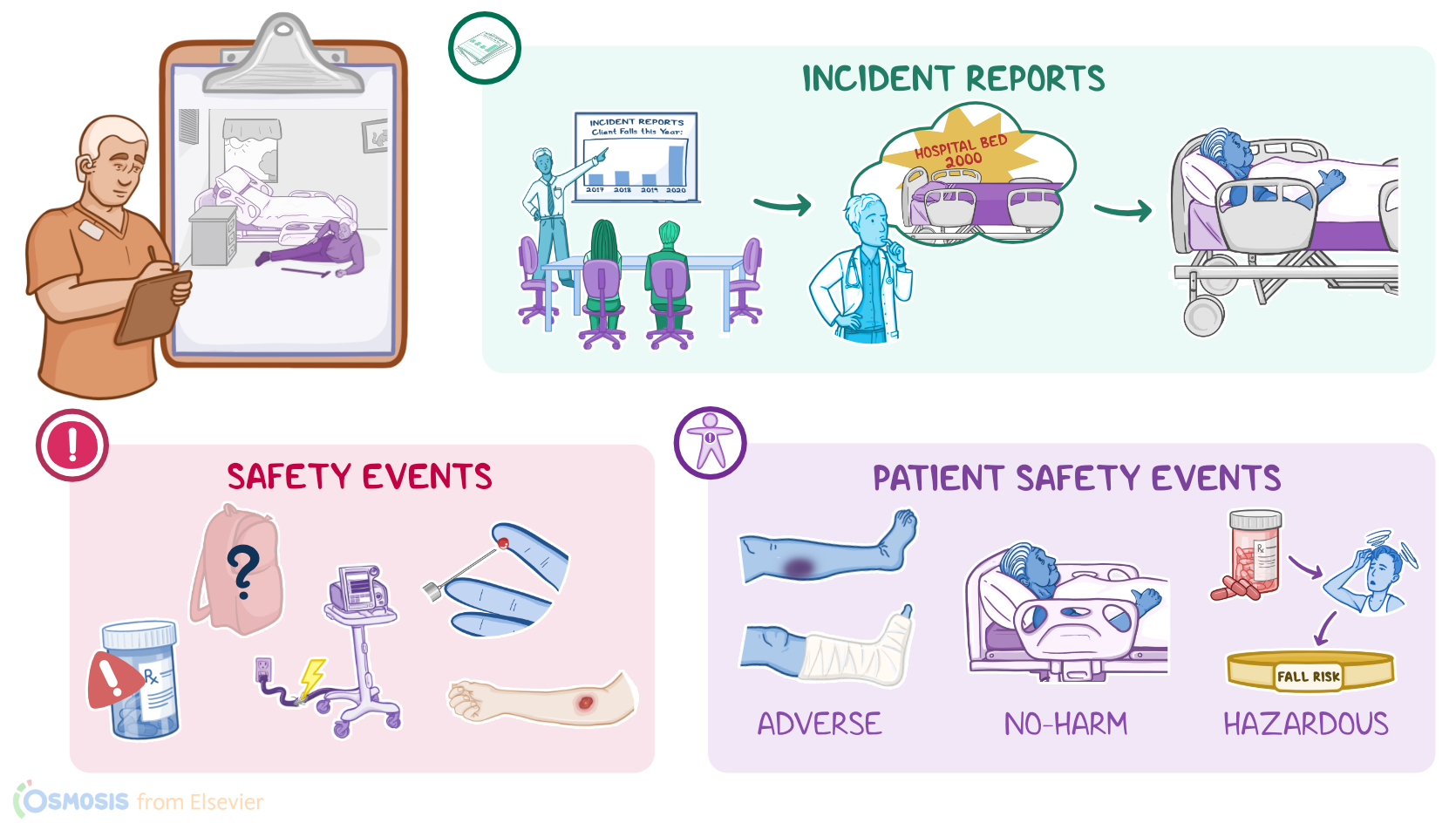
INCIDENT REPORTS

KEY POINTS
NOTES
DEFINITION
  • Incident reports
    • Term used to describe safety event reporting
  • Safety event
    • Can occur when evidence-based practice (EBP) isn't following, resulting in harm or potential harm

INCIDENT REPORTS
  • Important safety communication tool
  • Provide risk management and healthcare administration with information to help identify areas prone to error
  • Allow risk managers, hospital administration, and staff to further research events and develop best practices for prevention
  • Require follow-up, development of solutions, and implementation of solutions

PATIENT SAFETY EVENTS
  • Incident or condition that could result or did result in harm
    • Adverse events
      • Injured from fall
    • Sentinel event
      • Fall resulted in death
    • No-harm events
      • No injury from fall
    • Near miss
      • Side rails on bed were down but no fall occurred
    • Hazardous conditions
      • Pain medication causes fatigue, increasing risk for fall 

COMPLETING AN INCIDENT REPORT
  • Policies and procedures specific to each facility
  • Provide care to individual involved 
  • Prevent injury (or further injury)
  • Notify healthcare provider
  • Fill out report with accurate, factual, complete, graphic, and valid information

BARRIERS TO INCIDENT REPORTS
  • Not knowing how to complete the report
  • Not having time
  • Not seeing value
  • Fear

Transcript

Watch video only

Nurse Kevin has just started his lunch time rounds on the unit. As he approaches room 3B, he’s shocked to see his client, Mrs. Baron, laying on the floor. Nurse Kevin moves quickly to reach Mrs. Baron, and immediately assesses the situation.

“Mrs. Baron, are you alright?”. “Oh, I’m just fine”, she says, “I fell out of bed trying to reach my meal tray.” After ensuring Mrs. Baron’s safety and collecting information from her about what happened, it’s time for Nurse Kevin to complete an incident report:

Incident reports, or sometimes called incident reporting, unusual occurrence report, or variance report; is a commonly used term to describe safety event reporting. A safety event can occur when evidenced-based best practice isn’t followed, resulting in harm or potential harm to a client.

Some examples of safety events include accidental needlesticks, falls, medication errors which are the number one cause of incidents, defective systems or equipment failure, missing client belongings and hospital acquired infections. Usually, an incident report is generated from the healthcare worker, like a Nurse Kevin for example, that was either involved in the incident or witnessed it.

Now, incident reports are an important safety communication tool, and the ultimate goal of this type of reporting is to provide risk management and healthcare administration with information that can help them identify areas that are most prone to error.

For example, if a risk manager recognizes there’s an increase of reports about clients falling out of bed, this can indicate problems with things like bed safety, client monitoring, or the call light system.

With the data collected, risk managers, hospital administration and staff can further research the events and help develop best practices to prevent those events from occurring in the future.

While many facilities encourage and support the reporting of incidents, it’s essential that they also have a solid plan in place for following up on the report, developing solutions, and implementing those actions.

Incident reports are frequently used to document Patient Safety Events. A patient safety event can be an incident, or in some cases a condition, that could result or did result in harm to a client.

For example, failure to maintain the side rails in an upright position for a client who is at risk for falls is a safety event that could result in harm. If the client actually does fall out of bed and is injured as a result of the side rails not being in the upright position, then this incident did result in harm to the client.

The three main types of Patient safety events include adverse events, no-harm events, and hazardous conditions.

Let’s take a closer look at each of these: If Mrs. Baron was hurt from her fall out of bed, this is an example of an adverse event. Now, if the fall resulted in death, permanent harm or severe temporary harm, this is called a sentinel event.

However, if she wasn’t harmed at all as a result of falling out of bed, this is described as a no-harm event. Simply put, this means that the client was subject to the event, but they were not harmed from it.

Now, let’s imagine that all of Mrs. Baron’s side rails were down. This is a safety event that increases her risk of falling out of the bed.

However, if Mrs. Baron doesn’t fall out of the bed as a result of this safety event, but the potential is still there, this is referred to as a “near miss”, or a “close call event”. This means that while the side rails error occurred, the client wasn’t harmed by it.

Finally, a hazardous condition is a term used to describe a situation, not including the client’s current condition or illness, that increases their risk of an adverse event happening to them. For example, if Mrs. Baron receives a pain medication that causes dizziness and fatigue, this increases her risk for falls.

Now, since each facility or institution creates their own policies and procedures around incident reporting, it’s important to understand and follow the system that’s in place at your facility. Luckily, most incident reports and reporting systems share common elements.

When an incident occurs, the priority is to provide care for the individual involved; whether it’s a client, family member, visitor or co-worker; to prevent injury, or further injury, and complications from occurring.

With that said, before completing the incident report, be sure to notify the healthcare provider right away so that any prescriptions or interventions that are needed can be carried out immediately.

Generally when documenting an incident, it’s essential to fill out the form, whether on paper or electronically, fully. An effective incident report is accurate, factual, complete, graphic and valid.

An accurate incident report is clearly documented and free of any spelling or grammatical errors, like misspelling a person’s name or accidently inputting the incorrect date. They should also be very specific, rather than vague about the details.

A great practice habit to adopt is to proofread your incident report before submitting it, just to double check that everything is correct.

The details included in an incident report should always be factual. This means you should use objective facts and not your opinions or hypotheses about the event, or placing the blame of what happened on another individual.