Informatics: Nursing
Introduction0:00–0:59
Nurse Kofi works in the emergency department at a small rural hospital and has noticed that several incident reports have been filed within the last month regarding medication errors.
After investigating further, he found that several of the medication errors were related to inaccurate or incomplete documentation of medication administration.
For example, Nurse Amy administered an extra dose of an antihypertensive medication to a client, causing them to become hypotensive.
When Nurse Kofi speaks to Nurse Amy about this, she says, “I looked at the paper chart, but the previous documentation was illegible, so I couldn’t tell that the medication had already been given!” Nurse Kofi brought these issues to the hospital administration team and recommended improving informatics by switching to a computerized clinical information system from paper records.
After reviewing the incident reports, the hospital administration team decides to switch to an electronic health record for the facility.
Defining healthcare informatics0:59–1:25
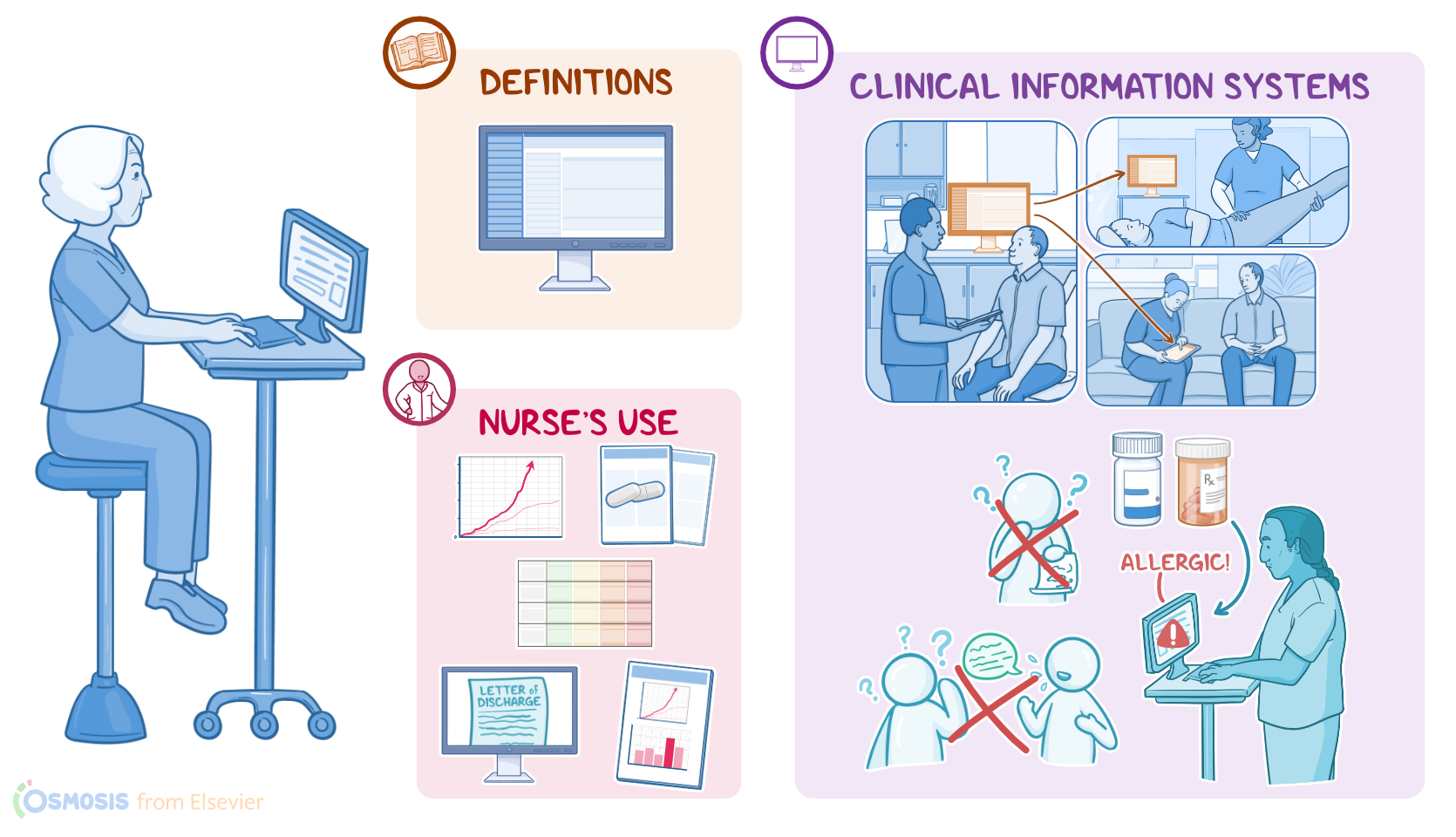
Okay, so healthcare informatics is a type of informatics used to support clinical decision making by using data to improve the safety and effectiveness of healthcare delivery.
An example of the use of healthcare informatics is the electronic health record, or EHR. EHR which is used by different members of the healthcare team to document, store, and view client data like client notes, vital signs, and medication.
Okay, so many facilities use a clinical information system, or CIS. A CIS is a large, computerized management system that allows for secure storage and retreival of client information, which is used by nurses and other healthcare team members to plan, implement, and evaluate care.
Clinical Information Systems1:25–3:17
A CIS facilitates timely and effective access to information which can enhance the quality of client care as well as improve workflow processes.
So, there can be many components to a CIS. The EHR for example, is a very common one.
An advantage of EHRs is the ability for different members of the healthcare teams to communicate with each other efficiently.
For example, if a client recovering from hip surgery is seen by their primary care provider, their EHR from the visit can be quickly accessed by their physical therapist and their home health care nurse on their computers.
In addition, the CIS allows for the indentification and analysis of trends in care such as rates of healthcare and aquired infections or falls, thereby providing data that can support necessary practice changes at the facility.Another widely used component of CIS is computerized provider order entry, or CPOE.
CPOE allows healthcare providers to enter prescriptions and orders directly into the EHR, which can reduce errors due to poor handwriting or misunderstood verbal orders.
CPOE allows nurses to safely acknowledge and confirm clinician orders while saving time. In addition, the CPOE can issue clinical alerts which prevent clinicians from making errors, such as indicating that a client is allergic to a medication when it’s being prescribed.
Finally, another component of CIS could be remote patient monitoring, which allows for use of software to track patient information such as blood pressure or ECGs for capturing heart arrhythmias.
How Nurses Use Informatics3:17–4:07
Now, for nurses, healthcare informatics can assist them in providing everyday care. Nurses can use informatics to track and trend client data, such as vital signs and assessments, as well as document and analyze incidents, like Nurse Amy’s medication error.
In addition, using a CIS allows nurses to automatically calculate client risk scores for events such as falls, alcohol withdrawl, and development of pressure injuries.
Nursing informatics can also be used to process, transform, mine, and evaluate data to answer clinical or research questions.
Nursing Informatics in Practice4:07–5:07
Nurse Kofi is taking care of Ms. Carol who has come to the emergency department for lightheadedness.
The unlicensed assistive personnel takes Ms. Carol’s blood pressure using a vital signs machine that is connected the CIS.
That blood pressure is automatically documented and time-stamped in Ms. Carol’s EHR.
When Nurse Kofi logs into the EHR, he is alerted that Ms. Carol’s blood pressure is low.
Through the CIS, Nurse Kofi is able to see that Ms. Carol started a new antihypertensive medication four days ago.
The physician determines that the lightheadedness was caused by low blood pressure from the new medication. He then discontinues the medication through the pharmacy system and sends a message to Ms.
Carol’s primary care physician. Once Ms.
Carol about ways to prevent falls and also sets a follow-up appointment with her primary care physician for the next day.
All right, as a quick recap… Healthcare informatics is used to support clinical decision making by using data to improve the safety and effectiveness of healthcare delivery.
Review5:07–5:45
A clinical information system, or CIS, is a computerized management system that allows for secure storage and retreival of client information, and can include a client’s electronic health record, or EHR; computerized provider order entry or CPOE, as well as remote patient monitoring.
| INFORMATICS | ||
| KEY POINTS | NOTES | |
| INTRODUCTION |
| |
| DEFINITION |
| |
| CLINICAL INFORMATION SYSTEMS (CIS) |
| |
| HOW NURSES USE INFORMATICS |
| |
No notes for this video yet
Try adding a note below