Intestinal obstruction: Nursing
Introduction0:00–0:15
Intestinal obstruction is when the normal flow of contents moving through the small or large intestine is interrupted, causing problems with nutrient and fluid absorption and waste elimination.
Physiology0:15–1:21
Okay, first, let’s recall the physiology of the intestinal tract. The small and large intestines are tube-shaped structures through which the partially digested food, fluid and air pass through.
After the intestines absorb the nutrients and fluid, the stool is formed and passed further until excreted.Let’s zoom into the wall of the intestine, which is made up of four layers.
The outermost layer is called serosa or adventitia, that faces the abdominal or peritoneal cavity. This is the space between the abdominal wall and abdominal organs that is lined with peritoneal membrane and contains a small amount of serous fluid.
Next is the muscular layer, which contracts to move food through the bowel, and this is called peristalsis. After that is the submucosa, which consists of a dense layer of tissue that contains blood vessels, lymphatics, and nerves.
And finally, there’s the innermost layer, called the mucosa, which contains the epithelial lining, facing the lumen, that enables nutrients and fluid absorption.The causes of bowel obstruction can be either mechanical or functional; and the latter is also called ileus.
Causes & risk factors1:21–4:06
Mechanical obstruction is caused by actual blockages in the small or large intestine, and it can be defined as partial or complete, as well as simple or strangulated.
Partial obstruction is when gas or liquid stool can pass through the point of narrowing, while with complete obstruction, nothing is able to pass through.
Now, there’s also simple mechanical obstruction, which is when the obstructed segment of the intestine maintains
Pathology4:06–6:16
Clinical manifestations6:16–8:14
Diagnosis8:14–9:17
Treatment9:17–10:43
Management and care10:43–12:37
Client and Family Education12:37–14:03
Review14:03–1:53
| INTESTINAL OBSTRUCTION | ||
| KEY POINTS | NOTES | |
| DEFINITION |
| |
| PHYSIOLOGY |
| |
| CAUSES AND RISK FACTORS |
| |
| PATHOPHYSIOLOGY |
| |
| SIGNS AND SYMPTOMS |
| |
| DIAGNOSIS |
| |
| TREATMENT |
| |
| MANAGEMENT OF CARE |
| |
| PATIENT AND FAMILY TEACHING |
| |
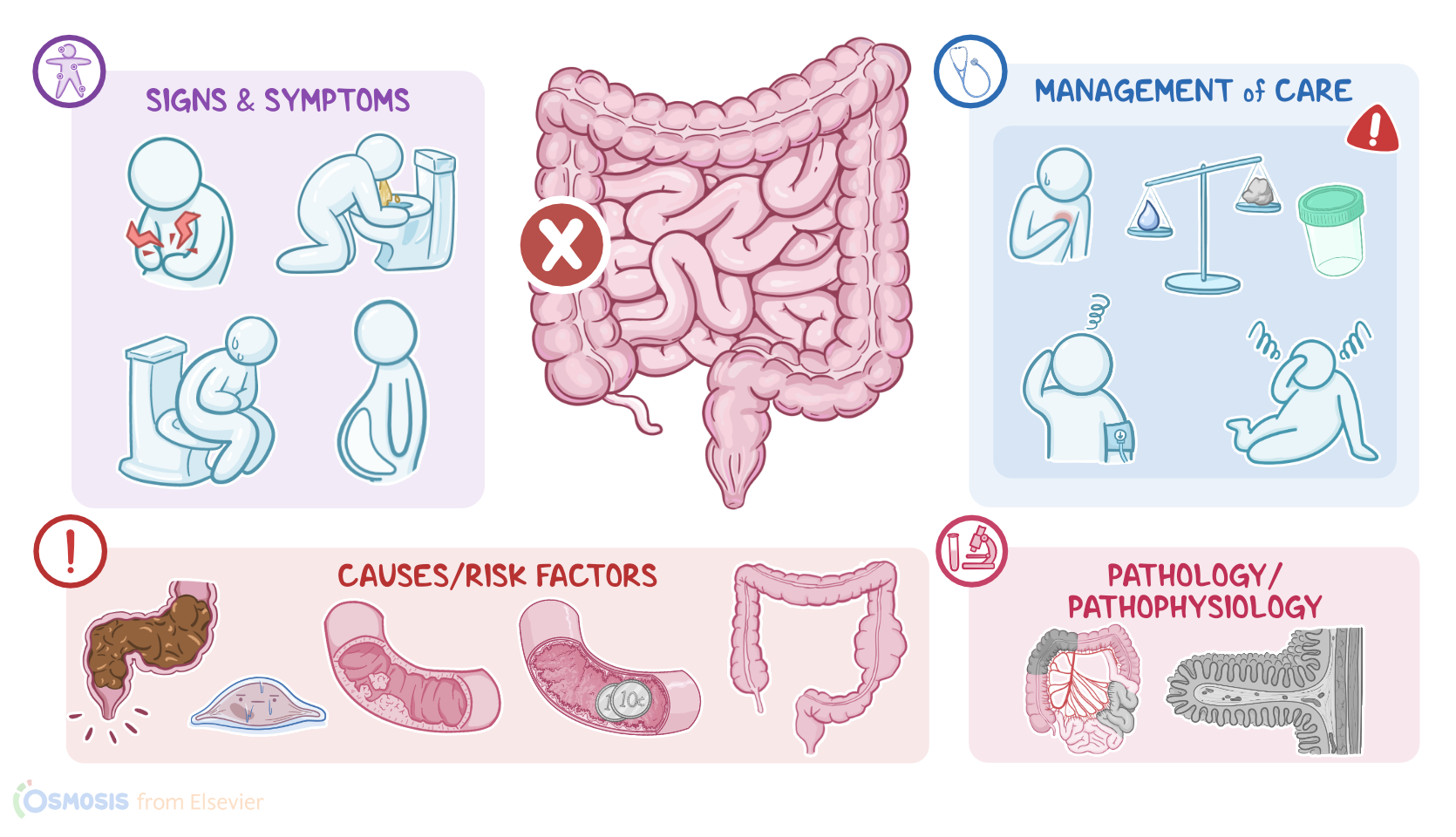
- "Lewis’s Medical-Surgical Nursing: Assessment and Management of Clinical Problems. 12th Edition. ISBN: 978-0-323-78961-5 " Elsevier (2023)
- "The Oncological Emergency of Intestinal Obstruction: ED recognition and Treatment Outcomes. 37(5):151207." Seminars in Oncology Nursing (2021)
- "Seidel’s guide to physical examination (10th ed). ISBN 9780323481953 " Elsevier (2023)
- "Lewis’s Medical-Surgical Nursing: Assessment and Management of Clinical Problems. 11th Edition. ISBN: 978-0-323-55149-6 " Mosby (2019)
- "Medical-Surgical Nursing: Concepts for Interprofessional Collaborative Care. 10th Edition. ISBN: 978-0-323-61242-5 " Elsevier (2020)
- "Prediction model for irreversible intestinal ischemia in strangulated bowel obstruction. 22(1), 321. " BMC surgery (2022)
- "Simultaneous occurrence of acute appendicitis and appendicular band syndrome in a patient with intestinal obstruction. 31:101637." Visual Journal of Emergency Medicine (2023)
No notes for this video yet
Try adding a note below