Medication administration - Safety principles: Nursing pharmacology
1,462views
Notes
| MEDICATION ADMINISTRATION - SAFETY PRINCIPLES | ||
| KEY POINTS | NOTES | |
| DEFINITION |
| |
| MEDICATION SAFETY RISKS |
| |
| SAFE MEDICATION ADMINISTRATION PRINCIPLES |
| |
| PATIENT TEACHING |
| |
Transcript
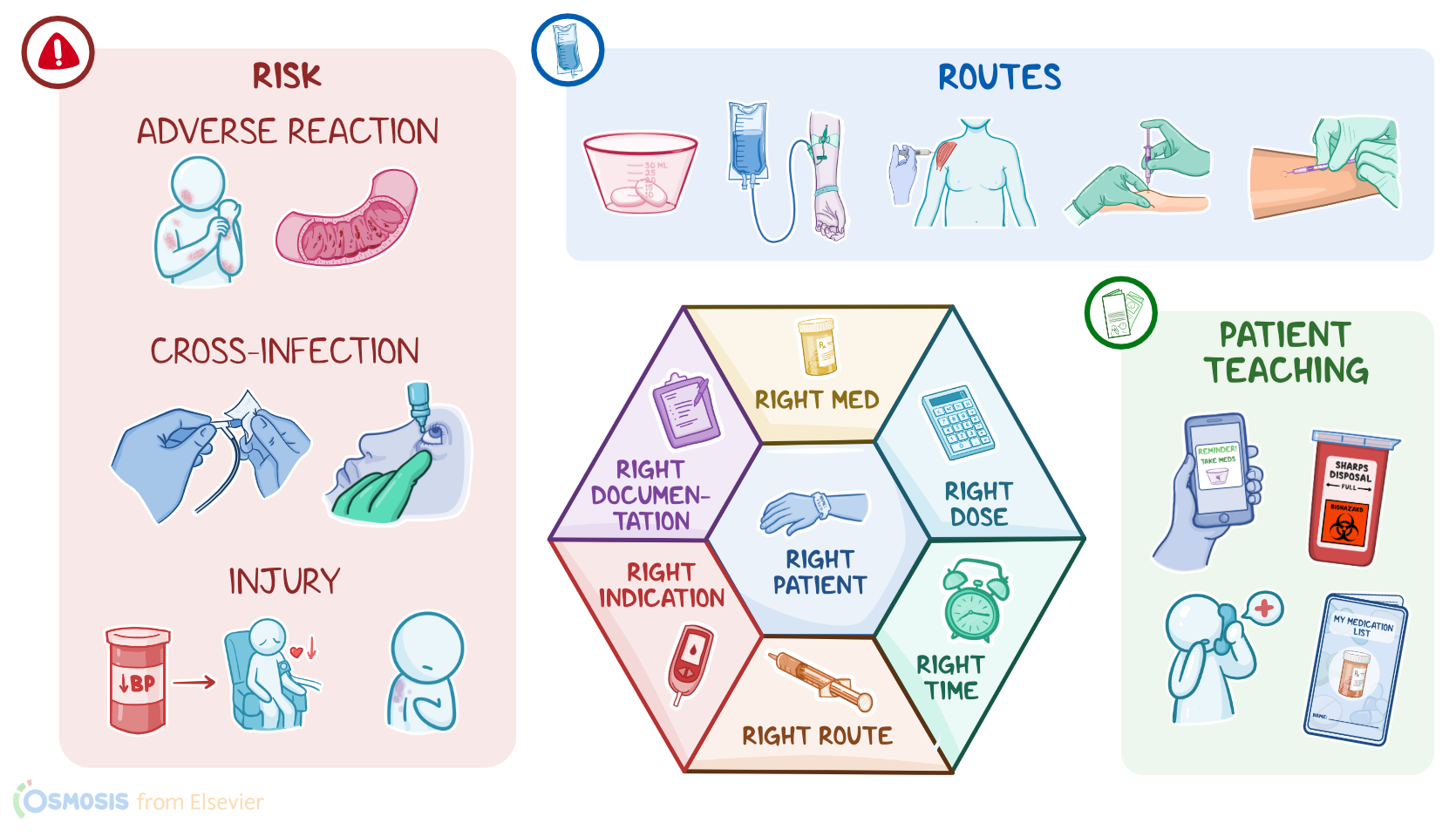
Medication administration is a complex process which involves the application of a prescribed medication to a patient. As the nurse, you must identify medication safety risks, follow safe administration principles, and evaluate your patient’s condition after administration.
Now, risks associated with medication administration include adverse medication reactions, cross-infection, or injury. Adverse reactions are unwanted effects that occur related to administration of a medication, which can be mild, like rash or nausea, or more severe, like kidney damage or GI bleeding.
Next, cross-infection is when organisms, like bacteria or viruses, are transferred to your patient during administration. This can occur when administering a medication through your patient’s IV without thoroughly cleaning the hub or when touching the tip of an eye dropper to your patient’s eye during administration.
Lastly, injury can occur to your patient when administering medications, like giving a hypertension medication to a patient who’s hypotensive or injecting a medication intramuscularly using incorrect technique, causing a hematoma or nerve injury.
Alright, so there are several different routes for medication administration. The most common routes are oral, also known as per os or PO; parenteral, which includes IV, intramuscular, or IM, subcutaneous; and intradermal. Other routes for medication administration include inhalation, sublingual, rectal, topical, otic, and ophthalmic.
Now, regardless of the route, prevent harm to your patient by following safe medication administration principles each time you administer a medication. The standard practice for safe medication administration involves adhering to the rights of medication administration, which include the: right patient, right medication, right dose, right time, right route, right indication, and right documentation. It’s important to note that there might be additional rights and you should follow the protocol outlined by your institution.
Right patient means you're giving the correct medication to the correct patient. You can verify this by using at least two patient identifiers prior to administration, like having the patient state their full name and date of birth while simultaneously verifying the information against the medication administration record, or MAR.
Sources
- "Fundamentals of nursing (11th ed.)" Elsevier (2023)
- "Fundamentals of nursing (10th ed.)" Elsevier (2021)
- "Fundamentals of nursing: Active learning for collaborative practice. (3rd ed.)" Elsevier (2022)
- "Fundamentals of nursing: Active learning for collaborative practice. (3rd ed.)" Elsevier (2022)