Medication orders: Nursing pharmacology
Introduction0:00–0:42
Medication orders are used to communicate which medications to administer to patients and are obtained from the health care provider in the form of written, electronic, or verbal orders.
Written and electronic orders are entered directly by the health care provider, whereas verbal orders can be taken in-person or over the phone in certain situations, transcribed by the nurse, and then signed by the health care provider within a certain timeframe.
All medication orders will include the date and time the order was made; the name of the medication; its dosage strength, route, and frequency; as well as the signature of the provider.
As the nurse, you’ll provide safe medication administration by correctly interpreting medication orders. Start by ensuring all the elements of the order are provided.
Medication Order Interpretation0:42–4:10
If the order is unclear or if there’s missing information, you’ll clarify it with the health care provider. If the order is handwritten, ensure that it’s legible.
Importantly, be sure the order only uses approved abbreviations, since unapproved abbreviations can lead to medication errors.
For example, the unapproved abbreviation QD is intended to mean “daily” but could be mistaken for the approved abbreviation QID, meaning “four times a day.” Instead, “daily” should be written out.
Finally, be sure you know which medications and dosages are safe for your patient, so you can identify and clarify any concerns with the health care provider.
Okay, let’s interpret a handwritten medication order to ensure all the elements are provided. You see the date and time the order was written, followed by the medication name, ondansetron.
The dosage strength is 4 mg, the route is IV, and the frequency is every 8 hours. Finally, it’s signed by the prescribing health care provider.
Since all the required elements are present and clearly communicated in the medication order, you can begin the medication administration process.
Let's look at another handwritten medication order. You see the date and time of the order, followed by the medication name, lorazepam.
The dosage strength is 2 mg, and the route is PO. However, this order is missing an important piece of information: the frequency.
It’s unclear if the health care provider intended this medication to be a one-time dose or be repeated. In this case, you’d need to contact the health care provider and clarify the frequency before administering the medication.
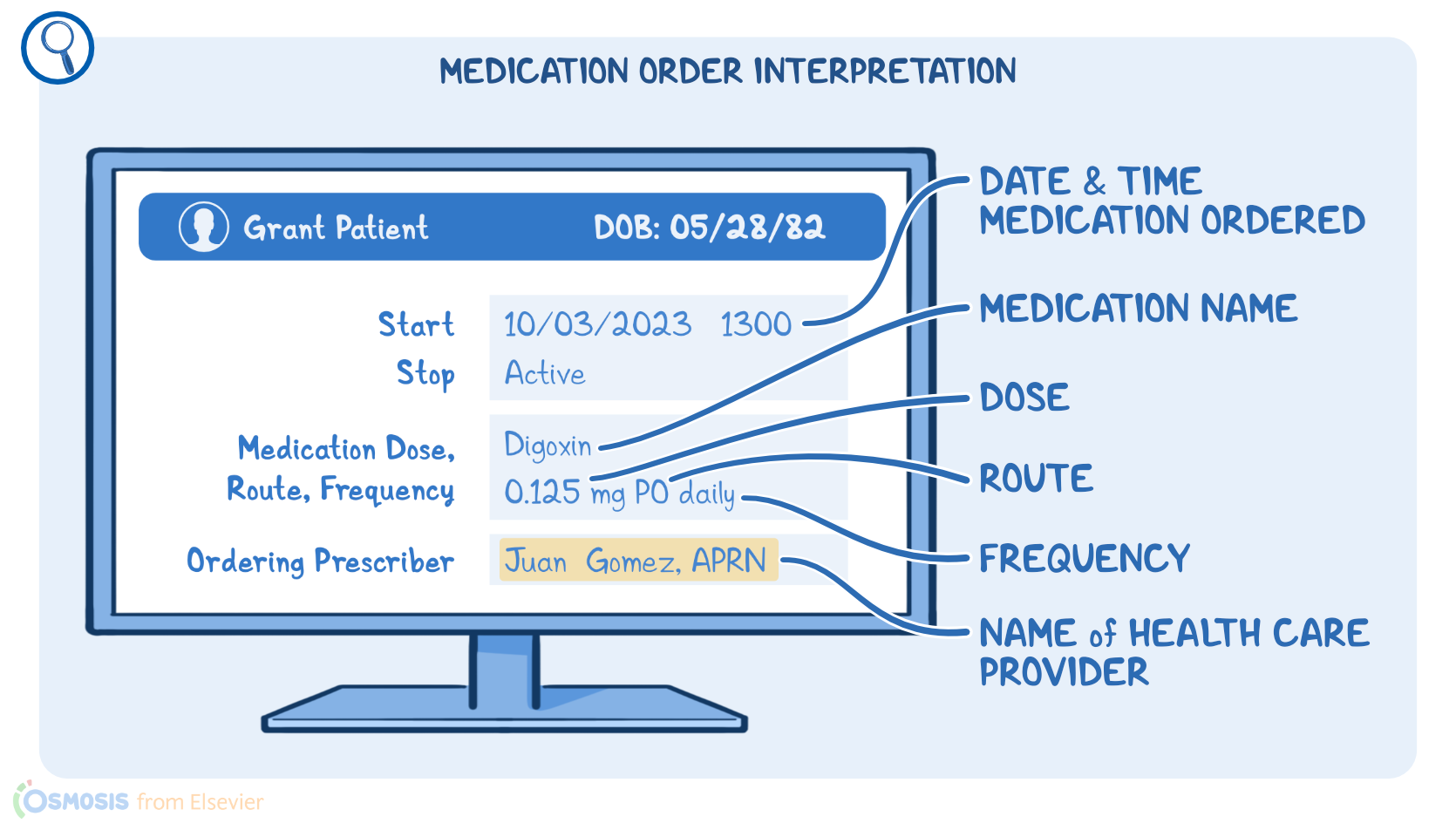
Now let’s review an electronic medication order from a computerized prescriber order system, or CPOS. On the screen, you’ll see the date and time the medication was ordered.
You might also see the date and time when the medication should be discontinued or the word “active”, indicating the health care provider intends the medication to be continued.
The ordered medication here lists the medication name, digoxin, followed by the dose of 0.125 mg, the route of PO, and the frequency of daily.
Finally, the name of the health care provider who electronically signed the order is listed. Given that all the required elements are present and clearly communicated in the medication order, you can begin the medication administration process.
Okay, so let’s look at one more electronic medication order. You’ll again see the date and time the medication was ordered and the word active meaning it's a current order.
The medication name of ampicillin is listed, followed by the dose of 2 grams, and the frequency of q6h, or every six hours.
However, this order is missing the medication route, so it’s incomplete. In this case, you’ll need to contact the health care provider to clarify the route before administering the medication.
Alright, as a quick recap...Medication orders are used to communicate which medications to administer to patients and are obtained from the health care provider in the form of written, electronic, or verbal orders.
Review4:10–4:40
Complete medication orders provide the date and time the order was made; the name of the medication, the dosage strength, route, and frequency of the medication; and the signature of the health care provider.
The nurse will interpret medication orders correctly to perform safe
| MEDICATION ORDERS | ||
| KEY POINTS | NOTES | |
| DEFINITION |
| |
| MEDICATION ORDER INTERPRETATION |
| |
- "Calculate with confidence. (8th ed.)" Elsevier (2022)
- "Calculation of drug dosages: A work text. (12th ed.)" Elsevier (2023)
- "Clinical calculations: With applications to general and specialty areas. (10th ed.)" Elsevier (2022)
- "Gray Morris's calculate with confidence, Canadian edition. (2nd ed.)" Elsevier (2022)
- "Mulholland's: The nurse, the math, the meds. (5th ed.)" Elsevier (2023)
No notes for this video yet
Try adding a note below