Public health nursing: Nursing
Introduction0:00–0:48
Often when someone thinks of a nurse, they picture settings like hospitals and clinics. However, nursing care is just as important in other settings like with public health nursing, community-based nursing, and home health nursing.
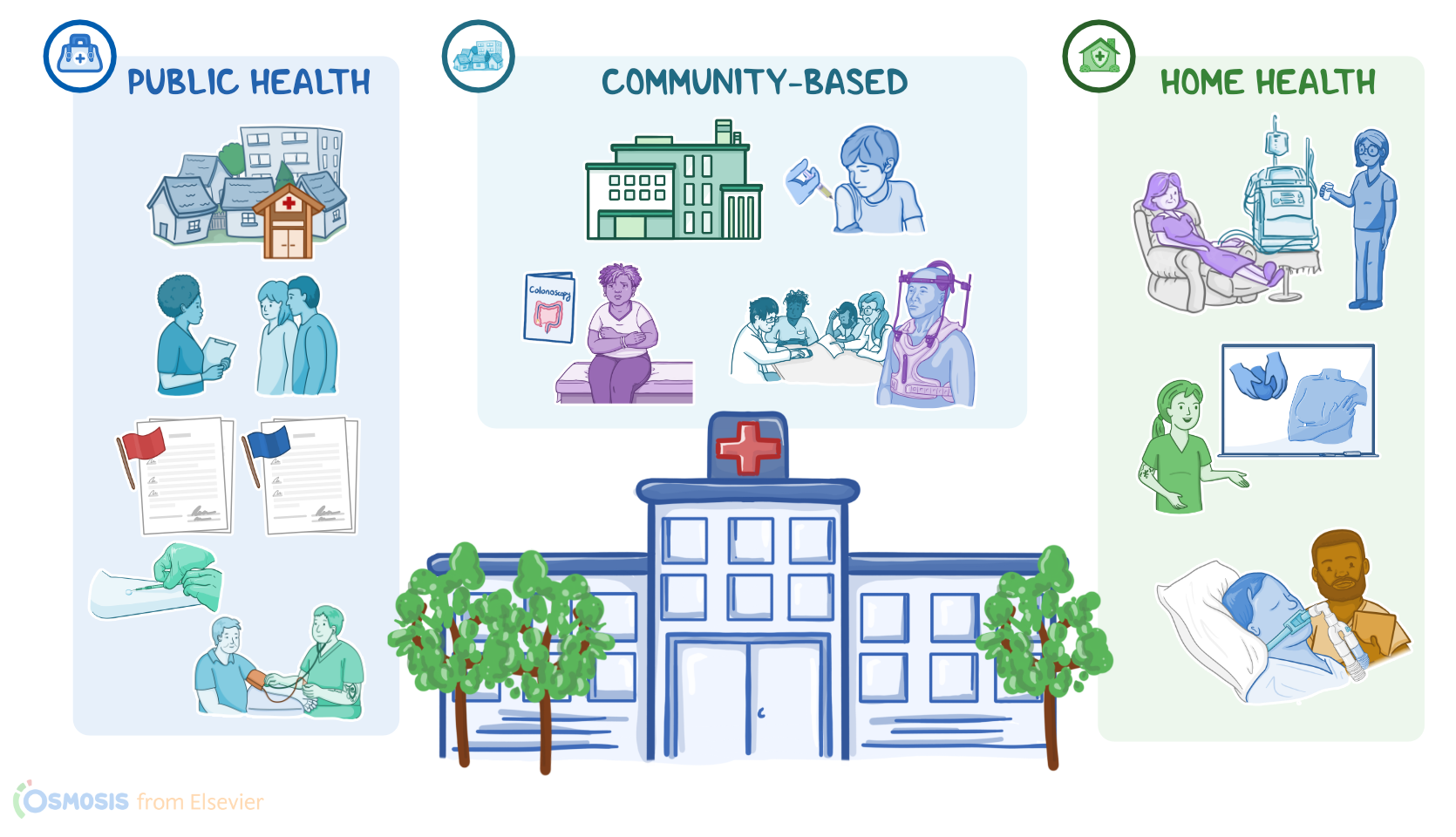
Each of these nursing specialties promote health by using primary prevention, which is aimed at minimizing the chance of developing an illness by reducing modifiable risk factors; secondary prevention, which involves screening for an illness in its early stages, before a patient develops signs and symptoms; and tertiary prevention, which is focused on slowing disease progression, preventing complications, and promoting optimal functioning.Now, the goal of public health nursing involves preventing disease and promoting health at three population levels: the individual and family level, directed at providing care for a patient and their support system; the community level, which encompasses a specific population, such as students living on a college campus or vulnerable populations like patients with developmental disabilities; and the system level, where care is directed at influencing the overarching systems that impact health, like healthcare policy.Now, the goal of public health nursing involves preventing disease and promoting health at three population levels: the individual and family level, directed at providing care for a patient and their support system; the community level, which encompasses a specific population, such as students living on a college campus or vulnerable populations like patients with developmental disabilities; and the system level, where care is directed at influencing the overarching systems that impact health, like healthcare policy.These functions help public health nurses focus care on primary prevention of illness within a population.
Public health nursing0:48–2:12
Public health nursing also has roles in secondary prevention, such as providing screenings for tuberculosis, and tertiary prevention, like running a foot care clinic for patients diagnosed with diabetes mellitus.
Next, community-based nursing is a branch of public health nursing where nurses manage acute and chronic conditions within the community, where individuals live, work, play, and worship.Like public health nurses, community-based nurses have a multifaceted role that is shaped by the needs of the community.
Community based nursing2:12–3:31
The community-based nurse can determine these needs by conducting a community assessment, like using a windshield survey to make observations by driving or walking around the community.
For example, the nurse can determine a community’s access to healthy foods by observing that for every one grocery store, there are four fast-food restaurants, or that the local grocery store isn’t easily accessible using public transportation.
The nurse can also assess the community by interviewing community members and stakeholders to identify community needs.Now, community-based nurses also provide care to patients at all three levels of prevention.
At the primary prevention level, they can encourage childhood immunizations; at the secondary prevention level, they can promote colonoscopy screenings for individuals aged 45 and older; and at the tertiary prevention level, they can support optimal functioning for a patient with a spinal cord injury by collaborating with physical and occupational therapists.Nursing that takes place in a patient’s home is known as home health nursing.
Home health nursing3:31–4:18
The goal of home health nursing is to optimize quality of life and functioning for patients who are at all stages of health and illness.Services provided by home health nurses are comprehensive and address the patient’s specific needs at all levels of prevention.
They provide care at the primary prevention level by helping patients remain up to date on vaccinations. As for secondary prevention, the home health nurse may teach a patient how to perform a testicular or breast self-exam to screen for possible cancerous lumps.
Lastly, they provide care at the tertiary level of prevention by providing direct care to patients, such as patients who use specialized equipment like ventilators or tube feedings.
Alright, as a quick recap.... In addition to hospitals and clinics, nursing care takes place in many other settings like in public health nursing, community-based nursing, and home health nursing.
Review4:18–5:01
Public health nursing involves preventing disease and promoting health at the individual and family level, the community level, and the system level.
Next, community-based nursing is a branch of public health nursing where nurses manage acute and chronic conditions within the community, where individuals live, work, play, and worship.
Then, there’s home health nursing, which focuses on providing care for patients in their home. Each of these nursing specialties promote health by using primary,
| PUBLIC HEALTH NURSING | ||
| KEY POINTS | NOTES | |
| DEFINITION |
| |
| PUBLIC HEALTH NURSING |
| |
| COMMUNITY BASED NURSING |
| |
| HOME HEALTH NURSING |
| |
- "Fundamentals of nursing (11th ed.)" Elsevier (2023)
- "Fundamentals of nursing (10th ed.)" Elsevier (2021)
- "Fundamentals of nursing: Active learning for collaborative practice. (3rd ed.)" Elsevier (2022)
- "Fundamentals of nursing: Active learning for collaborative practice. (3rd ed.)" Elsevier (2022)
No notes for this video yet
Try adding a note below