Research - Conducting a literature review: Nursing
Introduction0:00–0:47
Nurse Marin works in a cardiac catheterization lab. Last week, a client experienced a major bleed from the puncture site after leaving the cath lab.
This is the third bleeding event in the past month. Nurse Robin, who also works in the lab, asks “I wonder if there is something we can do differently to prevent bleeding in this client population?” Nurse Marin agrees and proposes that the healthcare team begin a quality improvement study on how to prevent bleeding in the post-catheterization period.
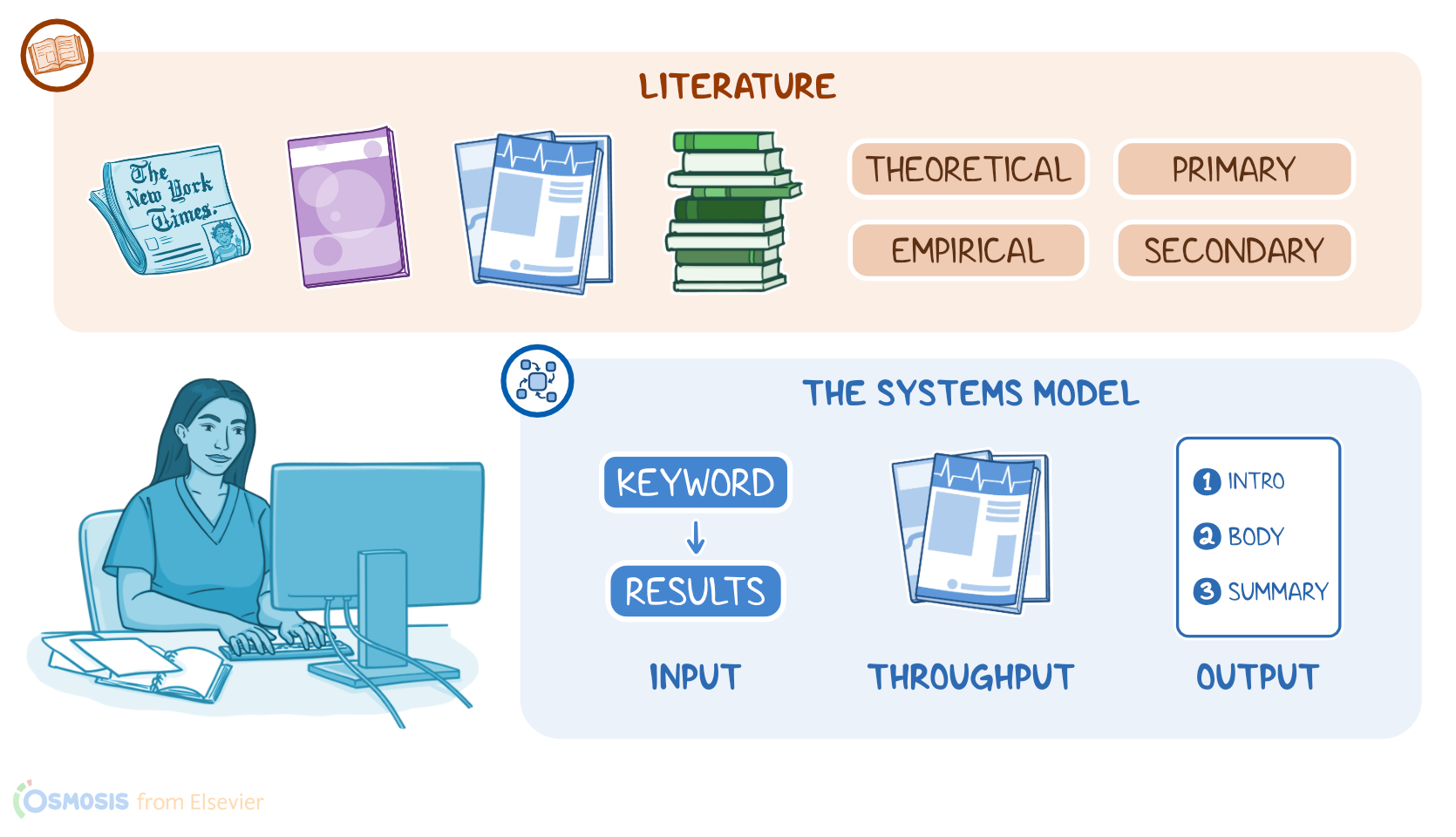
As a first step in this research study, Nurse Marin will perform a literature review to learn more about best practice in the post-catheterization client.Literature is any written document like a newspaper, magazine, scientific journal, or book.
Defining the Literature Review0:47–1:16
A literature review is done when a researcher wants to compile all of the literature that currently exists on a topic to answer a research question or problem.
This is sometimes called the ‘state of the science.” A literature review is often done as one of the first steps of a research study or it can be published alone as a summary of what is known about a topic.Now, literature can be classified in a few different ways.
Types of Literature1:16–2:54
First, you can categorize literature as either theoretical or empirical. Theoretical literature discusses the application of a theory to practice.
Types of literature that fall into this category are theories and theoretical models. Nurse Marin finds a source that describes how the Theory of Self-Care could be applied in the post-catheterization period.
Empirical literature, on the other hand, includes sources that use direct or indirect observation, like quantitative and qualitative research.
Nurse Marin finds an example of empirical literature when she comes across a quantitative research study showing that clients on anticoagulants during pre-cardiac catheterization were more likely to have post-catheterization bleeding.Next, literature sources are categorized as either primary or secondary.
Primary literature is original research presented by the researchers, like an experimental study. Secondary literature is an interpretation or analysis of a primary source, like a meta analysis that reviews multiple studies to form a single conclusion.
. One primary source Nurse Marin finds is a quantitative research study which measures the incidence of bleeding in clients who received heparin in the post-catheterization period.
A secondary source that she found was a published literature review comparing risk of post-catheterization bleeding between five of the most commonly used anticoagulant medications.When you’re getting started with your literature review, The Systems Model is a helpful tool to guide you through the process.
Stages of a Literature Review2:54–3:07
In The Systems Model, there are three stages: input, throughput, and output. During the input stage, you complete your literature search, which is an organized search to identify sources that are relevant to your topic.
Input3:07–5:46
The highest quality research can be found in databases, which are collections of literature, typically grouped by discipline, like medicine or education.
The Cumulative Index to Nursing and Allied Health Literature, called CINAHL, is a commonly used database with a nursing focus.
When conducting a large literature search, you can use keywords related to your topic, but this could deliver an overwhelming number of sources.
So, it’s useful to narrow down your search with Boolean operators which are words like “and”, “or”, and “not” that link keywords.
The word “and” will get you a smaller number of search results since both of the keywords must be present. Using “or”, on the other hand, will increase your search results because either word could be present to show up in your results.
Lastly, “not” will eliminate literature that you don’t want.So, when Nurse Marin is conducting her literature search, she uses the keyword “cardiac catheterization” which generates over 10,000 results!
As she skimms the results, she notices that some of the sources also use the key word “heart catheterization.” Nurse Marin doesn’t want to miss any of the relevant sources for her literature review so she utilizes the Boolean operator “or.” Now she searches for “cardiac catheterization OR heart catheterization” and gets 10,800 results.
Nurse Marin sees that many of these sources do not even address bleeding so she changes her results to: cardiac catheterization OR heart catheterization AND bleeding.
Now she is down to 1,000 results which are more closely related to her topic. Another technique is to identify search filters.
Filters are criteria you can set within an electronic search engine to eliminate sources that do not meet your criteria.
Now Nurse Marin has 1,000 potential sources and that is still too many to sort through, so she decides to apply a search filter so that only literature from the past five years will appear in her search.
This brings her number of sources down to 300.As you conduct your search, it is important to keep a record of the different search engines, key words, key phrases, and filters used to generate your results since this information is usually reported when literature findings are shared.
Once the literature search is done, you will move to the throughput stage. In this stage, you will check to make sure the literature you found is high-quality and relevant to your topic.Using inclusion criteria can help you when deciding if sources are relevant.
Throughput5:46–6:37
Inclusion criteria are specific characteristics of a source that make it meaningful to include. Nurse Marin’s inclusion criteria are studies that address anticoagulant side effects post-cardiac catheterization and were conducted in North America.
When she takes her 300 sources and begins to review each one against her inclusion criteria, she eliminates 150 sources because the studies were not conducted in North America and another 100 sources because they discussed anticoagulant side effects during the procedure, not after.
Now, she is left with 50 studies that meet her inclusion criteria.The last stage of conducting a literature review is output.
Output6:37–8:19
Output is when you are compiling the information from your identified sources into a written summary. When writing your literature review, the paper will have three main sections: an introduction, a body, and a summary.
Let’s check in on Nurse Marin who’s writing her summary. First, she writes her introduction where she explains her purpose for completing the literature review which was to find the best method for preventing bleeding in the post-cardiac catheterization period in preparation for a research study.
In her introduction, she describes the process she used to identify the sources. This helps the reader understand how her information was obtained, like how sources were eliminated if they were more than 5 years old.
Finally, she will summarize the current “state of the science” based on what she has learned from completing the literature review.
In her summary, Nurse Marin concludes that reassessing the catheterization site every hour has the most evidentiary support to prevent significant bleeding, but there is promising evidence that suggests the type of dressing used may also impact bleeding.
Review8:19–9:27
Literature is any written document, like a newspaper, magazine, scientific journal, or book. Sometimes, pieces of literature are referred to as sources.
There are different ways to classify literature. First there is theoretical literature that discusses the application of theory.
This is different from empirical literature which discusses knowledge gained from direct or indirect observation like quantitative and qualitative research.
There are also primary and secondary sources. A primary source is written by the person who directly created the knowledge while a secondary source is written by someone who is summarizing another person’s ideas or work.
When it comes to the literature review process, the Systems Model can serve as a helpful guide with three stages. During the input stage, you are collecting sources relevant to your topic.
Next in the throughput stage, you are evaluating the quality and relevance of the identified sources. Finally, in the output stage, you are writing a summary of what you have discovered or the
| CONDUCTING A LITERATURE REVIEW | ||
| KEY POINTS | NOTES | |
| INTRODUCTION |
| |
| DEFINITIONS |
| |
| TYPES OF LITERATURE |
| |
| STAGES |
| |
No notes for this video yet
Try adding a note below