Research - Critical appraisal: Nursing
Introduction0:00–0:41
Nurse Greg works in an oncology unit where several clients have asked him about the connection between diet and cancer. He’s been working with a dietician who told him that she has seen great results in reducing incidence rates of hypertension and diabetes in clients who follow a plant-based diet.This gives Nurse Greg an idea.
He wonders, “Will a plant-based diet also be effective in reducing incidence rates of cancer?” He decides to review the literature to better understand how plant-based diets affect cancer rates.
He completes a literature search and is now moving on to the next step which is critical appraisal of the literature. A literature review is when a researcher compiles all of the literature that currently exists on a topic.
Critical appraisal0:41–1:15
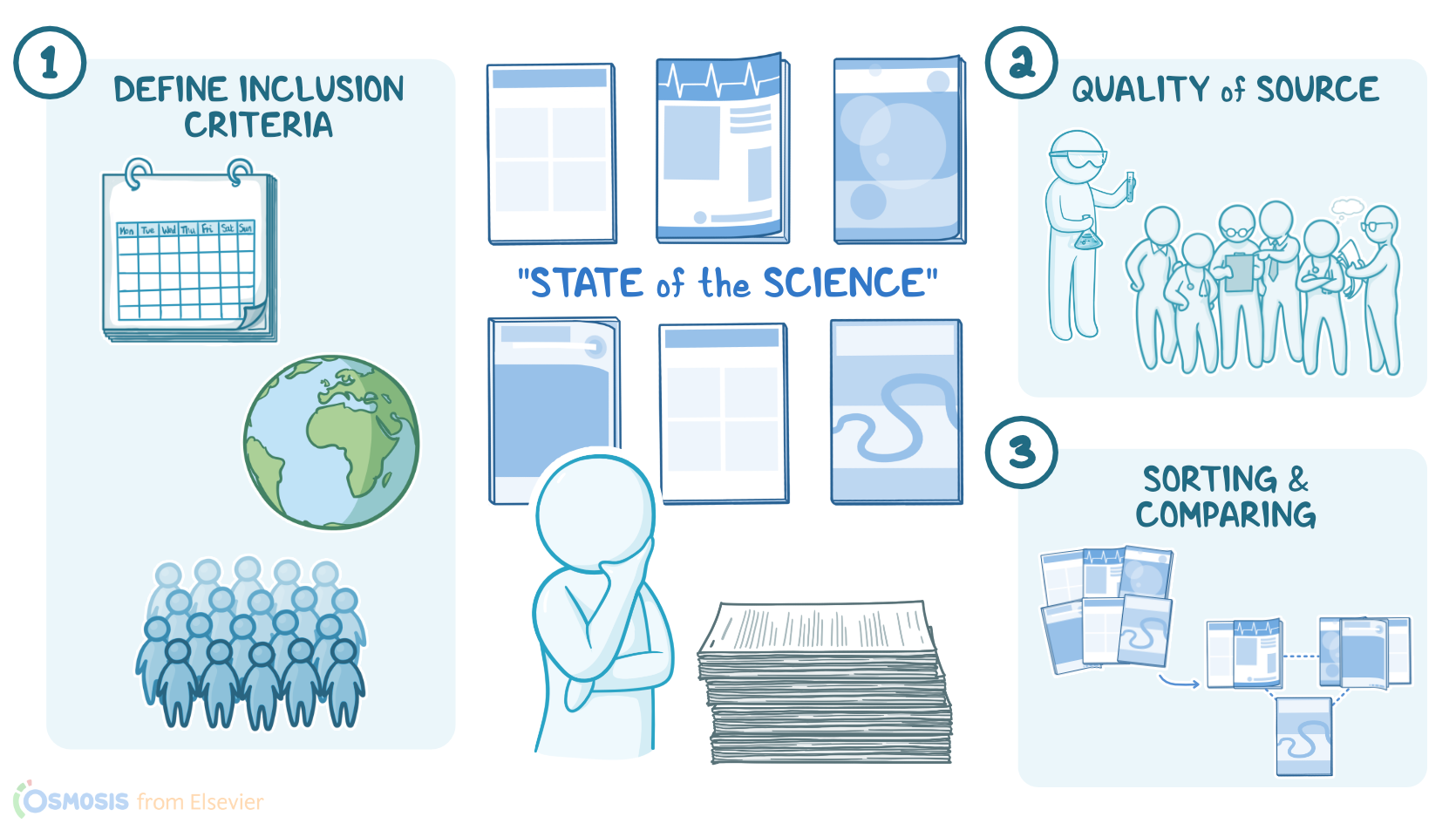
This is sometimes called the “state of the science.” Once the literature search is complete, the researcher must critically appraise each of the sources.
This is an organized, step-by-step process that evaluates each source using standardized criteria. It is an important step in research because it helps the researcher understand what is known about a topic and if that information is reliable.
To do a critical appraisal, the researcher will choose criteria to judge both the content and quality of each source. First comes appraising for content, also known as inclusion criteria, which includes things like topic, year of publication, or even the type of source.
Critically Appraising for Content1:15–2:11
Usually, the researcher will exclude sources that do not meet their inclusion criteria before analyzing the sources for quality.
This saves time, because eliminating sources means there are less to evaluate for quality later. For example, Nurse Greg found 100 sources about plant-based diets and cancer during his search so he needs to determine if those sources match the criteria of what he is studying.
He decided to exclude all sources older than five years because the data they contain might be outdated. That leaves him with 50 sources.
Then, he excluded any source that did not originate from his geographical area of South America because other geographical locations may have different plant-based sources available to them.
So now, after applying his inclusion criteria, Nurse Greg is left with 25 sources.After applying the content criteria, the researcher should begin to assess criteria related to quality.
Critically Appraising for Quality2:11–6:56
The quality of the source helps to determine if the steps in the research process were followed, if the research plan was rigorous, if there were no significant study limitations, and if the findings were statistically significant.
One way to evaluate the quality of a source is to check if it is peer-reviewed. If a source is peer-reviewed, it means that experts in the field have evaluated the study and determined it is accurate and meets professional standards of research.
Additionally, to help in the quality review process, the researcher can ask themselves some key questions when appraising a source: First, “Is this source complete?” “Does it contain all of the major elements of a study like the hypothesis, research method, sampling method, sample size, and research design, strength, limitation, and results section?” “If so, is each section presented clearly?” If the researcher comes across an incomplete source, it may mean that the study has poor scientific merit or that the findings of the study cannot be used broadly.Next, “Does this source build on previous research?” This helps the researcher figure out if the source is consistent with the most up-to-date research and evidence.
For example, Nurse Greg finds a source explaining how clients who consumed a plant-based diet had a decreased incidence of colon cancer using fecal occult blood testing as an indicator; but, Nurse Greg knows the current standard for colon cancer screening is colonoscopy.
Since the study is not making recommendations consistent with best practice, he can reasonably determine that the source is inconsistent with current research and practice.Then, the researcher could ask, “What are the weaknesses of the source?” and “Could the weakness have been avoided?” If the researcher identifies limitations that were not acknowledged in the article, like when the data collection process was disrupted for some reason, it may indicate that the study quality is poor.
Nurse Greg discovered a study on how plant-based diets reduce the incidence of ovarian cancer. When appraising the study, he found that the researcher’s original recruitment plan was disrupted by Covid-19 but instead of devising a new plan to recruit subjects, they decided to proceed with only 20 out of the original 50 participants.
Although there was an acknowledgment that this limitation might have impacted the study results, Nurse Greg decided not to include the study in his literature review due to the study’s data collection process.
Also, “Do the findings of this source appear to be credible?” Credibility can be determined by a number of factors like study methodology, sampling tactics, statistical significance, or even who funded the study.
Usually, if a study is being funded by an organization, this information is disclosed in the article to avoid questions of credibility.
Statistical significance means that mathematically, the findings of a study represent a true relationship rather than coincidence.
When considering credibility, Nurse Greg decides not to include a source in his literature review that endorses the use of a new plant-based supplement because the study was funded by the supplement manufacturer.Next, “What populations can I apply the findings to?” This can be determined by looking at the target population described in the study and then comparing it to the study sample.
If a source has a small sample size or lacks diversity within the sample, it may not be applicable to a larger population.
So, Nurse Greg finds a study that has a target population of clients with lung cancer, but has a sample that is 95% Caucasian clients over 65 years of age.
Therefore, the findings of that study may not be applicable to younger, more ethnically diverse clients with lung cancer.
Finally, the researcher could ask, “Did the source discuss how their findings might contribute to future practice?” This helps the researcher to understand how the findings of a study apply or impact client care.
A study may have significant findings but be so abstract that it does not have a meaningful use in care. Nurse Greg finds a research article that suggests clients with a home garden are less likely to develop brain cancer but the article doesn’t really explain why or how.
Nurse Greg might assume that it is because they are more likely to consume a plant-based diet but the researcher does not state that conclusion so, it becomes more difficult to apply the study to client care recommendations.So, after Nurse Greg critically appraised each of his 25 sources for quality, he found that 10 of them did not have statistically significant findings, another 5 had very small sample sizes, and 3 described limitations that could have altered the study outcomes.
Now, Nurse Greg is left with 7 sources for his literature review.Sorting and Comparing is the final step of critical appraisal.
Sorting and Comparing6:56–7:52
When sorting and comparing, the researcher will take the remaining articles from the literature search and sort them according to topic or theme.
That makes it easier to compare and contrast the findings. Once that is done, the researcher can identify what is known about the topic and identify potential gaps that exist in the literature.
Back to Nurse Greg. When sorting his 7 sources, he finds 3 sources that talk about how a plant-based diet high in fiber is linked to reduced rates of cancer.
Since they have similar findings, he groups them together. When comparing these 3 sources, he discovers that they all used food as the only source of fiber and none of the sources discussed the use of fiber supplements.
He determines that since there is a relationship between fiber and reduced cancer rates, and no studies looked at the role of fiber supplementation, this may be a gap to address with future research.
Alright, as a quick recap… A literature review is when the researcher compiles all of the literature that currently exists on a topic.
Review7:52–9:14
This is sometimes called the ‘state of the science’. The first step of the literature review is the literature search.
The literature search is an organized search of existing literature. Critical appraisal of research is a step-by-step process that evaluates a study using standardized criteria.
It is an important step in the research process because it establishes the reliability of what is known on a subject. The criteria can apply to the content or quality of the source.
First, the researcher will define their inclusion criteria which are characteristics the source must have to be included in the final review of the literature.
These criteria can be things like year of publication, country of origin, or the study population. The quality of the source determines that the scientific method was followed, the research plan was rigorous, there were no significant study limitations, and the findings were statistically significant.
Peer-review means other experts in the field have evaluated the study and determined that it is accurate and meets the professional standard of research.
This is another way to evaluate the quality of a source. The final step is sorting and comparing, when the researcher will take the identified articles and sort them according to topic or theme.
When sources are sorted it is easier to compare and
| CRITICAL APPRAISAL | ||
| KEY POINTS | NOTES | |
| INTRODUCTION |
| |
| CRITICAL APPRAISAL |
| |
No notes for this video yet
Try adding a note below