Research - Data collection: Nursing
Introduction0:00–0:57
I’d be happy to assist you in the data collection process!” Nurse Jenna and Nurse Chad plan to measure stress levels in a sample of clients scheduled for MRIs, CT scans, and X-rays at their hospital by collecting interview data as well as biological data through measuring cortisol levels in the participant’s saliva.
They will use what they know about data collection to gather both types of information.Okay, so research is a systematic process of validating, refining, and generating knowledge.
Defining Data and Data Collection0:57–2:16
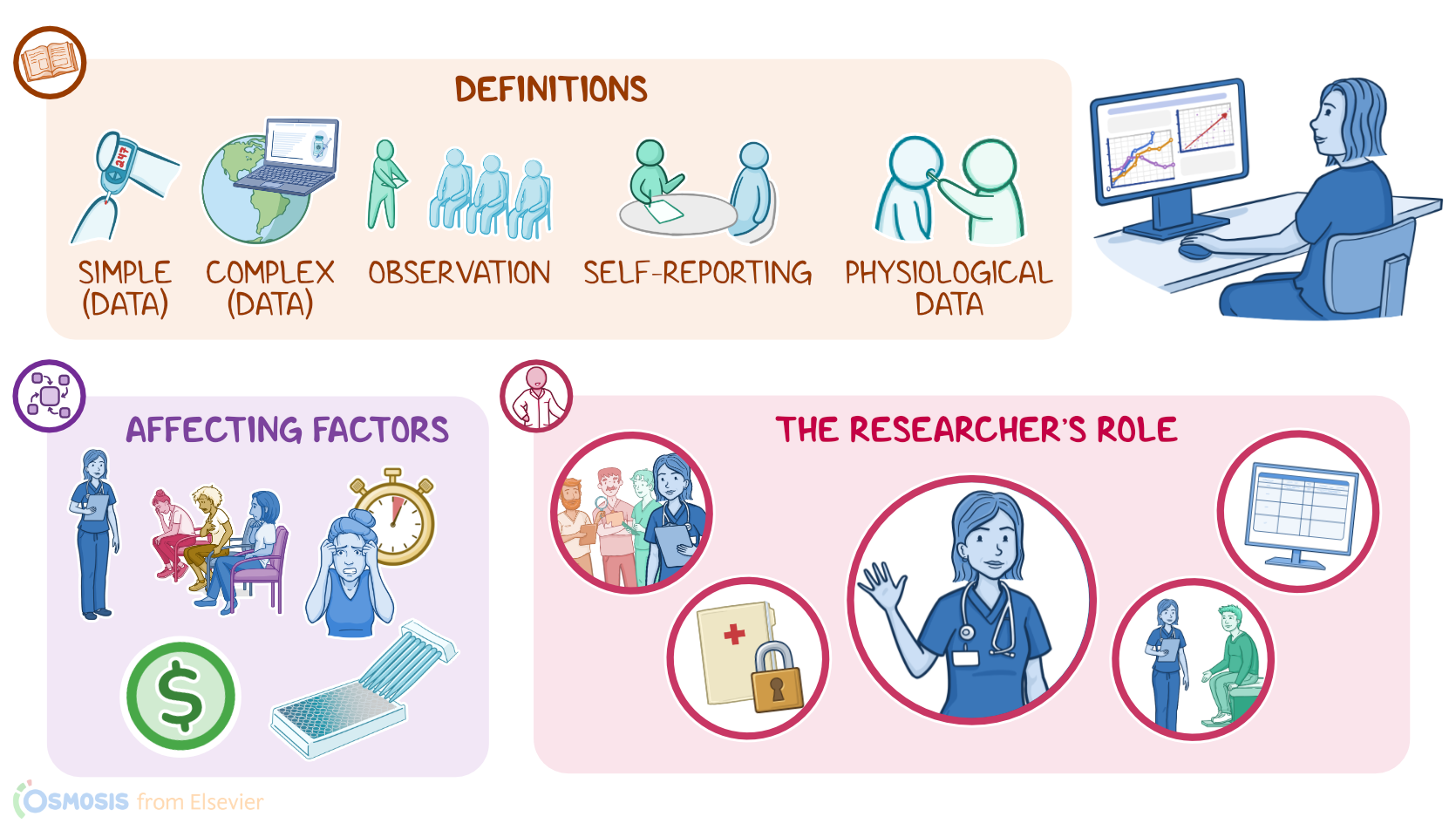
Data can be as simple as a single blood glucose level to determine an insulin dose for a client, or as complex as international vaccine statistics to guide vaccination education campaigns.
In addition to informing practice, data is also important in research. In research, data collection is done by systematically gathering data to be used to answer a research question and advance knowledge around a specific topic.
Alright, several factors can affect data collection, such as bias, time, cost, and instrument. These are important for researchers to consider since they can impact the accuracy of research findings.Bias refers to an error that causes data to become distorted, causing the results to be altered..
Factors Affecting Data Collection2:16–5:16
It can also happen unintentionally when a researcher asks a question which influences the responses of the participants.
For example, if Nurse Jenna asked participants, “Don’t you think that MRIs are a very stressful experience?” This question would introduce bias into the study since it could lead the participants to answer a question in a particular way.
Instead, to eliminate bias, Nurse Jenna could say, “Tell me your thoughts about having an MRI.”Time also affects data collection because data can change depending on the time period when it was collected.
Cost is another factor that researchers need to consider when planning to collect research data. For example, in some studies the researcher will want to compensate participants for their time by providing compensation, such as a gift card or a voucher; this may require prior approval from the institution funding the research.
Another cost consideration is that a piece of equipment or software may need to be purchased in order to collect or analyze the data, such as a scale or statistical software.
It’s up to the researcher to make sure that the research budget accounts for such purchases before data collection begins.The reliability and validity of the instrument that the researcher selects to collect data are other factors that can affect data collection.
Reliability is about the instrument’s consistency of measurement. For example, the laboratory tool used to measure a participant’s cortisol levels should give the researcher very similar results if the participant’s cortisol is tested once and then again five minutes later.
If the instrument is not calibrated correctly, it can provide unreliable data. The researcher should also make sure the instrument is valid, meaning that it accurately measures what it is intended to measure.
The Researchers Role in Data Collection5:16–6:29
The first role is that of a data collector like Nurse Jenna, who interviews participants and takes saliva samples herself.
But in some studies that are large or take place in multiple locations, there will be others who assist in collecting the data.
In this case, the nurse’s role is to act as a manager and work with others on the research team to oversee the data collection using a data collection plan.
This is a template that helps to standardize the process for data collection. In Nurse Jenna’s case, a data collection plan would include directions on how to collect saliva and an interview guide which specifies the questions participants should be asked.
This data collection plan helps to ensure that data is being collected consistently. Another role the nurse researcher may take on is the instrument creator.
This includes maintaining participant confidentiality and privacy. Alright, as a quick recap… Research is a systematic process of validating, refining, and generating knowledge.
Review6:29–7:07
Data are pieces of information that are collected during research to answer a research question. Several factors can affect data collection, such as bias, time, cost, instruments, and data entry.
One way to regulate data collection is for the researcher to create a standardized data collection plan. In addition, the researcher is responsible for collecting the data, creating the collection instrument, as well as upholding ethical principles during data collection, such as participant confidentiality.
| RESEARCH - DATA COLLECTION | ||
| KEY POINTS | NOTES | |
| INTRODUCTION |
| |
| DEFINITION |
| |
| AFFECTING FACTORS |
| |
| RESEARCHER'S ROLE |
| |
No notes for this video yet
Try adding a note below