Research - Ethics: Nursing
Introduction0:00–0:48
Debbie is a client who’s being discharged from the hospital after having a portable chest tube placed following a spontaneous lung collapse.
Before leaving, Debbie is approached by Nurse Randy, a nurse researcher, who says, “I’m conducting a study to learn about peoples’ experience being discharged home with a chest tube.
Would you be interested in participating?” Debbie says, “I’m not sure, I’m a little worried about my personal information being shared with strangers.” Nurse Randy informs Debbie of the ethical considerations of his study and explains how he plans to protect each participant’s human rights, including privacy.
After listening to Nurse Randy, Debbie agrees to participate in the study and Nurse Randy obtains informed consent from her.
Okay, so research is a systematic process of validating, refining, and generating knowledge; and ethics refers to moral principles that guide a person’s behavior and choices, like deciding between right or wrong.
Defining Research Ethics0:48–1:28
When conducting a study, researchers should adhere to principles of research ethics by following ethical principles which protect human rights, such as Nurse Randy obtaining Debbie’s informed consent by explaining the purpose of the study; how Debbie would participate in the study; any possible risks or benefits of the study; and giving her the choice whether or not to participate in the study.
When research ethics are not upheld, research misconduct occurs. Research misconduct is intentional behavior in research that is considered unethical.
Historical Implications of Research Misconduct1:28–3:34
There are several historical incidences of research misconduct which served as catalysts in the formation of the ethical codes and guidelines which direct ethical research today.
One example is the Tuskegee syphilis study. In this study, which lasted from 1932 to 1972, researchers observed the effect of untreated syphilis in Black men.
The participants were examined by doctors, but never administered penicillin, even though it became standard treatment in the 1940s.
This resulted in preventable participant harm and even death. An investigation of the Tuskegee study found it to be unethical and, in 1997, President Clinton publicly apologized for the government’s role in the event.
Another example of research misconduct occurred during World War II when Nazi doctor’s performed research on disabled, mentally ill Jewish individuals who couldn’t or didn’t consent.
The research consisted of exposing participants to high altitudes and freezing temperatures as well as poisons and experimental surgeries.
In 1945, the doctors who performed these experiments were brought to trial in Nuremberg, Germany. Following the trials, the defense team presented guidelines for future research with human participants, known as the Nuremberg Code.
Among the guidelines were the need for a participant’s voluntary consent for research; the right of participants to withdraw from studies; protection of participants from physical and mental suffering, injury, disability, and death during studies; and lastly, an assessment of the benefits and risks in a study.
In 1976, the National Commission for the Protection of Human Subjects of Biomedical and Behavioral Research created the Belmont Report, which identified three ethical principles as crucial in human research.
These ethical principles included respect, or having regard for someone’s feelings and wishes; beneficence, which means doing good, and justice, or treating all people fairly.Alright, so it’s your responsibility as a nurse researcher to uphold the ethical principles associated with research to protect the rights of the subjects participating in the study.
Protecting Human Rights in Research3:34–5:20
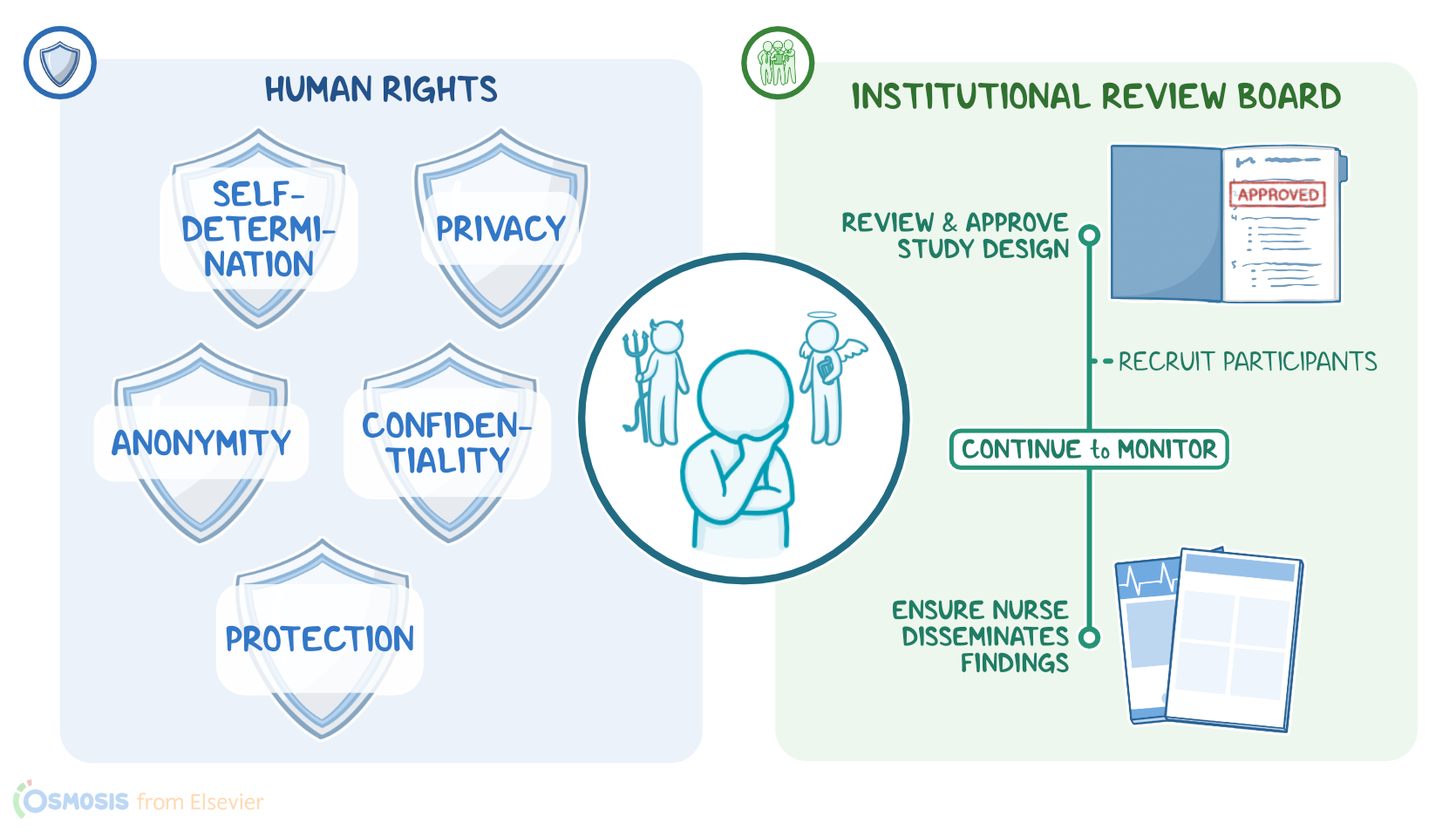
You can uphold the ethical principles of respect by protecting the participant’s right to self-determination, meaning that they can make their own decisions, and that potential study subjects should never be coerced into participating.
Nurse Randy upheld self-determination by informing Debbie about the details of the study as well as respecting her choice to voluntarily participate or not; and to reassess her feelings about participation throughout the data collection process.The ethical principles of respect and justice are upheld when the participant’s right to privacy, anonymity, and confidentiality are protected.
Privacy is the freedom of a person to choose if, how, and when their private information is shared with others. For example, to ensure privacy, Nurse Randy plans to conduct Debbie’s interview in a private room and make her aware of when he’s recording her.
Next, anonymity exists when a participant’s identity can’t be linked with the data collected, not even by the researcher; whereas confidentiality means that the participant’s identity won’t be publicly divulged when findings are shared.
Nurse Randy will promote these rights by removing Debbie’s identifiers from the data he collects, such as name, birthday, and address.
Lastly, it’s essential to protect participants from discomfort and harm, which correlates with the ethical principle of beneficence.
For example, since Nurse Randy is collecting data from client interviews, he will stop the interview if Debbie becomes emotionally distraught while describing her experience.
Nurse Randy will also have a counselor available if needed.You can ensure you uphold ethical standards and protect human rights during research by adhering to government and institutional regulations.
The Impact of Regulations on Nursing Research5:20–6:26
One important regulation is The Declaration of Helsinki, which was created in 1964 in response to the Nazi medical experiements during World War II.
This declaration formed the foundation for current human research protection; one component being the use of an ethics committee, which is a group of individuals responsible for protecting the best interests of clients and addressing ethical issues.
One example of an ethics committee used for healthcare research is the institutional review board, or IRB, which is a committee that reviews research studies before they can be conducted to ensure that the investigators have a plan for conducting research ethically.
In Nurse Randy’s study, the IRB was responsible for reviewing and approving his study design prior to recruiting participants, like Debbie.
After his study was approved, the IRB will continue to monitor it until completion, as well as ensure Nurse Randy disseminates his findings.
Alright, as a quick recap… Research is a systematic process of validating, refining, and generating knowledge; and ethics refers to moral principles that guide a person’s behavior and choices.
Summary6:26–7:21
When conducting a study, researchers must adhere to research ethics by following ethical principles which protect human rights.
When research ethics are not upheld, research misconduct occurs. Nurse researchers are responsible for upholding the ethical principles of respect, beneficence, and justice by securing the human rights of self-determination, privacy, anonymity, confidentiality, and protection from discomfort and harm.
Government and institutional regulations have been put into place to uphold ethical standards and protect human rights, such as ethics committees and IRBs.
In order to protect human rights during research, Nurses must make sure they follow these regulations.
| RESEARCH - ETHICS | ||
| KEY POINTS | NOTES | |
| INTRODUCTION |
| |
| DEFINITIONS |
| |
| HISTORICAL IMPLICATIONS OF RESEARCH MISCONDUCT |
| |
| PROTECTING HUMAN RIGHTS |
| |
| RESEARCH REGULATIONS |
| |
No notes for this video yet
Try adding a note below