Research - Sampling: Nursing
Introduction0:00–0:40
Nurse Beth works in a large outpatient pediatric practice that cares for many clients diagnosed with a variety of illnesses.
So, she develops a research study to better understand the number of pediatric clients diagnosed with COVID-19 who are experiencing headaches 6 months or more following their initial COVID-19 diagnosis.
As she begins to develop her study, Nurse Beth uses what she knows about population sampling so the right participants are included in the study.
Okay, so research is a systematic process of validating, refining, and generating knowledge. It is used by nurses and other members of the healthcare team, to answer questions that come up when caring for clients.
Research Population0:40–1:58
Now, the population is an entire group, with certain shared characteristics, that the researcher wants to study. Characteristics of a population can include but are not limited to physical traits, like height or eye color; diagnoses like hypertension or chronic kidney disease; or shared experiences, like taking an online course or receiving outpatient intravenous antibiotics.
These characteristics, often referred to as sampling criteria, determine what or who will be studied. Sampling criteria can be divided into two categories, inclusion criteria, or characteristics belonging to individuals that will be studied, and exclusion criteria, or characteristics of individuals that will not be studied.
In Nurse Beth’s study, children who are patients in pediatric clinics in Beth’s area who are under the age of 18, and who’ve been diagnosed with COVID-19 will meet the study’s inclusion criteria; whereas, children who have not been diagnosed with COVID-19 will be excluded.
In most research, it’s impossible to study an entire population; Nurse Beth can’t possibly study every single child in the United States diagnosed with COVID-19!
Research Sampling1:58–2:40
Therefore, a sample, which is a smaller portion of the population, is selected. A sample of a population is meant to be representative of the target population, which is the population that the researcher wants to generalize, or draw similar conclusions about, using the research findings.
One way to promote representativeness of the target population is by recruiting an adequate sample size, or number of participants, to be included in the study, as well as ensuring that the characteristics of the sample share enough characteristics of the target population.So, there are two main strategies that are used to obtain a sample of the chosen population.
Sampling Strategies2:40–6:52
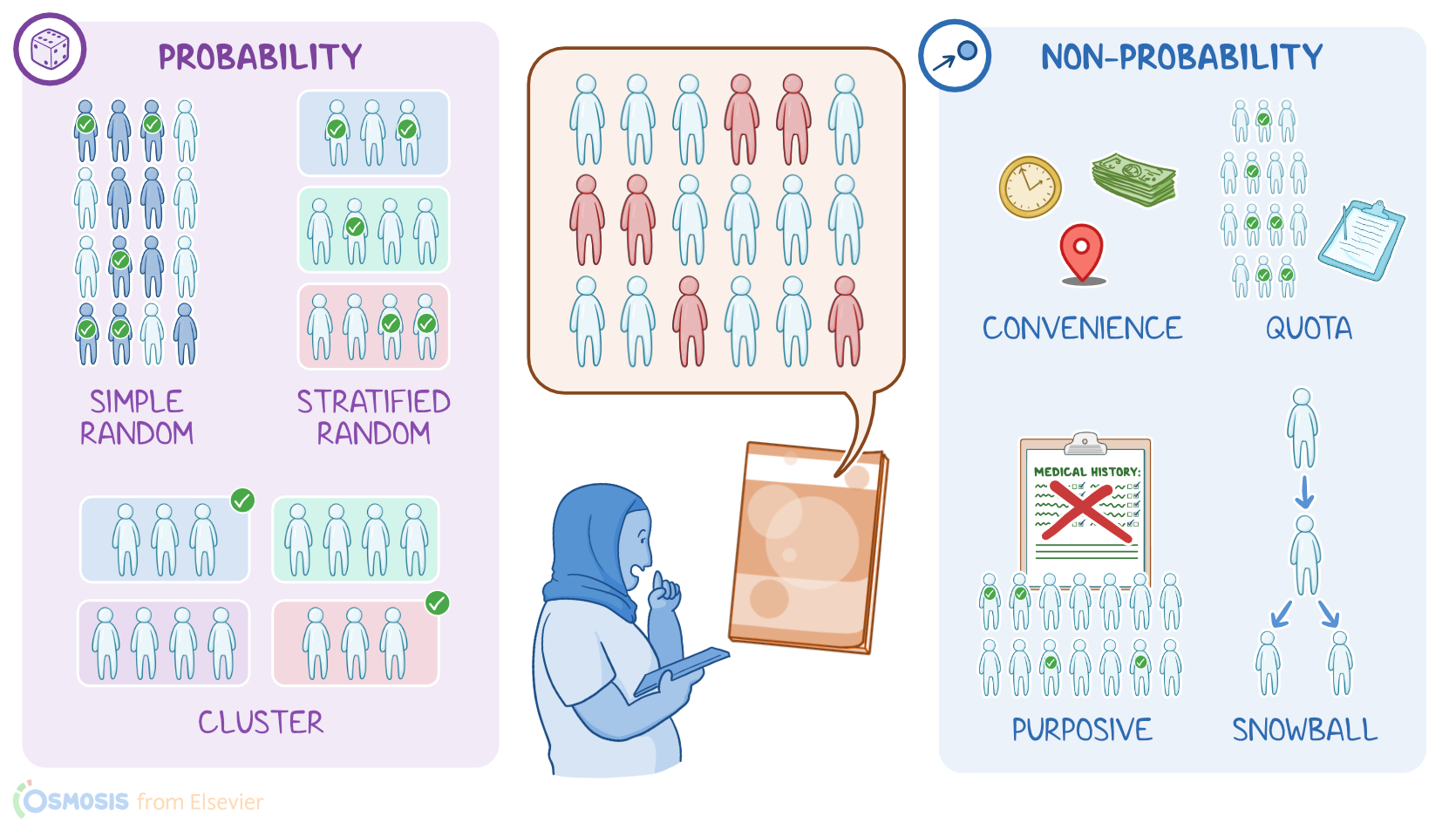
First is probability sampling which uses randomization to choose the participants from the population. Randomization is when each member of the population has an equal chance of being chosen, like drawing names out of a hat.
Using this strategy, the researcher increases the likelihood that the research findings from a study can apply to the whole population since the sample will be representative of the population.
There are several types of probability sampling, such as simple random sampling, stratified random sampling, and cluster sampling.Simple random sampling is a controlled process where the researcher lists each member of the population with the desired characteristics, also known as a sampling frame; then, sample participants are randomly selected from the list.
So, if Nurse Beth chooses this sampling technique, she would first create a list of pediatric clients cared for in pediatric practice settings that she has access to in her area who have been diagnosed with COVID-19.
Then, she would randomly select clients from that list for her study. Next is stratified random sampling, which is where the target population is divided into a few strata, or subgroups of people with similar characteristics.
Then participants are chosen randomly from these subgroups. One way to think of this is to imagine you have a large bag of candy-coated chocolates.
You sort each candy by color before randomly selecting some of each color subgroup. If Nurse Beth decides to use stratified random sampling, she could divide her target population into strata based upon age range, like 0-1 month, 1 month to 2 years, etc and select participants from each group.
Finally, there is cluster sampling. In this type of sampling, the researcher clusters the target population into subgroups and then selects several clusters for the sample.
For example, imagine you have many small bags of candy-coated chocolates. Each small bag is considered a cluster and you randomly select a few of these bags as your sample.
For Nurse Beth, if she chooses cluster sampling for her research, she could cluster her target population by each clinic where the children received care, and then select a few of the clinics to draw from for her sample.
Now, changing gears, we also have nonprobability, or nonrandom sampling. In nonprobability sampling, not every participant has an equal opportunity to be included in a study, so this can decrease the generalizability of findings.
Although this type of sampling is not as rigorous as probability sampling, it is beneficial in studies where a large sample is difficult to obtain.
It also saves researchers time and money. Just like with probability sampling, there are also several types of nonprobability sampling methods.
These are convenience, quota, purposive, and snowball. Convenience sampling is when a researcher uses the most easily accessible participants for the sample that meet the inclusion criteria.
For Nurse Beth, she could select the first 50 pediatric clients with a history of COVID-19. Next is quota sampling, which is a type of convenience sampling when the participants are first divided into strata and then recruited until the desired sample size, or quota, is met.
To use quota sampling, Nurse Beth could send out questionnaires to different subgroups, and then enroll participants from each subgroup until she reaches her quota.
Purposive sampling is where the researcher uses their experience and knowledge of the context surrounding the phenomena to select the best participants for the study.
Nurse Beth knows that many children in her community have chronic headaches due to stress, so she might choose participants without a history of stress or headaches.
Lastly, snowball, also called network sampling, is used for locating samples that are difficult to access. Nurse Beth could use snowball sampling by enrolling participants in her study and then asking those participants to recruit other potential participants from their families, communities, or social networks.
Alright, as a quick recap…. Research is a systematic process of validating, refining, and generating knowledge.
Review6:52–7:58
It is used by members of the healthcare team, such as nurses, to answer questions that come up when caring for a population of clients.
A population is an entire group of individuals with certain shared characteristics that the researcher wants to study. From the population, the researcher chooses a sample, which is a smaller group which should represent the desired population.
The two main strategies of sampling are probability and nonprobability. Probability sampling uses randomization to choose the participants from the population and includes types like simple random sampling, stratified random sampling, and cluster sampling.
In nonprobability sampling, on the other hand, not every participant has an equal opportunity to be included in a study, thus decreasing the generalizability of findings.
Nonprobability sampling includes types like convenience sampling, quota sampling, purposive sampling, and snowball sampling.
| RESEARCH - SAMPLING | ||
| KEY POINTS | NOTES | |
| INTRODUCTION |
| |
| DEFINITIONS |
| |
| SAMPLING CRITERIA |
| |
| RESEARCH SAMPLING |
| |
| SAMPLING STRATEGIES |
| |
No notes for this video yet
Try adding a note below