Sjögren syndrome: Nursing
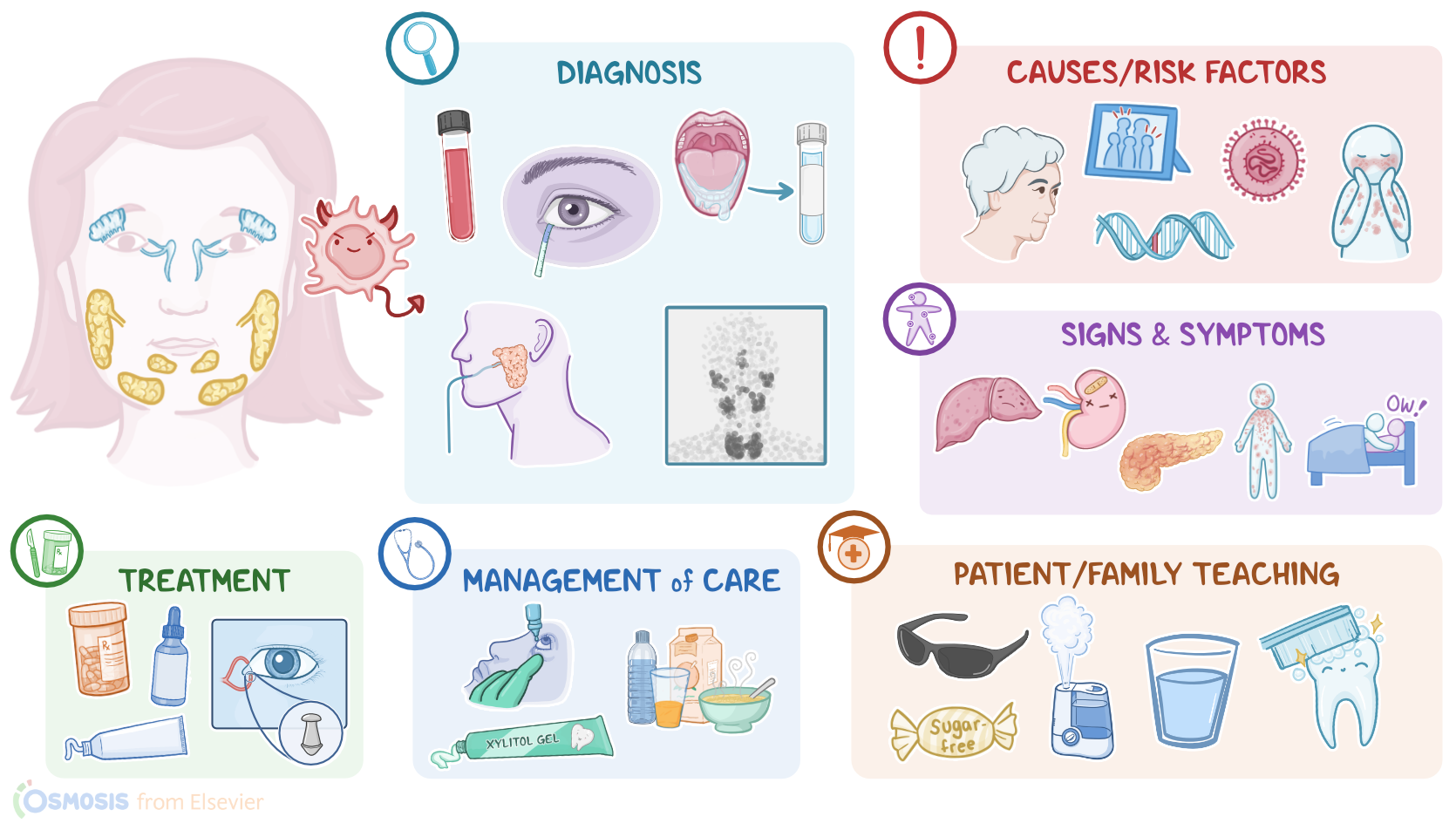
Sjogren syndrome is an autoimmune disease in which the immune system targets and attacks various exocrine glands, most commonly the lacrimal glands and the salivary glands.
Alright, now let’s quickly review the physiology of exocrine glands, which are found throughout body organs. These glands release various substances into a ductal system, which in turn carries these substances to an epithelial surface. Two particular examples of exocrine glands are salivary and lacrimal glands.
Now, there are three main pairs of salivary glands, called major salivary glands, which include the parotid, submandibular, and sublingual glands.
There are also a few smaller companions called minor salivary glands, which are sprinkled over the palate, lips, cheeks, tonsils, and tongue. When it comes to function, salivary glands secrete saliva into ducts that open in the oral cavity. Saliva contains enzymes that begin the digestion process, lubricates, and protects the mucosal surfaces of the mouth, in addition to preventing bacteria from forming dental cavities or caries.
On the other hand, lacrimal glands are paired exocrine glands located within the orbital cavity, just above the lateral angle of the eye. These glands secrete tears, which lubricate and nourish the surface of the eyes, help wash away debris, and act as a protective barrier against foreign particles, like pollen or dust.
The exact cause for Sjogren syndrome is unknown, but it seems to be related to both genetic and environmental factors. Sjogren syndrome typically affects clients over the age of 40, and risk factors include a family history of Sjogren syndrome, clients assigned female at birth, white or black race, as well as HLA genes that encode specific types of immune molecules, called HLA-DRW52, HLA-DQA1, or HLA-DQB1, which normally identify and bind to foreign molecules.
Environmental risk factors mainly include viral and bacterial infections of the exocrine glands, as well as being diagnosed with other autoimmune disorders, like rheumatoid arthritis or systemic lupus erythematosus. Okay, now the pathology of Sjogren syndrome starts with an environmental trigger, such as an infection, which damages the cells of the exocrine glands, mainly the salivary and lacrimal glands, and exposes their cell components to circulating immune cells.
| SJOGREN SYNDROME | ||
| KEY POINTS | NOTES | |
| DEFINITION |
| |
| PHYSIOLOGY |
| |
| CAUSES AND RISK FACTORS |
| |
| PATHOPHYSIOLOGY |
| |
| SIGNS AND SYMPTOMS |
| |
| DIAGNOSIS |
| |
| TREATMENT |
| |
| MANAGEMENT OF CARE |
| |
| PATIENT AND FAMILY TEACHING |
| |
No notes for this video yet
Try adding a note below