Social determinants of health (SDOH): Nursing
Introduction0:00–0:14
Social determinants of health, or SDOH for short, refers to the conditions where people live, work, play, worship, and age, that influence health.
Social Determinants of Health Categories0:14–1:47
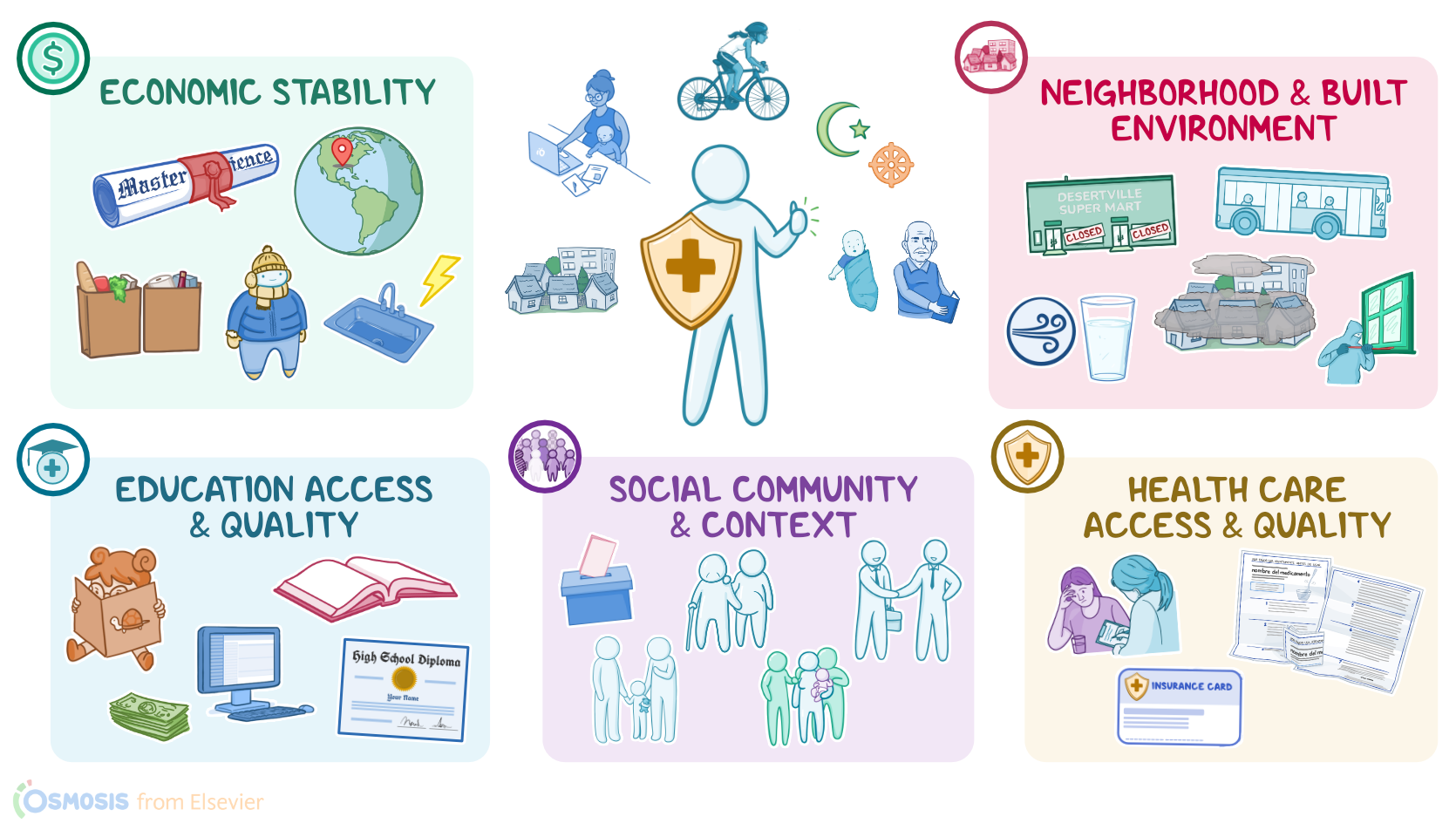
Now, there are five major categories of social determinants of health: Economic stability, neighborhood and built environment, education access and quality, social community and context and lastly, health care access and quality.
First, there’s economic stability, which means that people have opportunities for employment and sufficient financial resources to afford basic needs like food, clothing, housing, and utilities.
Then there’s neighborhood and built environment, which includes characteristics like having access to a grocery store, availability of public transportation, the quality of housing, as well as factors like clean air and water and neighborhood crime rates.
Next, education access and quality addresses factors like the availability of early childhood education, high school graduation rates, and opportunities to enroll in college, as well as general literacy.
Social community and context refers to the sense of community cohesion and connectiveness, like the interactions between family, friends, and coworkers and the degree of civic engagement.
Finally, health care access and quality includes the availability and coverage of health care services, the quality of care, and health literacy, which is the ability to locate, understand, and use health information to make well-informed decisions about health.
Now, health equity means that every person has the opportunity to attain their full health potential, and that their socially determined situation does not place them at a disadvantage.
Health Equity and Health Disparities1:47–3:21
However, health disparities can occur in socially disadvantaged populations, creating differences in the incidence and prevalence of disease, injury, and mortality.
For example, individuals who have limited access to grocery stores with healthy foods are less likely to have proper nutrition, which increases their risk of certain health conditions such as obesity and hypertension.
Likewise, if a family can only afford housing where their water supply contains toxins like lead, their children are at increased risk for developmental delay, which will have lifelong effects on their health, education, and economic stability.
Health disparities can also happen due to specific factors like age, ethnicity, gender, sexual orientation, or disability status.
For example, LGBTQ+ youth who are more likely to be bullied, which can lead to depression, anxiety, poor grades, and dropping out of school.
This can multiply the health disparities they could experience, since individuals with less education are less likely to engage in healthy behaviors; are at increased risk for health problems like obesity and diabetes; and often have fewer opportunities for economic stability and access to health care.
Nursing Considerations3:21–5:03
Alright, as a nurse, you can promote health equity by assessing your own cultural background, values, and beliefs so you can be aware of your own biases or prejudices and be accountable for them.
Also remember to practice self-reflection and continuously learn about the communities you care for so you can better understand your patient’s cultural beliefs and practices.
Next, identify causes of health disparities your patients could be experiencing by administering an SDOH screening tool, like the Protocol for Responding to and Assessing Patient Assets, Risks, and Experiences; or PRAPARE, for short.
Using this tool, you’ll ask questions like “What language are you most comfortable speaking?”; “What is your housing situation today?”; “What is your current work situation?”; and “How stressed are you?” Also assess their risk of inadequate health care services, including access to resources like medication or devices like a glucometer or a blood pressure monitor, as well as their level of health literacy.
Review any resources they may be eligible for, including food assistance or help with transportation to their health care appointments.
As you provide care, be sure to use standardized, evidence-based care to help reduce disparities in treatment. For instance, base your pain management interventions on current guidelines, along with alternative therapies based on your patient’s preference and customs like acupuncture or meditation.
Lastly, always use an interpreter rather than a family member if your patient doesn’t speak the same language as you and provide educational materials in your patient’s own language or ones that are a basic literacy level, as needed.
Alright, as a quick recap... Social determinants of health refers to the conditions where people live, work, play, worship, and age, that influence their health, and economic stability, neighborhood and built environment, education access and quality, social community and context, and health care access and quality.
Review5:03–5:49
Health equity occurs when every person has the opportunity to attain their full health potential, and no one is at a disadvantage because of their social determinants of health.
Health disparities can occur in socially disadvantaged populations, creating differences in the incidence and prevalence of disease, injury, and mortality.
Nursing considerations for promoting health equity include awareness of your own cultural values, beliefs, and biases; identifying and following standards of
| SOCIAL DETERMINANTS OF HEATH (SDOH) | ||
| KEY POINTS | NOTES | |
| DEFINITION |
| |
| SOCIAL DETERMINANTS OF HEALTH CATEGORIES |
| |
| HEALTH EQUITY AND HEALTH DISPARITIES |
| |
| NURSING CONSIDERATIONS |
| |
- "Social determinants of health" Centers for Disease Control and Prevention (n.d.)
- "Lewis's medical-surgical nursing: Assessment and management of clinical problems (12th ed.)" Elsevier (2022)
No notes for this video yet
Try adding a note below