Stress and coping: Nursing
Introduction0:00–0:37
Stress is a normal human response to an internal or external threat to homeostasis, or the body’s stable equilibrium, and can be prompted by stressors.
These stressors such as illness, high workload, or economic hardship, can induce the stress response, also known as an allostasis, in an attempt to reestablish homeostasis.
In the short term, the body can adapt to the physiological changes to stress; however, when stress becomes chronic, it can have a negative impact on mental and physical health.Now, not all stress is harmful, in fact, it is essential for daily life.
Types of Stress0:37–1:05
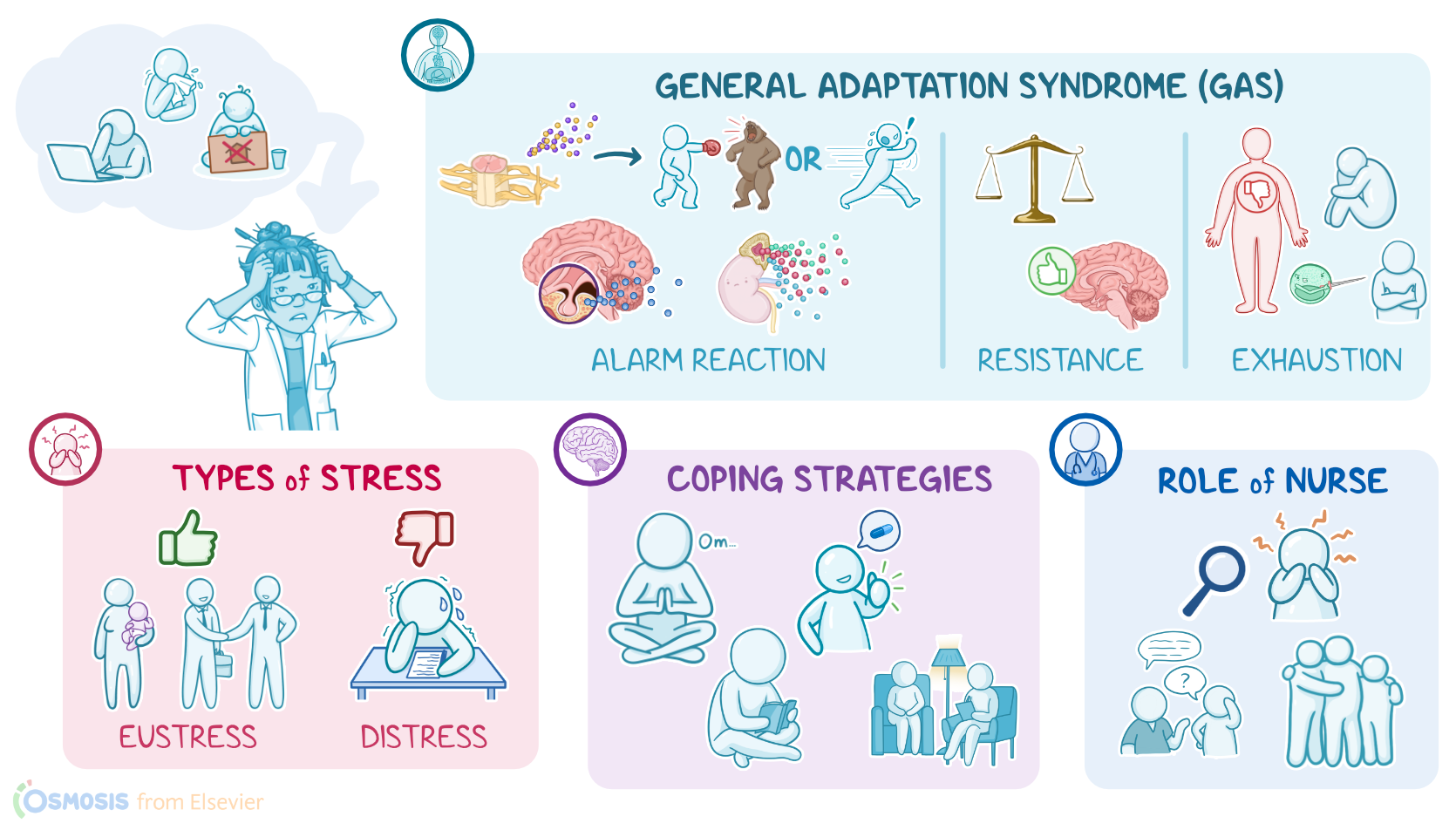
There are two types of stress; eustress and distress. Eustress is positive stress, which is necessary for normal development and motivation and can occur with beneficial life changes like having a baby or getting a new job; whereas distress is negative stress that occurs when a person is unable to adapt or cope effectively to the stressor.Okay, the body’s response to a stressful event can be explained by the General Adaptation Syndrome, or GAS, which has three stages.
Physiological Response to Stress1:05–2:41
First, the alarm reaction stage occurs as the sympathetic nervous system is activated, triggering the fight-or-flight response, which involves the release of hormones and neurotransmitters to support the body’s reaction to stress.
The posterior pituitary releases antidiuretic hormone, or ADH, and the adrenal cortex releases aldosterone, both of which increase circulating blood volume.
The adrenal cortex also releases cortisol, which increases the body’s supply of glucose, while the adrenal medulla releases epinephrine and norepinephrine, which increases the heart rate, blood pressure, and blood flow to the skeletal muscles.
Next, the resistance stage is when the body attempts to stabilize and return to homeostasis. If the stress has been dealt with effectively, the parasympathetic nervous system returns vital signs to normal and begins to repair tissue damage.
However, if the stress continues, the sympathetic activation will also continue, and the person moves to the exhaustion stage.
This stage is characterized by excessive wear and tear on the body, a suppressed immune system, and depletion of the body’s resources, referred to as allostatic load.
When allostatic load is not resolved, it can lead to health problems like depression, diabetes, and autoimmune disorders.Now, coping is a process by which a person uses cognitive and behavioral strategies to manage stress; and their response to stress will depend on their own appraisal of the stressful event and their perceived ability to respond to the stressor.
Coping and Coping Strategies2:41–4:08
Now, the use of coping strategies may not always involve healthy behaviors and they may not always be effective in resolving stress.
For example, defense mechanisms, coping strategies that are typically unconscious, that can be beneficial or detrimental.
Detrimental defense mechanisms include denial, where a person completely ignores distressing aspects of reality, or the use of alcohol or drugs.
On the other hand, a beneficial defense mechanism is sublimination, which occurs when unacceptable emotions are channeled into acceptable actions, like exercise.Other coping strategies include problem focused coping and emotion focused coping.
In problem focused coping, the person attempts to alter a stressor; for example, a patient with a new diagnosis of heart failure may gather information to learn about their condition, and to learn skills like how to take their blood pressure or manage their medications.
On the other hand, emotion focused coping involves reducing emotional distress caused by a stressor, like when a patient with lung cancer sees a therapist to discuss their perceived stressors.Okay, so, as the nurse, you should assess your patient’s stress levels and responses as well as coping strategies.
The Role of the Nurse in Stress and Coping4:08–5:37
First, you’ll need to build trust and rapport so patients will feel comfortable in providing the needed information. During your assessment, use open-ended questions such as, “What are sources of stress in your life?” and “What coping strategies have worked for you in the past?” There are also several scales you can use to identify stressors, such as the Holmes-Rahe Social Readjustment scale.
It’s also crucial to ask about the presence of a support system and include them in the plan of care.You are also responsible for educating patients on stress reduction techniques to promote effective coping and overall health.
Each patient will require individualized interventions; for example, some patients could benefit from anger management and support groups, whereas other patients prefer complementary therapies such as meditation and biofeedback.
If this is the case, you should initiate crisis intervention, which may include calling emergency services or referring the patient to a counselor.Alright, as a quick recap...
Review5:37–6:24
Stress is a normal human response to an internal or external threat to homeostasis. When stress is prolonged, it can have a negative impact on mental and physical health.
There are two types of stress; eustress, or positive stress, and distress, or negative stress. The body’s response to a stressful event can be explained by GAS, which is the body’s attempt to regain homeostasis, which has three stages, alarm reaction, resistance, and exhaustion.
Coping is a process by which cognitive and behavioral strategies are used to manage stress. The nurse is responsible for assessing stress and coping, and prioritizing interventions based on each patient’s needs.
| STRESS AND COPING | ||
| KEY POINTS | NOTES | |
| DEFINITION |
| |
| TYPE OF STRESS |
| |
| PHYSIOLOGICAL RESPONSE TO STRESS |
| |
| COPING AND COPING STRATEGIES |
| |
| THE ROLE OF THE NURSE IN STRESS AND COPING |
| |
- "Fundamentals of nursing (11th ed.)" Elsevier (2023)
- "Fundamentals of nursing (10th ed.)" Elsevier (2021)
No notes for this video yet
Try adding a note below