Case study - Heart failure with reduced ejection fraction (HFrEF): Nursing
Revisores de contenido
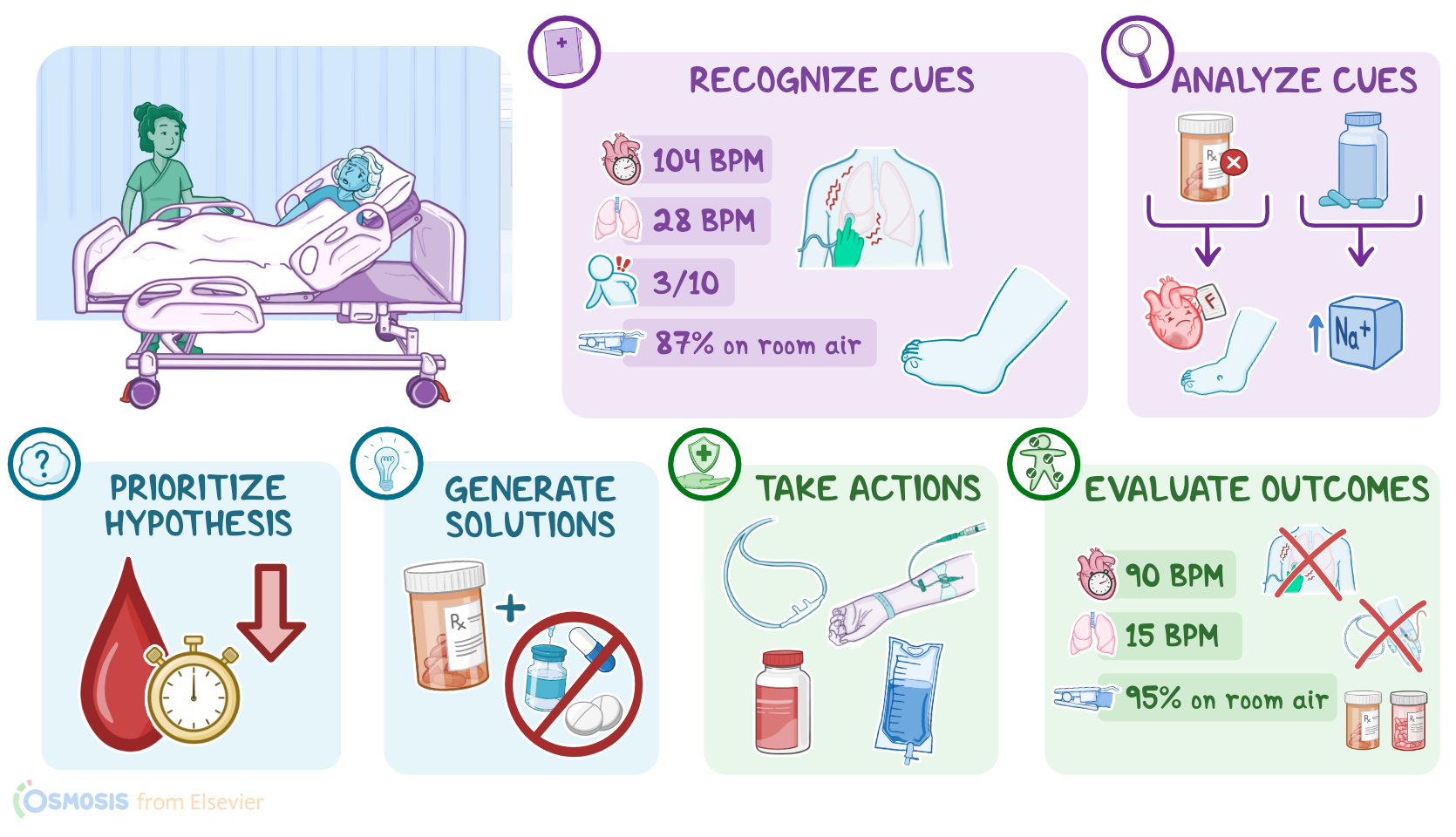
Nurse Pilar works on an inpatient cardiac unit and is caring for Esperanza, a 72-year-old female admitted for an exacerbation of heart failure with reduced ejection fraction. After settling Esperanza in her room, Nurse Pilar goes through the steps of the Clinical Judgment Measurement Model to make clinical decisions about Esperanza’s care by recognizing and analyzing cues, prioritizing hypotheses, generating solutions, taking action, and evaluating outcomes.
First, Nurse Pilar recognizes important cues, including Esperanza’s vital signs, which are heart rate 104 beats per minute, respirations 28 breaths per minute, oxygen saturation 87 percent on room air, and pain 3 out of 10, located in her back.
Nurse Pilar also notes that Esperanza’s breathing is labored and she’s using accessory muscles. Upon auscultation, Nurse Pilar notes fine inspiratory crackles in both lung bases. There’s also 2+ pitting edema in Esperanza’s ankles and feet.
Next, Nurse Pilar asks Esperanza about her recent activities and medications.
Nurse Pilar: I see your health care provider has prescribed two medicines for you. When was the last time you took them?
Esperanza: Well, I ran out of my medicines a week ago, and I haven’t been to the pharmacy to get my refills yet. I haven’t gone out of the house much the last two weeks because my back’s been hurting, and I’ve been so tired.
Nurse Pilar: I’m sorry you’ve been having back pain. Has anything helped with the pain?
Esperanza: Yes, ibuprofen helps. I’ve been taking it two times each day.
Nurse Pilar then analyzes these cues. She reviews Esperanza’s electronic health record, or EHR, and sees that she's prescribed two medications to control her heart failure, an ACE inhibitor and a beta blocker. Because Esperanza has been without her medications for a week, she is now showing symptoms of heart failure.
Additionally, Nurse Pilar knows taking non-steroidal anti-inflammatory drugs, or NSAIDs, like ibuprofen, can worsen existing heart failure by increasing sodium retention. Nurse Pilar realizes that Esperanza is experiencing impaired cardiac function.
Now, using the information she's gathered, Nurse Pilar chooses a priority hypothesis of decreased cardiac output.
Then, she generates solutions to address Esperanza’s cardiac function that will include pharmacologic and nonpharmacologic interventions. Nurse Pilar establishes the expected outcome that after intervening, Esperanza will exhibit signs of increased cardiac output.
Nurse Pilar then takes action to implement these solutions. She reviews the orders from the health care provider and sees Esperanza is prescribed oxygen at 2 liters per minute per nasal cannula; the diuretic furosemide IV push, a continuous IV infusion of the vasodilator, nitroglycerin; and acetaminophen by mouth for back pain.
While she waits for the pharmacy to dispense these medications, Nurse Pilar re-enters Esperanza’s room.
Nurse Pilar: Okay, Esperanza, your heart can’t keep up with your body’s oxygen needs right now, so we’re going to give you some oxygen and start IV medications that will help.
| CASE STUDY - HEART FAILURE WITH REDUCED EJECTION FRACTION (HFrEF) | ||
| KEY POINTS | NOTES | |
| INTRODUCTION |
| |
| RECOGNIZING AND ANALYZING CUES |
| |
| PRIORITIZING HYPOTHESES, GENERATING SOLUTIONS, AND TAKING ACTION |
| |
| EVALUATING OUTCOMES |
| |
- "Lewis's medical-surgical nursing: Assessment and management of clinical problems. (12th ed.)" Elsevier (2022)
- "Medical-surgical nursing: Concepts for interprofessional and collaborative care. (10th ed.)" Elsevier (2021)
- "Lewis’s medical-surgical nursing in Canada: Assessment and management of clinical problems. (5th ed.)" Elsevier (2023)
Aún no hay notas para este video
Intenta agregar una nota a continuación