Transcripción
Revisores de contenido
Samantha Wilberson is a 29-year-old female client who was admitted to the Medical-Surgical floor during the night. Ms. Wilberson has a history of celiac disease and was directly admitted to the department by her gastroenterologist after a severe bout of watery diarrhea, vomiting, and dehydration. She says the last time she remembers feeling this sick was over a year ago after she had a bad case of the flu.
Celiac disease, also known as gluten enteropathy or celiac sprue, is currently understood as an immune-mediated disorder where the gluten in food triggers the body’s immune cells to attack the cells in the small intestine. Celiac disease is hereditary, and people with a first-degree relative with celiac disease, like a parent or sibling, have a 1 in 10 risk of developing it. Some people may be genetically predisposed to Celiac disease. In fact, it is estimated to affect 1 in 100 people worldwide.
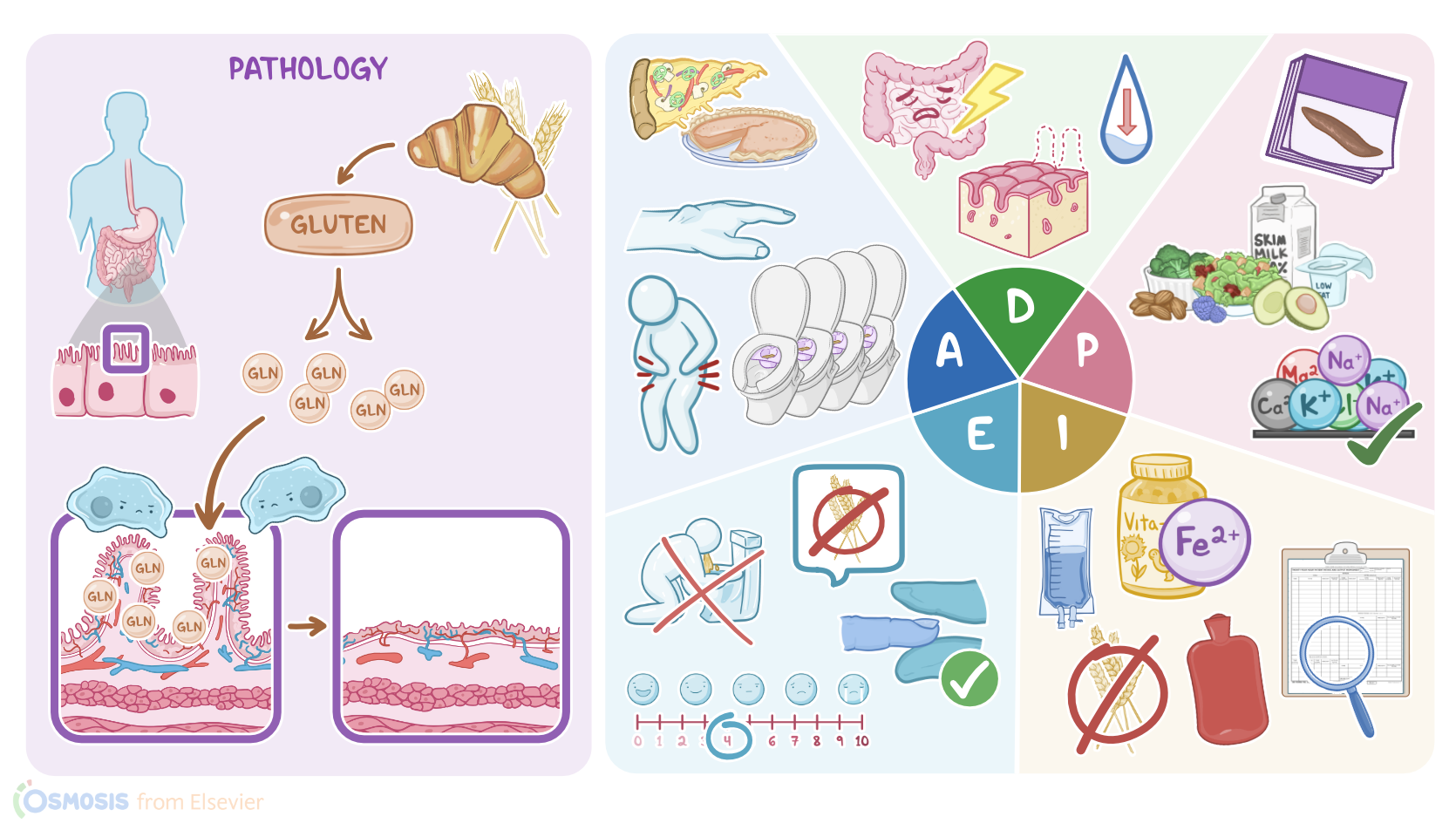
Now, gluten’s found in all sorts of wheats and grains, including rye and barley, and is the main culprit in Celiac disease. The intestine’s inability to fully digest the protein fractions of gluten leads to a build-up of the amino acid glutamine. This accumulation is toxic to the intestinal mucosa, damaging the intestinal villi, which are those small finger-like projections that line the small intestine and help promote nutrient absorption. When the villi become damaged, they can atrophy. This leads to complications like diarrhea, vomiting, fatty stools, abdominal distention, and malabsorption of important nutrients like iron and vitamin B12-- which can lead to anemia.
Symptoms of Celiac disease are commonly first noticed between the ages of 1 and 5. Usually, there’s a period of time anywhere between 3- 6 months from the time gluten is introduced in the diet and the manifestations of Celiac disease are apparent. And of course, because gluten intake leads to complications, lifelong dietary changes are necessary in order to prevent flare-ups. Occasionally a client like Ms. Wilberson can experience an acute episode where symptoms of Celiac disease are exacerbated. This is called a Celiac crisis. The severe loss of GI contents through diarrhea and vomiting can cause complications like electrolyte imbalances, severe dehydration, and metabolic acidosis. People living with Celiac disease have a greater risk for developing coronary artery disease and small bowel cancers. And left untreated, Celiac disease can increase the chance of developing other autoimmune disorders, like Type I diabetes mellitus and multiple sclerosis.
Notas
| CELIAC DISEASE | ||
| KEY POINTS | NOTES | |
| PATIENT REPORT |
| |
| PATHOPHYSIOLOGY |
| |
| ASSESSMENT |
| |
| NURSING DIAGNOSES |
| |
| PLANNING |
| |
| IMPLEMENTATION |
| |
| EVALUATION |
| |
Fuentes
- "Ackley and Ladwig’s Nursing Diagnosis Handbook: An Evidence-Based Guide to Planning Care, 13th edition" Mosby (2022)
- "The Gluten-Free Diet for Celiac Disease and Beyond" Nutrients (2021)
- "Celiac disease: a comprehensive current review" BMC Med (2019)
- "Harrison’s Principles of Internal Medicine. 21st edition" McGraw Hill / Medical (2022)
- "Celiac Disease: Fallacies and Facts" Am J Gastroenterol (2021)
- "Updates in the diagnosis and management of coeliac disease" Best Pract Res Clin Gastroenterol (2023)
- "Critical Care Nursing: Diagnosis and Management, 9th edition" Elsevier (2021)
Aún no hay notas para este video
Intenta agregar una nota a continuación
Transcript
Samantha Wilberson is a 29-year-old female client who was admitted to the Medical-Surgical floor during the night. Ms. Wilberson has a history of celiac disease and was directly admitted to the department by her gastroenterologist after a severe bout of watery diarrhea, vomiting, and dehydration. She says the last time she remembers feeling this sick was over a year ago after she had a bad case of the flu.
Celiac disease, also known as gluten enteropathy or celiac sprue, is currently understood as an immune-mediated disorder where the gluten in food triggers the body’s immune cells to attack the cells in the small intestine. Celiac disease is hereditary, and people with a first-degree relative with celiac disease, like a parent or sibling, have a 1 in 10 risk of developing it. Some people may be genetically predisposed to Celiac disease. In fact, it is estimated to affect 1 in 100 people worldwide.
Now, gluten’s found in all sorts of wheats and grains, including rye and barley, and is the main culprit in Celiac disease. The intestine’s inability to fully digest the protein fractions of gluten leads to a build-up of the amino acid glutamine. This accumulation is toxic to the intestinal mucosa, damaging the intestinal villi, which are those small finger-like projections that line the small intestine and help promote nutrient absorption. When the villi become damaged, they can atrophy. This leads to complications like diarrhea, vomiting, fatty stools, abdominal distention, and malabsorption of important nutrients like iron and vitamin B12-- which can lead to anemia.
Symptoms of Celiac disease are commonly first noticed between the ages of 1 and 5. Usually, there’s a period of time anywhere between 3- 6 months from the time gluten is introduced in the diet and the manifestations of Celiac disease are apparent. And of course, because gluten intake leads to complications, lifelong dietary changes are necessary in order to prevent flare-ups. Occasionally a client like Ms. Wilberson can experience an acute episode where symptoms of Celiac disease are exacerbated. This is called a Celiac crisis. The severe loss of GI contents through diarrhea and vomiting can cause complications like electrolyte imbalances, severe dehydration, and metabolic acidosis. People living with Celiac disease have a greater risk for developing coronary artery disease and small bowel cancers. And left untreated, Celiac disease can increase the chance of developing other autoimmune disorders, like Type I diabetes mellitus and multiple sclerosis.