Left-sided heart failure: Nursing process (ADPIE)
Revisores de contenido
Jamal Hendrick is a 63-year-old male client who was admitted to the Medical-Surgical floor yesterday.
Mr. Hendrick has a history of chronic left-sided heart failure and hypertension.
He was directly admitted by his cardiologist after complaints of shortness of breath, dry cough, and severe fatigue.
He states his last hospitalization was around 6 months ago for similar symptoms.
Heart failure, also called congestive heart failure, is when the heart is unable to pump effectively enough to maintain cardiac output to meet the demands of the body.
Common risk factors for heart failure include uncontrolled hypertension, ischemic heart disease, valvular heart disease, cardiomyopathy, endocarditis, and acute myocardial infarction.
The onset of heart failure can be acute, which occurs suddenly and resolves in a short period of time, but usually develops slowly over a long period of time and persists as a chronic disease.
Often an individual can live with chronic heart failure, but then suddenly develop an acute exacerbation.
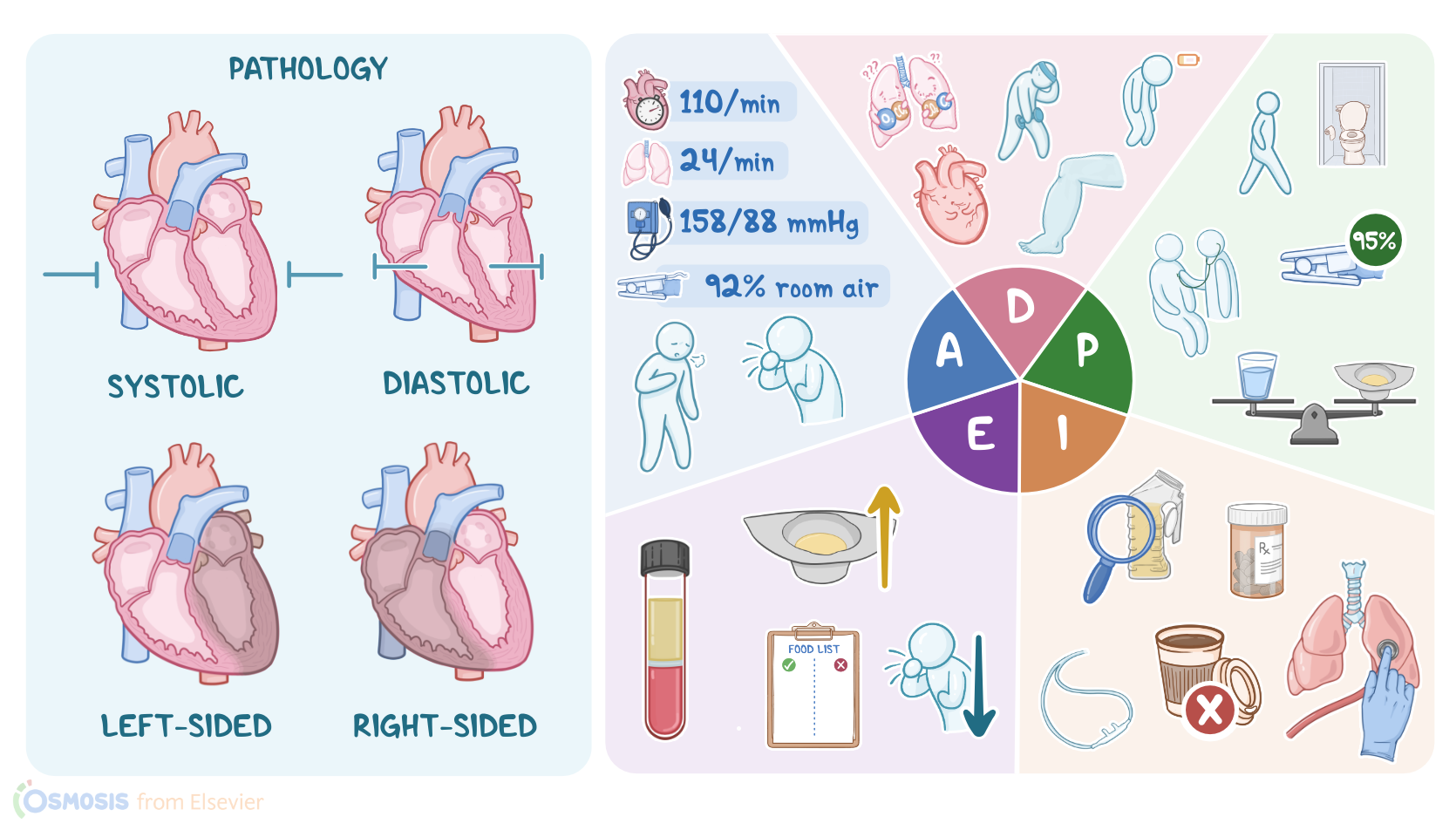
Heart failure can be the result of either systolic dysfunction, which is due to inadequate contractility, or diastolic dysfunction, when the heart is unable to relax and fill with blood.
Heart failure can affect the right side, the left side, or both sides of the heart.
The left and right sides of the heart are two separate pumping systems, and one side can remain functional for some time even if the other side is failing.
Most cases of heart failure initially start on the left side, and then eventually progress to include both sides.
With left-sided heart failure, the left ventricle is unable to pump with enough force to push blood into the aorta and the rest of the body.
When this happens, the blood remaining in the left side of the heart will back up into the lungs, causing pulmonary problems such as dyspnea, tachypnea, crackles, dry cough, paroxysmal nocturnal dyspnea, pulmonary edema, and pulmonary hypertension.
| LEFT-SIDED HEART FAILURE | ||
| KEY POINTS | NOTES | |
| PATIENT REPORT |
| |
| PATHOPHYSIOLOGY |
| |
| ASSESSMENT |
| |
| NURSING DIAGNOSES |
| |
| PLANNING |
| |
| IMPLEMENTATION |
| |
| EVALUATION |
| |
Aún no hay notas para este video
Intenta agregar una nota a continuación