Pericarditis: Nursing
Pericarditis refers to inflammation of the pericardium, which is a thin, fibro-elastic sac that surrounds the heart and the roots of the great vessels, cushioning them, and preventing friction during each heartbeat.
Let’s start with a bit of physiology. The pericardium has two layers: an outer fibrous layer, known as the parietal pericardium; and an inner serous layer, called the visceral pericardium. The visceral pericardium is continuous with the parietal pericardium, so they form an enclosed space called the pericardial cavity. Within it, there’s serous pericardial fluid, that is secreted by visceral pericardium cells and drained by parietal pericardial cells and lymphatics, in order to maintain a normal volume of about 5 to 20 mL. The pericardial fluid cushions the heart from any kind of external jerk or shock and also acts as a lubricant to reduce friction with each heartbeat. The pericardium also fixes the heart to the mediastinum, preventing it from twisting, so that blood circulation through the great vessels doesn’t get cut off.
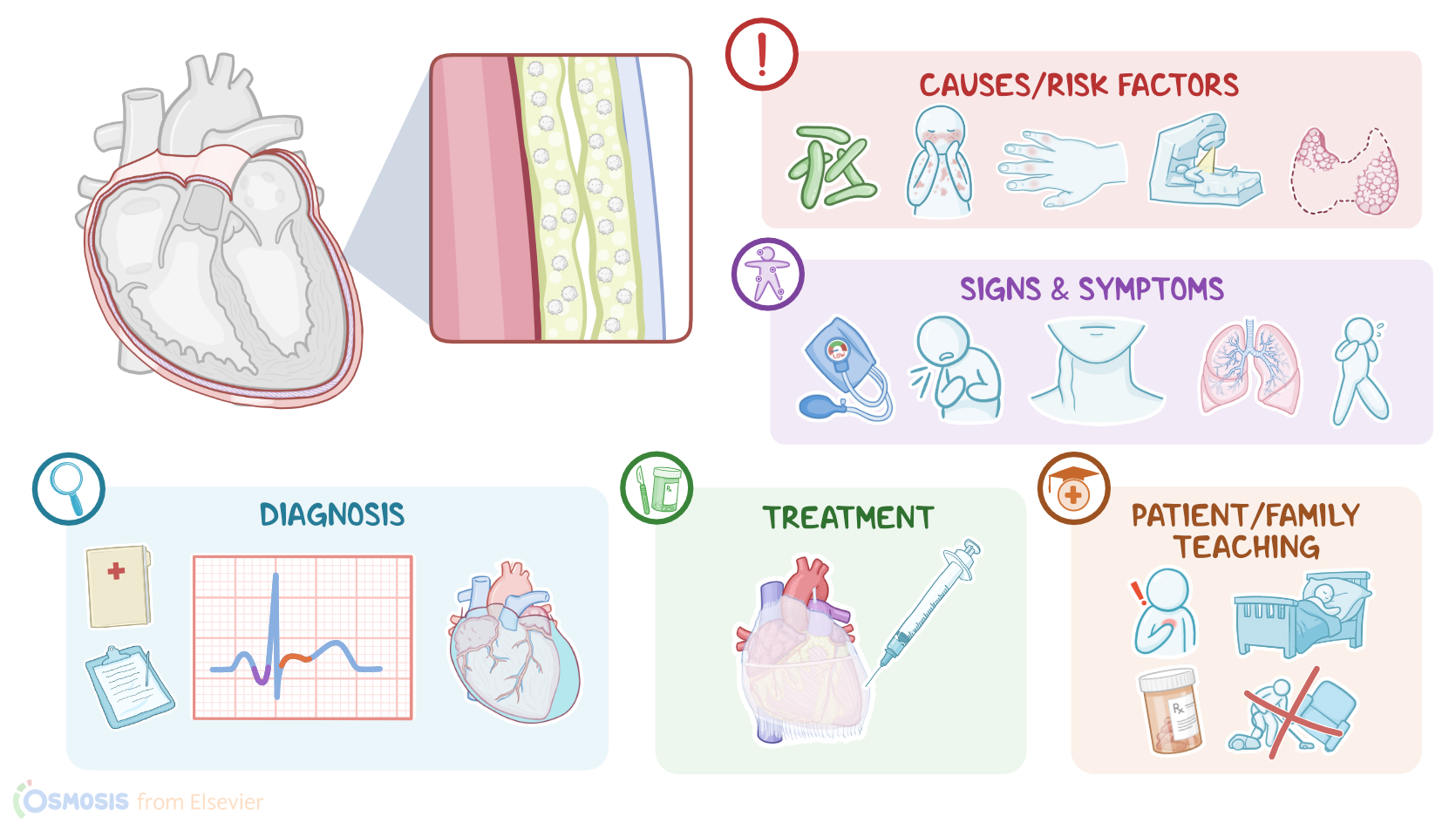
Now, pericarditis is caused by inflammation of the pericardium, and most cases are idiopathic, meaning that there’s no identifiable cause. When the cause is identified, it’s usually an infection, most commonly a virus, such as Coxsackie B virus or echovirus. Less frequently, pericarditis can be caused by bacteria like Streptococcus pneumoniae or Staphylococcus aureus; as well as fungi like Histoplasma capsulatum and Candida species.
On the other hand, non-infectious causes of pericarditis include Dressler syndrome, also known as postmyocardial infarction syndrome, which is an immune response triggered by antigens released by dying heart cells and occurs several weeks after myocardial infarction. Another non-infectious cause of pericarditis is uremia, which is when blood levels of urea get really high, usually due to kidney failure. The high levels of urea irritate the visceral pericardium cells, leading them to secrete a thick pericardial fluid that’s full of fibrin strands and white blood cells.
Pericarditis can also be caused by autoimmune diseases, such as systemic lupus erythematosus, rheumatoid arthritis, or scleroderma. Finally, other causes of pericarditis include cancer and radiation therapy to the chest, as well as severe hypothyroidism and certain medications like penicillin, procainamide, and hydralazine.
| PERICARDITIS | ||
| KEY POINTS | NOTES | |
| DEFINITION |
| |
| PHYSIOLOGY |
| |
| CAUSES AND RISK FACTORS |
| |
| PATHOPHYSIOLOGY |
| |
| SIGNS AND SYMPTOMS |
| |
| DIAGNOSIS |
| |
| TREATMENT |
| |
| MANAGEMENT OF CARE |
| |
| PATIENT AND FAMILY TEACHING |
| |
- "Lewis’s Medical-Surgical Nursing: Assessment and Management of Clinical Problems. 11th Edition. ISBN: 978-0-323-55149-6 " Mosby (2019)
- "Heimgartner N. Medical-Surgical Nursing: Concepts for Interprofessional Collaborative Care. 10th Edition. ISBN: 978-0-323-61242-5 " Elsevier (2020)
- "Saunders Comprehensive Review for the NCLEX-RN. 9th Edition. ISBN: 978-0-323-79530-2 " Saunders (2022)
- "Acute Pericarditis: Update. 24(8):905-913. " Curr Cardiol Rep (2022)
- "Recurrent pericarditis: an update on diagnosis and management. 16(3):551-558. " Intern Emerg Med (2021)
Aún no hay notas para este video
Intenta agregar una nota a continuación