Social determinants of health (SDOH): Nursing
Social determinants of health, or SDOH for short, refers to the conditions where people live, work, play, worship, and age, that influence health.
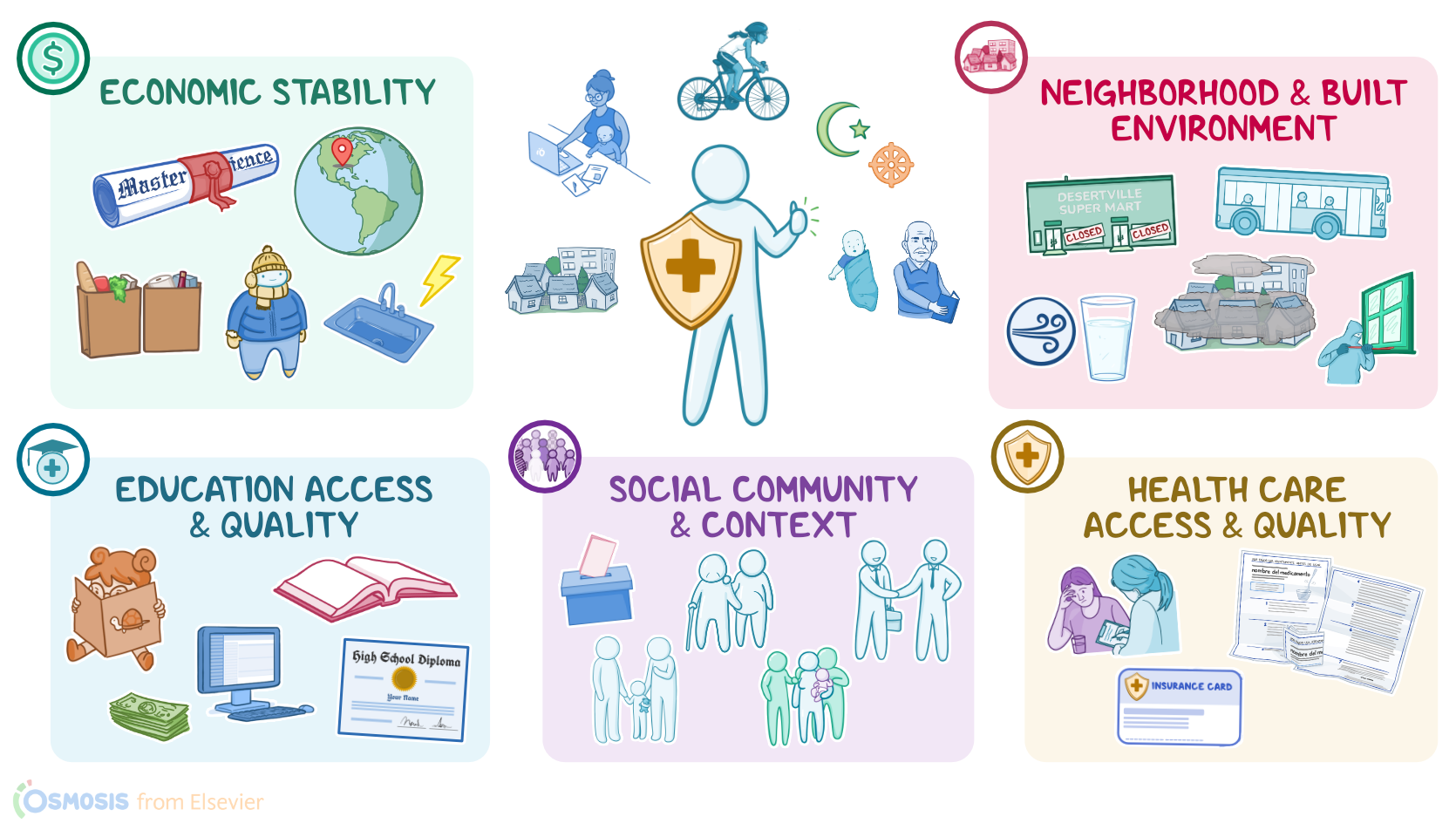
Now, there are five major categories of social determinants of health: Economic stability, neighborhood and built environment, education access and quality, social community and context and lastly, health care access and quality.
First, there’s economic stability, which means that people have opportunities for employment and sufficient financial resources to afford basic needs like food, clothing, housing, and utilities.
Then there’s neighborhood and built environment, which includes characteristics like having access to a grocery store, availability of public transportation, the quality of housing, as well as factors like clean air and water and neighborhood crime rates.
Next, education access and quality addresses factors like the availability of early childhood education, high school graduation rates, and opportunities to enroll in college, as well as general literacy.
Social community and context refers to the sense of community cohesion and connectiveness, like the interactions between family, friends, and coworkers and the degree of civic engagement.
Finally, health care access and quality includes the availability and coverage of health care services, the quality of care, and health literacy, which is the ability to locate, understand, and use health information to make well-informed decisions about health.
Now, health equity means that every person has the opportunity to attain their full health potential, and that their socially determined situation does not place them at a disadvantage.
However, health disparities can occur in socially disadvantaged populations, creating differences in the incidence and prevalence of disease, injury, and mortality. For example, individuals who have limited access to grocery stores with healthy foods are less likely to have proper nutrition, which increases their risk of certain health conditions such as obesity and hypertension.
| SOCIAL DETERMINANTS OF HEATH (SDOH) | ||
| KEY POINTS | NOTES | |
| DEFINITION |
| |
| SOCIAL DETERMINANTS OF HEALTH CATEGORIES |
| |
| HEALTH EQUITY AND HEALTH DISPARITIES |
| |
| NURSING CONSIDERATIONS |
| |
- "Social determinants of health" Centers for Disease Control and Prevention (n.d.)
- "Lewis's medical-surgical nursing: Assessment and management of clinical problems (12th ed.)" Elsevier (2022)
Aún no hay notas para este video
Intenta agregar una nota a continuación