Vital signs - Oxygen saturation (SpO2): Nursing skills
As a healthcare professional, you will help provide safe care to patients who have or are at risk for hypoxemia, or low levels of oxygen in the blood. These patients require pulse oximetry, or pulse-ox for short, which is a non-invasive, easy, and pain-free method of measuring the percentage of hemoglobin that’s saturated with oxygen. This is known as the saturation of peripheral oxygen or SpO2 for short. A normal SpO2 usually indicates that the amount of oxygen travelling through the bloodstream to the tissues is enough to meet the needs of the body.
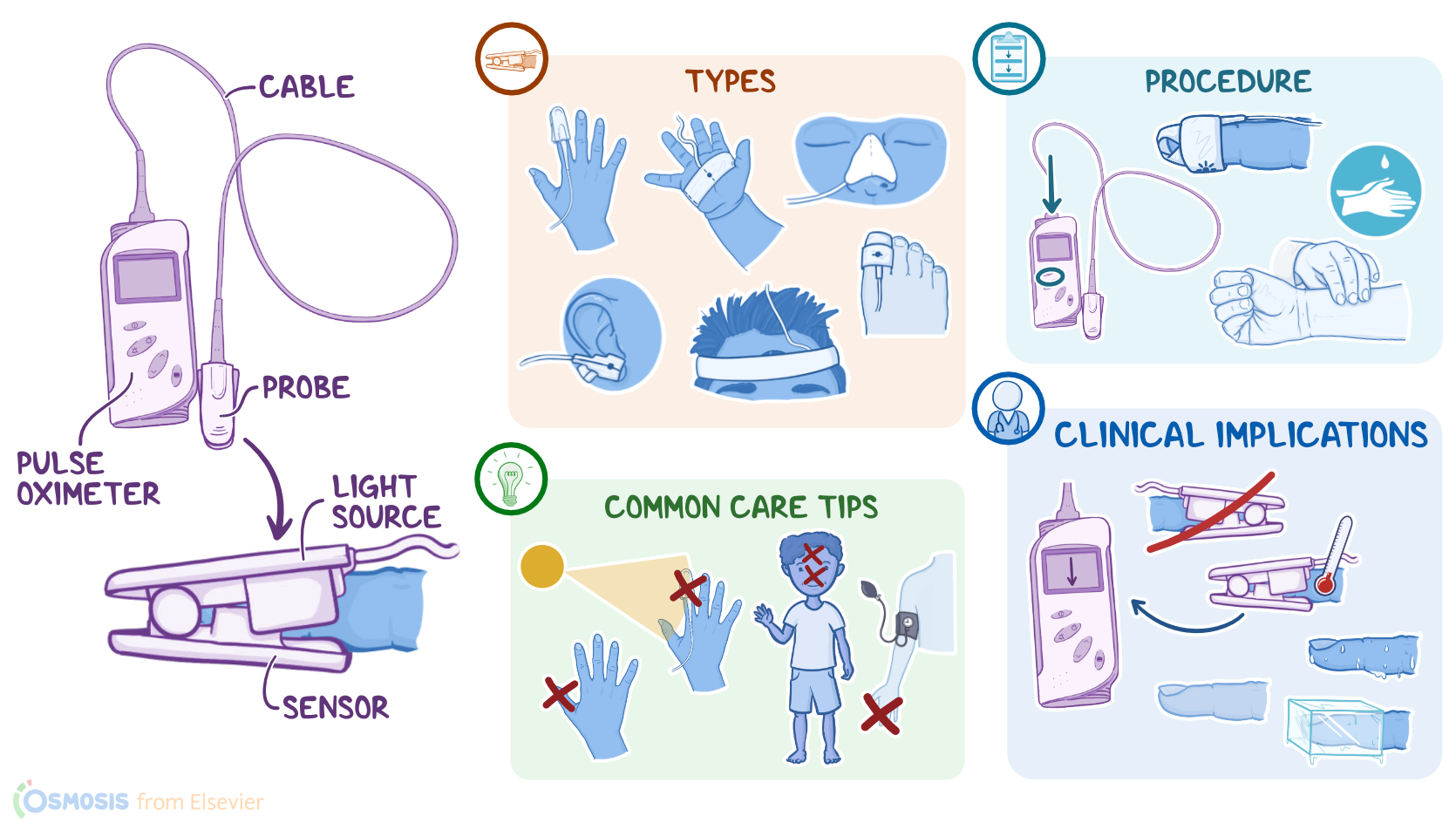
Now, a pulse oximeter consists of a probe, which is attached by a cable to a pulse oximeter. The probe has a light source on one side and a photodetector, or sensor, on the other side.
So, when it gets clipped onto a body part, two different wavelengths of light shine through the tissues on one side, and on the other side, the sensor detects how much of each wavelength has been absorbed by the arterial blood in the tissues. The principle is that, when hemoglobin is bound to oxygen, it absorbs a different wavelength of light than when it is not bound to oxygen, so the percentage of hemoglobin bound to oxygen can be calculated by the device. LO1, LO2
Now, there are several types of probes, depending on the site where they can be placed. The most commonly and easily used ones are digit probes, which can fit onto a finger or a toe. There are also earlobe probes, which attach to the patient’s ear. Less commonly, if the digits or earlobes are inaccessible, a pulse oximetry probe can be applied across the forehead and secured with a headband. Both earlobe and forehead probes tend to be more accurate than digit probes in cases when blood flow to the extremities is compromised or if the patient moves their hands or feet frequently, creating motion artifacts.
There are also sensor pads that can be used on several different sites, including an adult's nose bridge and a newborn's palms or soles.
Now, pulse oximeter probes can be disposable or reusable, and they also come in two types: adhesive and clip sensors. In general, adhesive sensors are better for younger children or if you need to place the sensor on an earlobe, nose bridge, or toe. Clip sensors are good for spot-checking a patient’s oxygen saturation but are not the best for continuous monitoring, especially in children because they are very easy to take off. LO3
| VITAL SIGNS - OXYGEN SATURATION | ||
| KEY POINTS | NOTES | |
| INTRODUCTION |
| |
| HOW IT WORKS |
| |
| PULSE OXIMETER PROBES AND SITES |
| |
| SpO2 VALUES |
| |
| COMMON CARE TIPS |
| |
| PROCEDURE |
| |
| CLINICAL IMPLICATIONS |
| |
- "Clinical nursing skills & techniques (11th ed.). ISBN 978-0-443-10718-4 " Elsevier (2025)
- "Physical examination and health assessment (9th ed.) ISBN: 978-0-323-80984-9 " Elsevier (2024)
- "Oxygen metabolism and oxygenation of the newborn. " Semin Fetal Neonatal Med. (2020;25(2):101078. )
- "Advanced Health Assessment & Clinical Diagnosis in Primary Care. ISBN 978-0323832069 " Elsevier (2023)
- "The value of vital sign trends in predicting and monitoring clinical deterioration: A systematic review. " PLOS ONE (2019;14(1):e0210875)
- "Drug-induced interstitial lung disease during cancer therapies: expert opinion on diagnosis and treatment. " ESMO Open. (2022;7(2):100404. )
- "Impact of Early and Regular Mobilization on Vital Signs and Oxygen Saturation in Patients Undergoing Open-Heart Surgery. " Braz J Cardiovasc Surg. (2021;36(4):506-514. Published 2021 Aug 6. )
- "Fundamentals of nursing (10th ed.). ISBN 978-0323810340 " Elsevier (2021)
Aún no hay notas para este video
Intenta agregar una nota a continuación