Vital signs - Pulse: Nursing skills
With every heartbeat, the heart creates a wave, or pulse, that’s sent to arteries all over the body in order to deliver oxygenated blood to our organs and tissues. As a healthcare professional, you need to be able to obtain a pulse and determine its characteristics, including the pulse rate, rhythm, and amplitude.
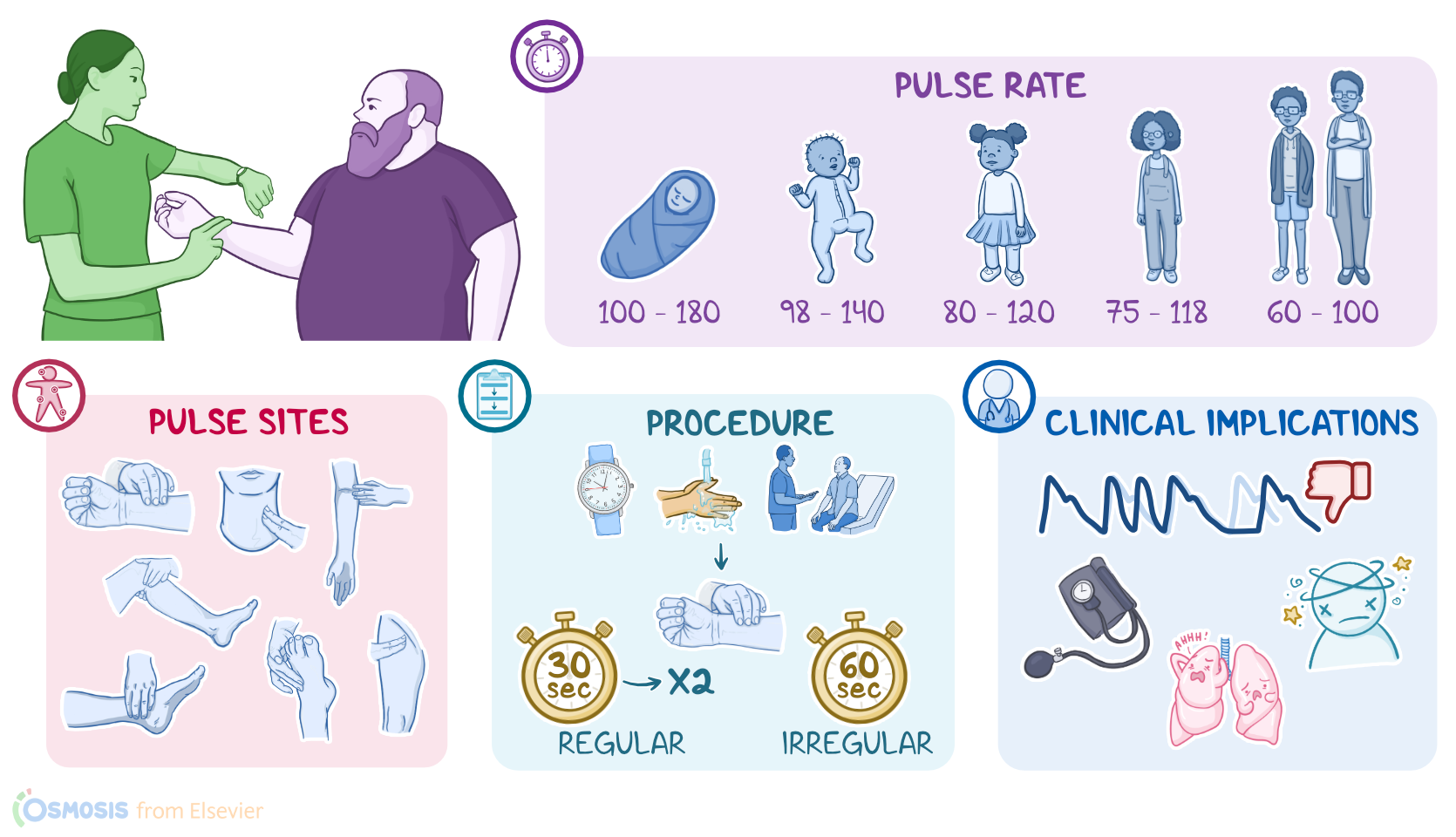
You can calculate the pulse rate by counting the number of pulsations felt over an artery in one minute. This should be equal to the heart rate, or the number of times the heart beats per minute. The normal pulse rate varies among different age groups and individual patients.
So, for adults and adolescents 12 years of age or older, the awake rate is typically between 60 and 100. For school-aged children between 6 and 12, it’s 75 to 118. For preschoolers from 3 to 5, it’s 80 to 120. Toddlers aged 1 and 2 years old have a normal pulse rate of 98 to 140. Finally, infants under one year of age normally have the fastest pulse rate, which ranges from 100 to 180 beats per minute.
Besides age, the pulse rate can also be influenced by many factors, including sleep; physical activity; body temperature; emotions, like anger, fear, or stress; medications; or even the weather.
So, tachycardia is when the pulse rate is faster than the normal range, or over 100 beats per minute for an adult. Tachycardia can occur in response to factors like strenuous exercise, fever, pain, anxiety, or certain medications. In contrast, bradycardia means that the pulse rate is too slow, or less than 60 beats per minute for an adult and can be due to heart problems or various medications.
Another important characteristic is the pulse rhythm, which is normally regular, meaning that the intervals between the beats are equal. In an irregular rhythm, the beats don’t follow an even tempo and some of them might even be skipped. It’s also useful to note whether the irregularity happens in a predictable way or unpredictable way.
A predictable, or “regularly irregular” pulse is one that follows the same pattern every time; an example of this is sinus arrhythmia, which is a benign finding where the heart rate increases in rate on inspiration and decreases in rate on expiration.
If, on the other hand, the pulse is irregular in an unpredictable pattern, it is called an “irregularly irregular” rhythm and can be the result of a heart problem such as atrial fibrillation.
| VITAL SIGNS - PULSE | ||
| KEY POINTS | NOTES | |
| DEFINITION |
| |
| PULSE RATE |
| |
| PULSE RHYTHM |
| |
| PULSE AMPLITUDE |
| |
| PULSE SITES |
| |
| PROCEDURE |
| |
| APICAL PULSE |
| |
| PULSE DEFICIT |
| |
| CLINICAL IMPLICATIONS |
| |
- "Pulse Pressure Augmentation During Exercise: An Important Stress Test Parameter. " JACC Heart Fail (2022;10(9):695-696.)
- " Heart rate variability: are you using it properly? Standardization checklist of procedures. " Braz J Phys Ther. (2020;24(2):91-102. )
- "Essentials for Nursing Assistants: A Humanistic Approach to Caregiving. Fifth, North American edition. ISBN: 978-1-975142-57-5 " LWW (2020)
- "Nursing Guide to Physical Examination and History Taking. 3rd edition. ISBN: 978-1-975161-09-5 " LWW (2021)
- "Clinical Nursing Skills and Techniques. 10th edition. ISBN: 978-0-323-70863-0 " Mosby (2021)
- "Textbook for Nursing Assistants. 10th edition. ISBN: 978-0-323-65560-6 " Mosby (2020)
- "Minimizing Pulse Check Duration Through Educational Video Review. " West J Emerg Med. (2020;21(6):276-283. Published 2020 Oct 20. )
Aún no hay notas para este video
Intenta agregar una nota a continuación