Osmosis video - Colon histology
Learn deeper with Osmosis
Master this topic faster with videos, questions, and AI.
Used by 8M+ healthcare learners.
No credit card · Cancel anytime
00:00 / 00:00

Video Summary of Colon histology
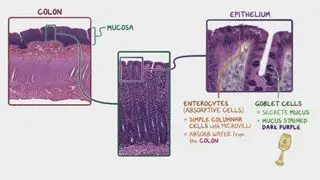
The colon is a section of the large intestine that helps to absorb water and electrolytes from food matter, and it also helps to store fecal matter until it can be eliminated from the body. The colon has three sections: the ascending colon, the transverse colon, and the descending colon. The ascending colon is located on the right side of the body, while the descending and transverse colons are on the left side. The wall of the colon has four layers. There is an inner layer called mucosa, a middle layer called submucosa, a muscular layer called muscular externa, and an outer layer called serosa.
The mucosa has enterocytes, the intestines' absorptive cells. These are simple columnar cells with microvilli, responsible for absorbing water and nutrients, and goblet cells secrete mucus. The submucosa contains connective tissue, blood, lymphatic vessels, and a network of nerves known as Meissner's plexus. The muscularis mucosa comprises two layers of smooth muscle tissue that contract and relaxes to help move food matter through the colon. The serosa is a thin layer of tissue that covers the outside of the colon and helps to protect it from infection. The colon is home to many different types of bacteria that help to break down food matter and extract nutrients from it. These bacteria also produce vitamins and other compounds that benefit the body. In addition, the colon plays an essential role in the immune system by producing antibodies that help to fight off infection.