Electrolyte balance - Overview: Nursing
Introduction0:00–0:23
Electrolytes are charged molecules or ions that have many essential functions throughout the body, including transmission of nerve impulses, facilitating muscle contraction and maintaining fluid osmolality because of their critical functions, maintaining electrolyte homeostasis is essential for normal functioning of the body.
OK. Let's review the major electrolytes and their functions.
Electrolytes and Their Functions0:23–3:07
They can be categorized as either cations which are positively charged like sodium or anions, which are negatively charged like phosphate.
Electrolytes can be measured in the urine, cerebrospinal fluid and blood. And they're usually expressed as milli equivalents per liter of fluid meq per liter.
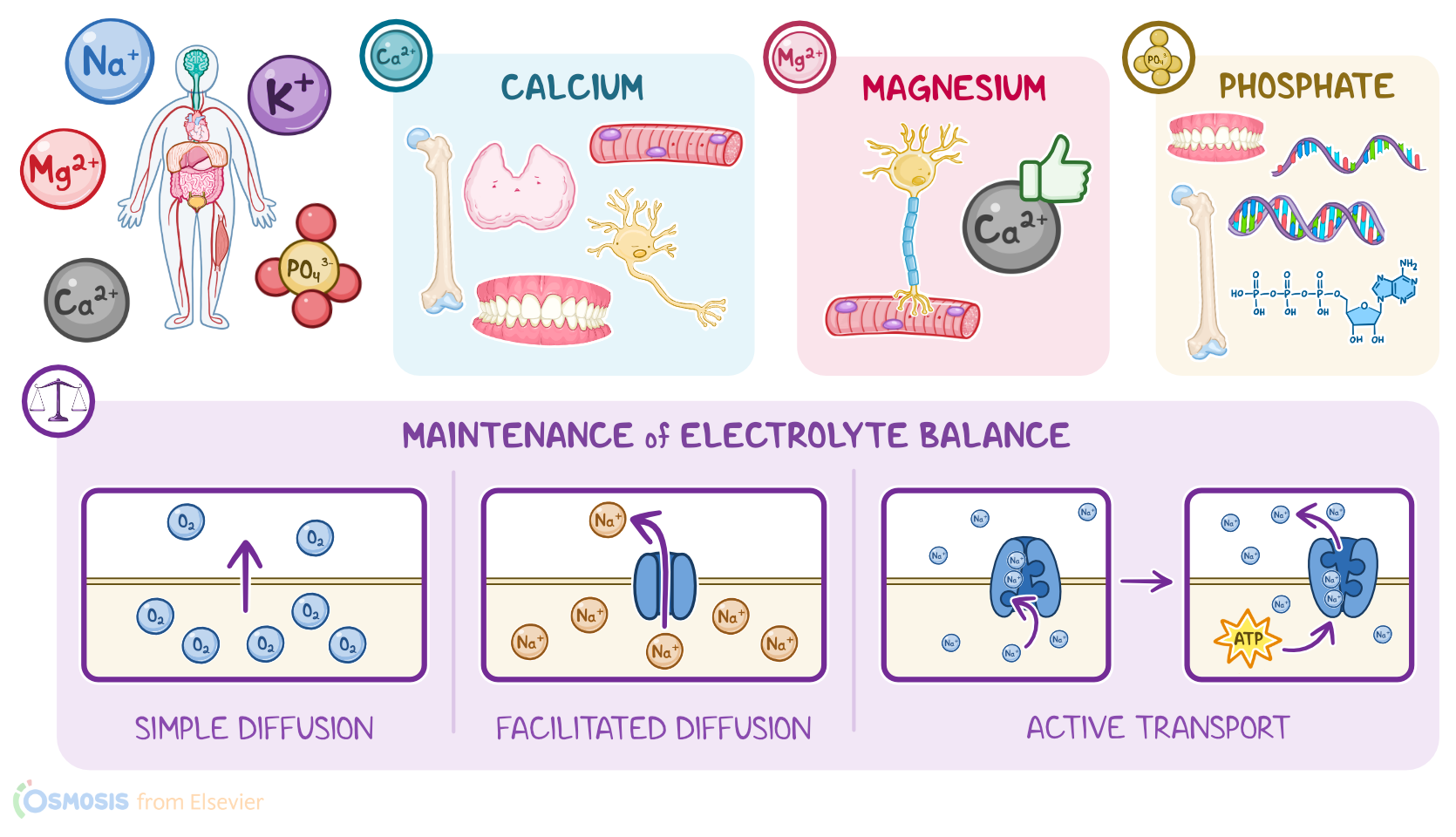
So first, there's sodium or N A plus, which is the main cation in the extracellular fluid. It's responsible for maintaining the extracellular fluids, osmolality or the concentration of the particles dissolved in the fluid.
So it determines blood volume and BP. Sodium also works closely with potassium or K plus to maintain the cells resting membrane potential, which is the distribution of ions on either side of the cellular membrane.
Sodium's normal value is 135 to 145 mill equivalents per liter. Now, potassium is the main cation in the intracellular fluid and it's responsible for maintaining intracellular osmolality.
Potassium is also essential for normal neuromuscular and cardiac function and its normal range is between 3.5 and five milliequivalents per liter.
Then there's calcium or ca two plus which helps with releasing neurotransmitters from neurons as well as releasing hormones from endocrine glands.
It influences the excitability of nerve and muscle cells and is essential for muscle contraction. It's also involved in blood clotting and maintaining strong bones and teeth.
Calcium's normal range is between 8.5 and 10.5 mgs per deciliter. Now, magnesium or MG two plus influences the function of both cardiac and skeletal muscles through its actions in the neuromuscular junction, which is where muscles and nerves meet.
It also acts as a cofactor in lots of enzyme reactions during carbohydrate metabolism and it helps maintain a normal calcium level.
Magnesium normally ranges between 1.3 and 2.1 milliequivalents per liter. Finally, phosphate or po 43 minus works with calcium to form bones and teeth.
It is also an essential component of adenosine triphosphate or ATP, which is the body's main energy source for cellular metabolism and nucleotides which make up DNA and RNA phosphate's normal range is between three and 4.5 mgs per deciliter.
Maintenance of Electrolyte Balance3:07–4:36
Now, electrolytes move from one compartment to another to maintain balance in a few different ways. First, they can move through diffusion which involves passive movement downhill or with the concentration gradient, moving from an area of higher concentration to an area of lower concentration.
Without the use of energy diffusion can be either simple or facilitated. For example, simple diffusion occurs when the concentration of a molecule like oxygen or O2 is lower outside the cell than inside the cell.
This prompts oxygen to diffuse from inside the cell across the cell membrane and out to the extracellular space, the diffusion stops once the oxygen concentration on either side of the cell membrane is equal.
Now, if an ion like sodium or potassium requires some assistance to cross the cell's membrane, it can move by facilitated diffusion with the help of a channel protein that opens up a channel.
So ions can move in and out of the cell. Then there's active transport in which ATP is used to move electrolytes from areas of lower concentration to areas of higher concentration ATP is needed because the movement is uphill or against the concentration gradient.
A common example is the sodium potassium pump which moves three sodium ions out of the cell for every two potassium ions moved into the cell.
In order to maintain the resting membrane potential of the cell electrolytes are ions that have many essential functions throughout the body, including transmission of nerve impulses, facilitating muscle contraction and maintaining fluid osmolality.
Review4:36–5:09
Optimal functioning of the body requires a balance of electrolytes in both the intracellular and extracellular space. So electrolytes will maintain balance by moving through simple diffusion, facilitated diffusion or active transport.
| ELECTROLYTE BALANCE - OVERVIEW | ||
| KEY POINTS | NOTES | |
| DEFINITION |
| |
| ELECTROLYTES AND THEIR FUNCTIONS |
| |
| MAINTENANCE OF ELECTROLYTE BALANCE |
| |
- "Fundamentals of nursing (11th ed.)" Elsevier (2023)
- "Fundamentals of nursing (10th ed.)" Elsevier (2021)
- "Fundamentals of nursing: Active learning for collaborative practice. (3rd ed.)" Elsevier (2022)
- "Fundamentals of nursing: Active learning for collaborative practice. (3rd ed.)" Elsevier (2022)
No notes for this video yet
Try adding a note below