Osmosis video - Pediatric gastrointestinal bleeding: Clinical
00:00 / 00:00
Video Summary of Pediatric gastrointestinal bleeding: Clinical
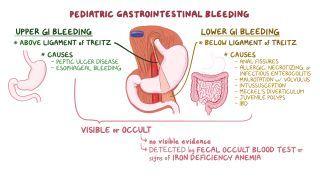
Pediatric gastrointestinal (GI) bleeding refers to bleeding that occurs in the stomach, small intestine, large intestine, or rectum of a child. Causes of gastrointestinal bleeding can be divided into upper and lower GI bleeding.
Upper GI bleeding arises above the ligament of Treitz or the suspensory ligament of the duodenum, and includes bleeding from the esophagus, stomach, or duodenum. Common causes of upper GI bleeding include peptic ulcer disease and esophageal bleeding. Children with upper GI bleeding typically present with hematemesis, and melena.
Lower GI bleeding arises below the ligament of Treitz and includes bleeding from the small intestines past the ligament of Treitz, large intestines, rectum, and anus. Some causes of lower GI bleeding include anal fissures, necrotizing or infectious enterocolitis, and intussusception. Children with lower GI bleeding present with bright red blood passing through the anus, what's known as hematochezia.