Osmosis video - Structure and function of the human body
00:00 / 00:00
Video Summary of Structure and function of the human body
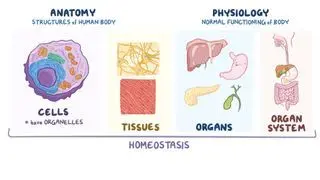
The human body has many different parts. The science that studies the structures and arrangement of those parts is called anatomy, while the study of how they function is called physiology. The structural organization of the body starts at the cellular level. Cells with similar structures and functions form tissues.
Tissues grouped to perform specific functions form organs, and when organs work together to carry out certain common tasks, they form an organ system. Cells have organelles that help them carry out their functions. Cell organelles include the cell membrane, cytoskeleton, nucleus, ribosomes, mitochondria, and others floating in the cytoplasm. For cells to work properly, homeostasis must be kept, meaning certain factors in their environment, such as pH and oxygen, body temperature, and concentration of substances like sodium and potassium, are kept constant to create an optimal state for the cells to perform their function.