
ABCDE

Melanoma Assessment Mnemonic

Author: Anna Hernández, MD
Editor: Alyssa Haag, MD
Editor: Lily Guo, MD
Editor: Kelsey LaFayette, DNP, ARNP, FNP-C
Illustrator: Abbey Richard, MSc
Modified: Jan 06, 2025

What is melanoma?

Melanoma is a type of skin cancer caused by the uncontrolled growth of melanocytes, which are the pigment-producing cells of the skin. The main risk factor for melanoma is exposure to ultraviolet rays, commonly from the sun and tanning beds, as well as having light skin and a tendency to sunburn. Having a family history of melanoma also increases one’s risk of developing melanoma. 

While melanoma is less common than other forms of skin cancer, such as squamous cell or basal cell carcinoma, it is more likely to spread to other parts of the body. It is, therefore, more dangerous if not detected early. According to the Skin Cancer Foundation, the 5-year survival rate for melanoma is estimated at 99% in early stages. The survival rate drops to 74% if the disease reaches the regional lymph nodes and 35% if it spreads to distant organs. 

Regularly examining the skin can help individuals notice the appearance of a new mole or any changes in existing ones, which may be early signs of skin cancer.  

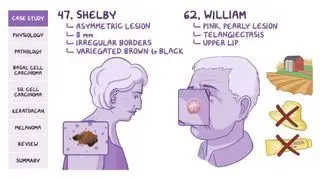
An infographic detailing the melanoma assessment mnemonic, ABCDE.

What is ABCDE?

ABCDE is a mnemonic used to help individuals recognize the warning signs of melanoma. While it provides a simple, straightforward guide to detecting early signs of skin cancer, it is important to note that not all melanomas have all of the characteristics of the ABCDE rule and that some benign lesions may display some of these features as well. Lesions that present with one or more warning signs should be evaluated by a healthcare professional, including a dermatologist, to rule out skin cancer. 

What does the “A” in ABCDE mean?

The “A” in ABCDE means asymmetry, meaning one half of the mole or lesion doesn't match the other half. Asymmetrical moles are usually easy to spot because they look different from the rest of the body, which look similar. This “ugly-duckling” sign can help spot suspicious moles that may need to be examined further. 

What does the “B” in ABCDE mean?

The “B” in ABCDE means border irregularity, which means the edges of the mole are irregular, ragged, blurred, or notched. Normally, benign moles have well-defined borders, whereas atypical moles tend to have more irregular borders due to the invading growth pattern of malignant cells. 

What does the “C” in ABCDE mean?

The “C” in ABCDE means color, which means the color of the mole is not a single shade. It may contain different shades of brown or black, or sometimes patches of red, gray, or dark blue. Although most melanomas are pigmented lesions, some rare types, like amelanotic melanoma, are colorless due to the lack of melanin, which can delay diagnosis. 

What does the “D” in ABCDE mean?

The “D” in ABCDE means a diameter larger than 6 millimeters or 1/4 inch, which is roughly the size of a pencil eraser. Although melanomas can be smaller, this sign may indicate the presence of a malignant or rapidly growing lesion that should be examined further. 

What does the “E” in ABCDE mean?

Finally, the “E” in ABCDE means evolution, which refers to any changes in size, shape, or color, as well as any skin elevation.  

What are the most important facts to know about the ABCDE mnemonic?

ABCDE is a mnemonic used to identify the warning signs of melanoma, an aggressive form of skin cancer that arises from the pigment-producing cells in the skin. ABCDE stands for asymmetry; border irregularities; color variations, such as different shades of brown or black with patches of red, blue, or gray; diameter, often larger than the size of a pencil eraser; and evolution, like changes in size, shape, color, or elevation. 

References


American Academy of Dermatology Ad Hoc Task Force for the ABCDEs of Melanoma, Tsao H, Olazagasti JM, et al. Early detection of melanoma: reviewing the ABCDEs. J Am Acad Dermatol. 2015;72(4):717-723. doi:10.1016/j.jaad.2015.01.025  


Conforti C, Zalaudek I. Epidemiology and risk factors of melanoma: A review. Dermatol Pract Concept. 2021;11(Suppl 1):2021161S. doi:10.5826/dpc.11s1a161s 


Long GV, Swetter SM, Menzies AM, Gershenwald JE, Scolyer RA. Cutaneous melanoma. Lancet. 2023;402(10400):485-502. doi:10.1016/s0140-6736(23)00821-8  


Melanoma warning signs and images. The Skin Cancer Foundation. Published June 3, 2019. Accessed May 13, 2024. https://www.skincancer.org/skin-cancer-information/melanoma/melanoma-warning-signs-and-images/