Bowen Disease · What Is It, Symptoms, Treatment, and More

Published: Oct 22, 2025
Author: Anna Hernández, MD
Editor: Alyssa Haag
Editor: Józia McGowan, DO
Editor: Kelsey LaFayette, DNP, ARNP, FNP-C
Editor: Anna Hernández, MD
Illustrator: Jessica Reynolds, MS
Copyeditor: David G. Walker
7-day free trial

Go deeper with Osmosis

Osmosis is a learning platform with videos, questions, and AI tools to help you master topics like this.

4.8 · 12,000+ reviews
Watch quick, visual videos
Practice with Qbank-style questions
Use AI to explain, quiz, and review
Study anytime with the mobile app
Start free trial

No credit card · Cancel anytime

What is Bowen disease?

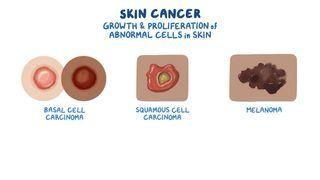
Bowen disease is an early stage of squamous cell carcinoma, a form of skin cancer that involves a group of cells called squamous keratinocytes

Squamous cell carcinoma is the second most common type of skin cancer, after basal cell carcinoma. It can be divided into three stages: actinic keratosisBowen disease, and invasive squamous cell carcinomaActinic keratosis is a precancerous lesion where keratinocytes are damaged by radiation and begin to overproduce keratin. Over time, these damaged keratinocytes can become malignant and develop into squamous cell carcinoma. On the other hand, Bowen disease is considered to be a form of squamous cell carcinoma in situ because cancer cells can be found in the epidermis but have not yet invaded the basement membrane. As squamous cell carcinoma becomes more invasive, it can breach the basement membrane and access blood vessels and lymphatics; from there, it can metastasize to other parts of the body 

Learn deeper with Osmosis

Master this topic faster with videos, questions, and AI.

Used by 8M+ healthcare learners.

Start free trial

No credit card · Cancel anytime

What causes Bowen disease?

There are a number of risk factors that can cause Bowen disease: the most important one being exposure to ultraviolet (UV) radiation from the sun or tanning booths. In general, fair skinned individuals are considered to be at a higher risk of developing skin cancer, and the risk increases with sun exposure over time. Other risk factors for Bowen disease include a weakened immune system (e.g., secondary to solid organ transplantation, HIV infection, or long-term glucocorticoid use), arsenic exposure, and human papillomavirus (HPV) infection. HPV infection is a common sexually transmitted infection (STI) that is generally asymptomatic but can sometimes lead to the development of premalignant and malignant lesions (including cervical cancer) in the anogenital area. Although the relationship is unclear, it has also been associated with cutaneous squamous cell carcinoma and other types of cancer.  

What are the signs and symptoms of Bowen disease?

Bowen disease usually presents as small, well-circumscribed, red or brown patches on the skin with scaly plaques on top. Most cases occur on sun-exposed skin regions, particularly the face, ears, neck, and hands; however, it is also possible for squamous cell carcinoma to develop on sun-protected areas, such as the legs and genitals. Bowen disease tends to grow slowly over months and years. Signs like rapid growth of the lesion, ulceration, bleeding, or pain should arouse suspicion of progression to invasive squamous cell carcinoma.  

How is Bowen disease diagnosed?

Diagnosis of Bowen disease starts with skin examination assessing the characteristics of the lesion as well as a detailed history of the current skin lesion, time of onset, duration, location, and evolution. Dermoscopy typically follows, which is a noninvasive technique that uses a magnifying lens to visualize skin structures that would otherwise not be visible to the naked eye. If Bowen disease or another form of skin cancer is suspected, a tissue biopsy including the subcutaneous tissue may be performed to confirm the diagnosis. On skin biopsy, Bowen disease reveals atypical keratinocytes that involve the full thickness of the epidermis without infiltration into the dermis 

In the anogenital area, Bowen disease should be distinguished from bowenoid papulosis, a premalignant lesion that presents as solitary or multiple small pink, brown, or violaceous papules that can resemble genital wartsBowenoid papulosis is considered a sexually transmitted infection caused by high-risk human papillomavirus, particularly HPV 16. 

How is Bowen disease treated?

There are several treatment options for Bowen disease, both surgical and non-surgical. Surgery is the preferred treatment for Bowen disease and squamous cell carcinoma. Options include standard surgical excision and Mohs surgery, a very precise technique used on high-risk sites, such as the face or genitalia.  

Non-surgical treatments may be performed in selected cases and include curettage and electrodesiccation, cryotherapyphotodynamic therapy, and topical medications. Curettage and electrodesiccation is one of the simplest, safest, and most effective treatments for Bowen disease; however, it can only be performed on small, solitary lesions that have a low risk of progression to invasive disease. It typically involves scraping out the lesion with a curette and then applying light cautery to stop the bleeding.  

Another alternative is cryotherapy, where the tumor is frozen off with liquid nitrogen. This technique is typically used in individuals with multiple superficial lesions where confirmation of the diagnosis has been obtained via a prior biopsy. Side effects of the procedure can include local discomfort and pain, ulceration, and long healing times, as well as hyper- or hypopigmentation, so it is preferred in areas where cosmesis is not a major concern.  

Next, photodynamic therapy is a treatment that uses photosensitizing agents that are activated with light to treat cancer cells. Finally, topical therapy with fluorouracil or imiquimod creams may be used to treat Bowen disease, especially for lesions that are larger than 3 centimeters in diameter and in situations where healing after the other treatment options would be compromised (e.g., lesions that involve the lower legs in older individuals or those with venous stasis disease). 

After successful treatment, individuals should follow up with their clinician to detect any recurrences. Follow-up time may vary between 3 to 6 months to a year, depending on the chosen treatment and the characteristics of the lesion. Because UV radiation is the main risk factor for Bowen disease and skin cancer, individuals may be advised to avoid or minimize sun exposure, use broad spectrum sunscreens daily, and wear protective clothing to protect the skin from the sun. 
What are the most important facts to know about Bowen disease?

Bowen disease is an early form of skin cancer that has the potential to develop into an invasive squamous cell carcinoma. The main risk factor is UV exposure; therefore, sun-exposed areas like the head and neck are particularly affected. Lesions usually appear as small, well-circumscribed, red elevations of the skin with scaly plaques that grow slowly over months or years. Diagnosis involves examining the skin closely with a dermatoscope followed by a skin biopsy. Treatment options include surgery to remove the tumor. In selected cases, non-surgical options may include curettage and electrodesiccation; cryotherapyphotodynamic therapy; and topical treatment, such as chemotherapy creams. 

Key Takeaways

Definition 

Bowen disease is an early stage of squamous cell carcinoma, a form of skin cancer that involves a group of cells called squamous keratinocytes. 

Causes 

- Exposure to ultraviolet (UV) radiation  

- Sun or tanning booths 

- Risk factors 

     - Fair-skinned individuals 

     - Weakened immune system  

          - Organ transplantation 

          - HIV infection  

          - Long-term glucocorticoid use  

     - Arsenic exposure  

     - Human papillomavirus (HPV) infection 

Signs and Symptoms 

- Small, well-circumscribed skin patches  

     - Red or brown  

    - Scaly plaques on top 

     - Slow-growing 

     - Typically on sun-exposed skin regions (face, ears, neck, hands)  

     - Can occur on sun-protected areas (leg, genitals 

- Can progress into invasive squamous cell carcinoma 

     - Rapid growth of the lesion 

     - Ulceration, bleeding, or pain  

Diagnosis 

- Skin assessment 

- Detailed history of the lesion  

     - Time of onset, duration, location, evolution  

- Dermoscopy (with magnifying lens) 

- Tissue biopsy  

- Differential diagnosis 

     - In anogenital area, distinguish from bowenoid papulosis caused by HPV  

Treatment 

- Surgical (preferred)  

     - Standard surgical excision  

     - Mohs surgery for high-risk sites (face or genitalia)   

- Non-surgical treatments  

     - Curettage and electrodesiccation  

     - Cryotherapy  

     - Photodynamic therapy  

- Topical medications  

Students say Osmosis is 100% worth it

Because Osmosis saves them time. Lowers stress. And actually helps them remember when it counts.

I used Osmosis to prepare for my first medical school licensing exam! Super helpful and interactive for people who may not do great with just pages of text info!

Cecilia Ruiz

Cecilia Ruiz

MD student

Sayan Misra

I have used Osmosis for about four years. Best thing I have ever used for my medical studies.

Sayan Misra

Sayan Misra

Med student

Osmosis videos are superior because they define simple concepts, tell a story with a clear progression, and provide context.

Jay Pate

Jay Pate

Dental student

References


Mohandas P, Lowden M, Varma S. Bowen’s disease. BMJ. 2020;368:m813. doi:10.1136/bmj.m813 


Petzold A, Wessely A, Steeb T, Berking C, Heppt MV. Efficacy of interventions for cutaneous squamous cell carcinoma in situ (Bowen’s disease): a systematic review and meta-analysis of proportions. J Eur Acad Dermatol Venereol. 2025;39(3):543-554. doi:10.1111/jdv.20267 


Rohini, Joseph LD, Priyadarshini A. Bowen’s disease: clinico pathological correlation with review of literature. Int J Res Dermatol. 2024;10(2):99-102. doi:10.18203/issn.2455-4529.intjresdermatol20240397 


Zhou C, Jiang B, Zhang K, et al. Clinical and histopathological characteristics, diagnosis and treatment, and comorbidities of Bowen’s disease: a retrospective study. Front Med (Lausanne). 2023;10:1281540. doi:10.3389/fmed.2023.1281540