
Dupuytren Contracture · What Is It, Risk Factors, Treatment, and More

Published: Mar 04, 2025
Author: Anna Hernández, MD
Editor: Alyssa Haag
Editor: Emily Miao, PharmD
Editor: Kelsey LaFayette, DNP
Illustrator: Jessica Reynolds, MS
Copyeditor: David G. Walker
7-day free trial

Go deeper with Osmosis

Osmosis is a learning platform with videos, questions, and AI tools to help you master topics like this.

4.8 · 12,000+ reviews
Watch quick, visual videos
Practice with Qbank-style questions
Use AI to explain, quiz, and review
Study anytime with the mobile app
Start free trial

No credit card · Cancel anytime

What is Dupuytren contracture?

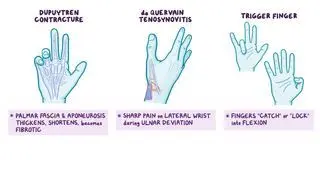
Dupuytren contracture is a condition where one or more fingers become permanently bent towards the palm of the hand, ultimately affecting finger mobility and grip strength. While it is a benign disorder, Dupuytren contracture can significantly impact daily life as it can cause difficulty with activities such as wearing gloves, holding objects, shaking hands, and putting hands into pockets. 

The palmar fascia, which is the fibrous layer of connective tissue that lies underneath the skin of the palm and fingers, is affected in Dupuytren contracture. With this condition, the palmar fascia gradually thickens as a result of excessive collagen deposition, leading to the formation of tight, tendon-like cords that lead to flexion deformities of the affected fingers.

Learn deeper with Osmosis

Master this topic faster with videos, questions, and AI.

Used by 8M+ healthcare learners.

Start free trial

No credit card · Cancel anytime

What causes Dupuytren contracture?

The exact cause of Dupuytren contracture is not completely understood; however, both genetic and environmental factors seem to play a role in its development. It typically affects individuals over the age of 40 who are assigned male at birth, and is more common in those of Northern-European heritage. Risk factors for developing Dupuytren contracture include a family history of the condition, alcohol dependence, tobacco smoking, liver or thyroid disease, and diabetes mellitus. Some studies show Dupuytren contracture may also be related to microtrauma associated with repetitive movements of the hand, such as those seen in manual workers.

What are the signs and symptoms of Dupuytren contracture?

The first sign of Dupuytren contracture is often a painless lump, or nodule, at the base of a finger on the palm of the hand. This may be followed by deep dents on the surface of the palm as the affected tissue pulls on the overlying skin. Over time, nodules may turn into longitudinal cords, which are thick bands of fibrous tissue that pull on the flexor tendons of the fingers, causing them to become permanently bent into a flexed position. As the condition progresses, Dupuytren contracture can prevent individuals from fully extending one or more fingers, limiting hand mobility and grip strength.

Dupuytren contracture often occurs bilaterally, but one hand is typically more affected than the other. Although any finger can be involved, contractures typically affect the fourth and fifth fingers. The disease typically progresses slowly over the course of years, but the rate of progression and severity vary between individuals. 

Some individuals with Dupuytren disease also develop abnormal growth of fibrous tissue in other parts of the body. For example, there may be plantar fibromatosis, known as Ledderhose disease: a disorder that causes fibrosis of the plantar fascia, thereby resulting in nodules on the bottom of the feet. Additionally, there may be thickening of the corpus cavernosum of the penis, called Peyronie disease, which causes a distinct curvature of the penis that can make erections painful. Other signs include skin changes in the knuckles, known as Garrod nodes or knuckle pads.

How is Dupuytren contracture diagnosed?

Diagnosis of Dupuytren contracture is based on a history of painless loss of extension of the fingers along with a physical examination. A clinician may examine the palm of the hand for nodules and cords as well as measure the range of motion of the fingers. A simple way to determine the severity of the contractures is the tabletop test, which is when the individual lays their hand flat on a table to observe if there is any space beneath it. When the individual is no longer able to lay the hand flat, surgical treatment is generally recommended. 

How is Dupuytren contracture treated?

Treatment of Dupuytren contracture depends on the stage of presentation. In early stages with no functional impairment, management typically involves observation as there is no treatment available to slow down or halt the progression of the disease. Several treatment options, such as physical therapy, splinting, radiotherapy, or extracorporeal shock wave therapy (ESWT), have been used with varying results but are generally not recommended due to a lack of evidence.

Individuals who present with functional impairment in early stages of the disease can be treated with collagenase injections, which contain enzymes that break down the collagen that forms the fibrous cords. Treatment with collagenase injections has less complications than surgery but a higher recurrence rate and is done in a two-step process. In a first visit, collagenase is injected directly into a Dupuytren cord. In the second visit, after a few days, the finger is manipulated carefully until the cord ruptures, allowing for an immediate release of the contracture.

Generally, individuals with more advanced contractures require surgery in order to improve function. The most common technique is called a fasciectomy, which involves removing as much of the affected fascia as possible to relieve the affected tendons and regain mobility. A dermofasciectomy is a similar technique where some of the skin from the palm or fingers is removed along with the fascia and a skin graft is applied to cover the area. A less common procedure is called needle aponeurotomy, a minimally invasive technique that uses a fine needle to perforate the cord at different levels, allowing the contracture to release. 

It is important to note that, while surgery has good functional outcomes in most cases, recurrence rates are high and some individuals require more than one intervention during the course of the disease; this increases the risk of complications.


What are the most important facts to know about Dupuytren contracture?

Dupuytren contracture is a connective tissue disorder that causes one or more fingers to become bent towards the palm of the hand due to thickening of the palmar fascia. Risk factors include a positive family history; tobacco smoking; alcohol use; and medical conditions, like diabetes mellitus. Signs and symptoms include nodules and cords that lead to flexion contractures, limiting the mobility of the fingers. Currently, there is no treatment to halt the progression of the disease; however, there are several treatment options to relieve the symptoms.
Students say Osmosis is 100% worth it

Because Osmosis saves them time. Lowers stress. And actually helps them remember when it counts.

I used Osmosis to prepare for my first medical school licensing exam! Super helpful and interactive for people who may not do great with just pages of text info!

Cecilia Ruiz

Cecilia Ruiz

MD student

Sayan Misra

I have used Osmosis for about four years. Best thing I have ever used for my medical studies.

Sayan Misra

Sayan Misra

Med student

Osmosis videos are superior because they define simple concepts, tell a story with a clear progression, and provide context.

Jay Pate

Jay Pate

Dental student

References


Boe C, Blazar P, Iannuzzi N. Dupuytren contractures: an update of recent literature. The Journal of Hand Surgery. 2021;46(10):896-906. doi:10.1016/j.jhsa.2021.07.005


Dutta A, Jayasinghe G, Deore S, Wahed K, Bhan K, Bakti N, Singh B. Dupuytren’s contracture – current concepts. Journal of Clinical Orthopaedics and Trauma. 2020;11(4):590-596. doi:10.1016/j.jcot.2020.03.026


Grazina R, Teixeira S, Ramos R, Sousa H, Ferreira A, Lemos R. Dupuytren’s disease: where do we stand? EFORT Open Reviews. 2019;4(2):63-69. doi:10.1302/2058-5241.4.180021


Nanchahal J, Chan JKK . Treatments for early-stage Dupuytren’s disease: an evidence-based approach. The Journal of Hand Surgery, European Volume. 2023;48(3):191-198. doi:10.1177/17531934221131373


van den Berge BA, Wiberg A, Werker PMN, Broekstra DC, Furniss D. Dupuytren’s disease is a work-related disorder: results of a population-based cohort study. Occupational and Environmental Medicine. 2023;80(3):137-145. doi:10.1136/oemed-2022-108670