
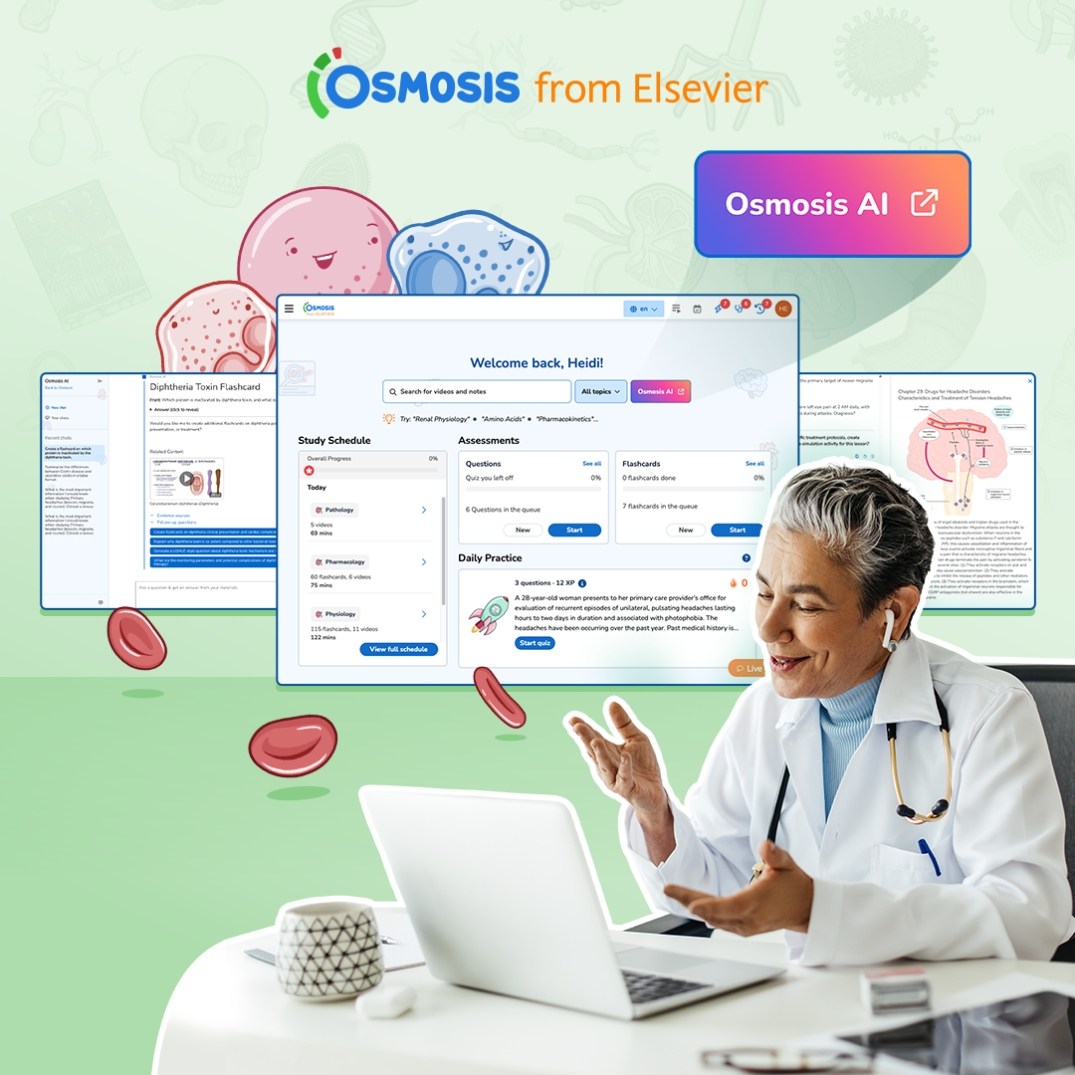
Osmosis AI is now available in our MD product. Contact your Elsevier representative to see when Osmosis AI will be available at your institution.
Medical educators today face a growing array of demands. Preparing engaging lessons, developing formative assessments, and supporting diverse learners all require time and effort amid busy schedules.
Created specifically for medical education, Osmosis AI was developed to address these challenges. This conversational, AI-powered tool delivers trusted explanations grounded in Elsevier sources, providing reliable, visually engaging, evidence-based support that helps faculty teach more efficiently and students learn more effectively.
Below, we explore key ways Osmosis AI can enhance your teaching experience, along with practical example prompts to help you get started.
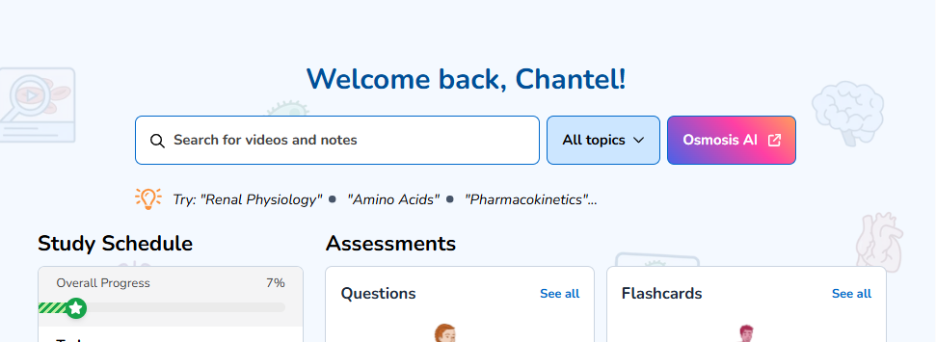
Leveraging Osmosis and Elsevier Visuals for Engaging Lessons
Visual aids play a crucial role in medical education by helping students grasp complex concepts more easily. Osmosis AI recommends relevant Osmosis videos and Elsevier textbook diagrams, charts, and illustrations alongside your topic searches, making it simple to discover and integrate trusted visuals into your lessons.
Trustworthy, Evidence-Based Content You Can Rely On
Osmosis AI helps institutions lead the way in responsible AI use by offering students and faculty a transparent solution that draws exclusively from vetted medical sources rather than the open web. Every explanation, recommendation, and study tool generated provides references to the trusted evidence-based sources used, reinforcing academic integrity.
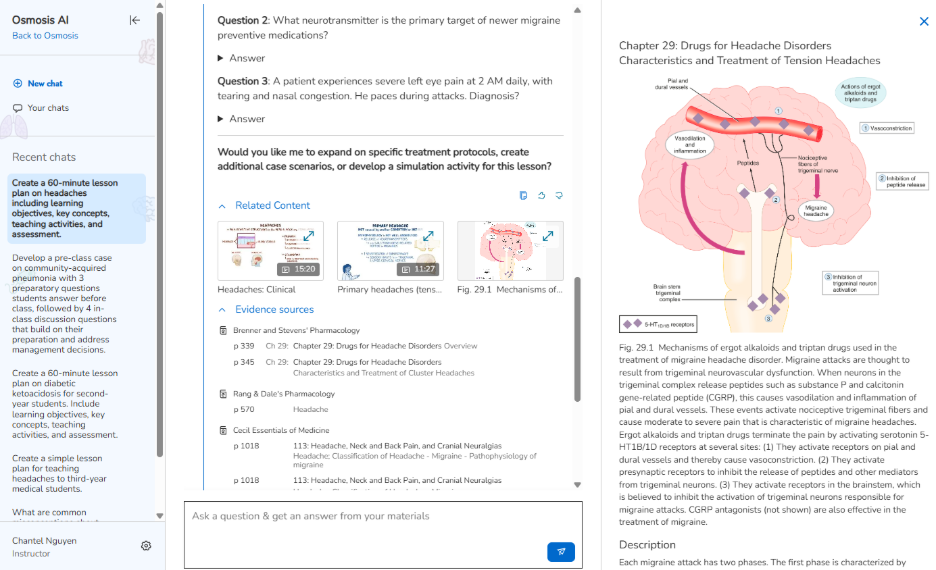
Streamline Lesson Preparation
Context-aware AI that reduces the need for long prompting to help you quickly generate clear, structured lesson plans tailored to specific topics and learner levels. These lesson plans incorporate evidence-based teaching practices while respecting your unique approach, saving valuable preparation time.
Consider using prompts like these during course preparation:
- “Create a 60-minute lesson plan for first year medical students on __________ including learning objectives, key concepts, teaching activities, and assessment.”
- “Create a one-page reference sheet on __________”
By assisting with routine lesson planning, Osmosis AI allows you to focus more on delivering engaging lectures and providing more personalized guidance to your students.
Enhance Teaching with Practical Tips and Strategies
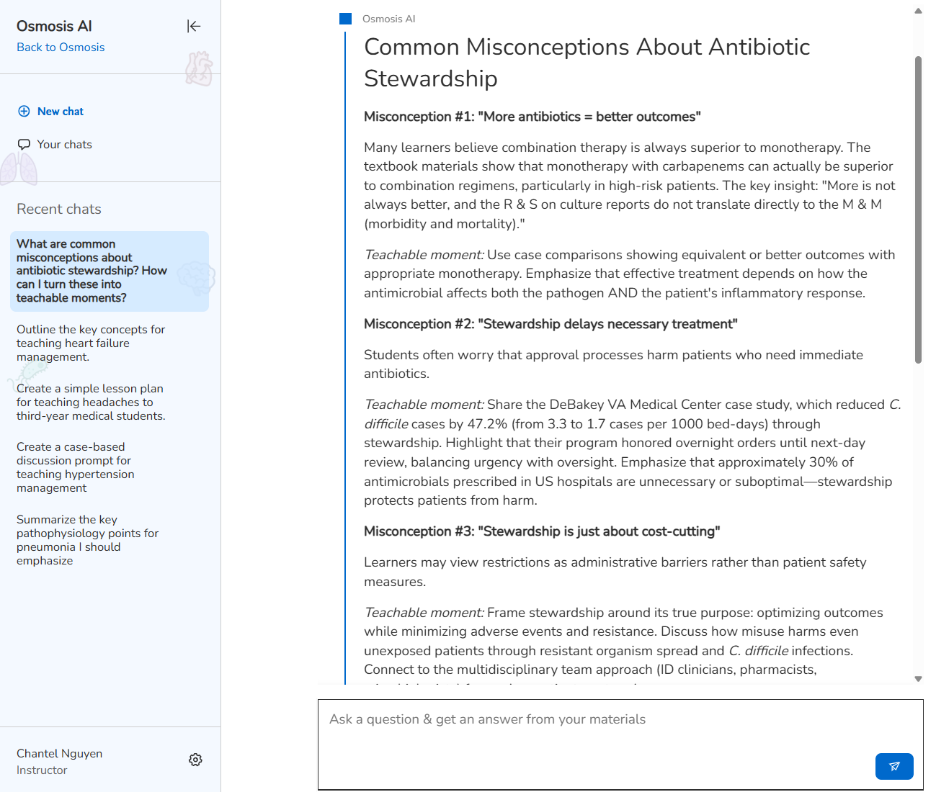
Osmosis AI provides practical teaching tips, clinical pearls, and active learning strategies that simplify complex topics and highlight common misconceptions, transforming them into valuable teachable moments. These insights promote deeper understanding and keep students engaged throughout the learning process.
Try prompts like these:
- “What are common misconceptions about __________? How can I turn these into teachable moments?”
- “What’s a memorable clinical pearl or teaching analogy I can use to help students remember __________”
Save Faculty Time on Assessment Creation
Creating formative assessments is often a time-consuming and resource-intensive task for faculty, requiring careful thought to ensure questions are clear, relevant, and aligned with learning objectives.
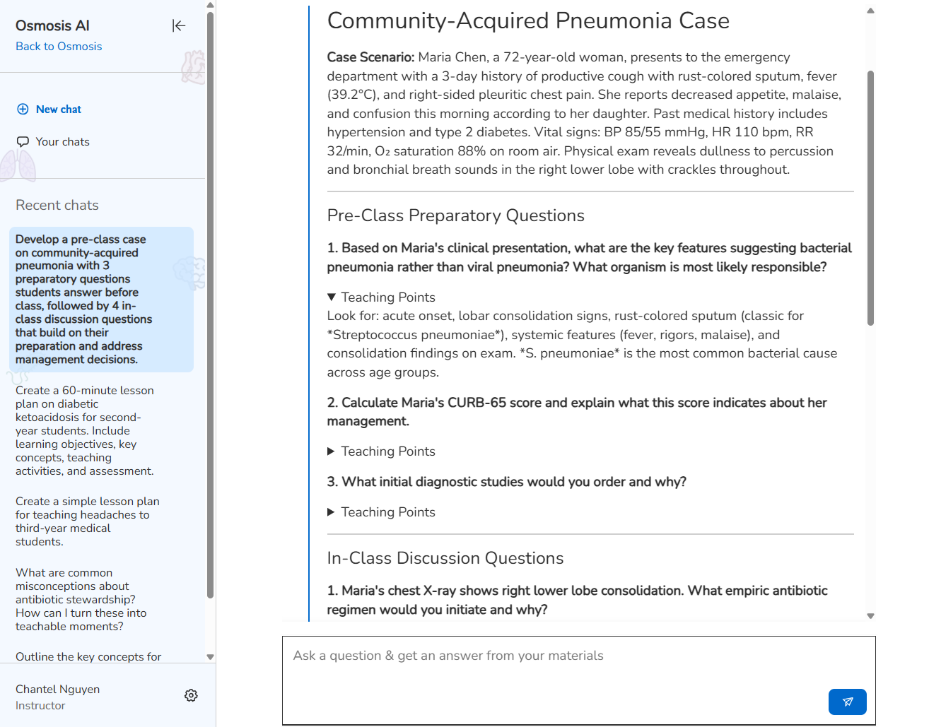
Osmosis AI streamlines this process by effortlessly generating a variety of assessment materials—including multiple-choice questions, case prompts, diagnostic reasoning exercises, observation checklists, and more— that are thoughtfully designed to support diverse learning styles and your learning objectives. By providing these ready-to-use resources, Osmosis AI frees up valuable time, allowing you to shift your focus from the administrative burden of content creation to more meaningful activities like personalized student coaching and fostering active learning in the classroom.
Explore these assessment prompts:
- “Generate five USMLE® -style multiple-choice questions on __________”
- “Create a pre-class case prompt on __________ with three preparatory questions, followed by four in-class discussion questions that build on the pre-work.”
- “Create a case study that assesses __________.”
Support Student Learning and Exam Preparation
Beyond faculty support, Osmosis AI was also designed to enhance student learning by enabling users to interact using natural language, engaging in a back-and-forth exchange of questions and answers in the moment of learning. Osmosis AI links concepts to relevant Osmosis videos to improve comprehension and helps students clarify difficult topics. Osmosis AI also generates targeted recall questions, flashcards, quizzes, visual study aids, and more to strengthen active recall and boost exam readiness.
For more details on how Osmosis AI supports students, check out this blog post.
Start exploring Osmosis AI today!
Osmosis AI is a powerful, evidence-based tool designed to help medical faculty manage the growing demands of teaching while enhancing student learning. By linking trusted Osmosis videos, streamlining lesson preparation, generating assessments, and more, Osmosis AI saves faculty time and supports more effective, engaging instruction.
Osmosis AI is now available in our MD product. Contact your Elsevier representative to see when Osmosis AI will be available at your institution.
Log in to your account and try Osmosis AI today.
Not using Osmosis yet? Start a conversation and learn how Osmosis can support your institution’s goals today!
Osmosis AI is designed to support teaching and learning. It’s not a substitute for professional medical advice, diagnosis, or treatment. Content is provided for educational purposes only and is only derived from English sources. No translation has been human reviewed. Please refrain from sharing personal, sensitive, or protected information when using AI-powered features.
Key Takeaways
- Osmosis AI integrates trusted Elsevier content to enrich results.
- The new tool streamlines planning and creates ready-to-use formative assessments.
- Content is sourced from vetted medical references to support integrity.
- Students benefit from recall questions, flashcards, quizzes, and visual aids.
- Availability is currently through the MD product; reach out to to our team for access.
Leave a Reply