Acute compartment syndrome: Nursing process (ADPIE)
Definitions & Key takeaways
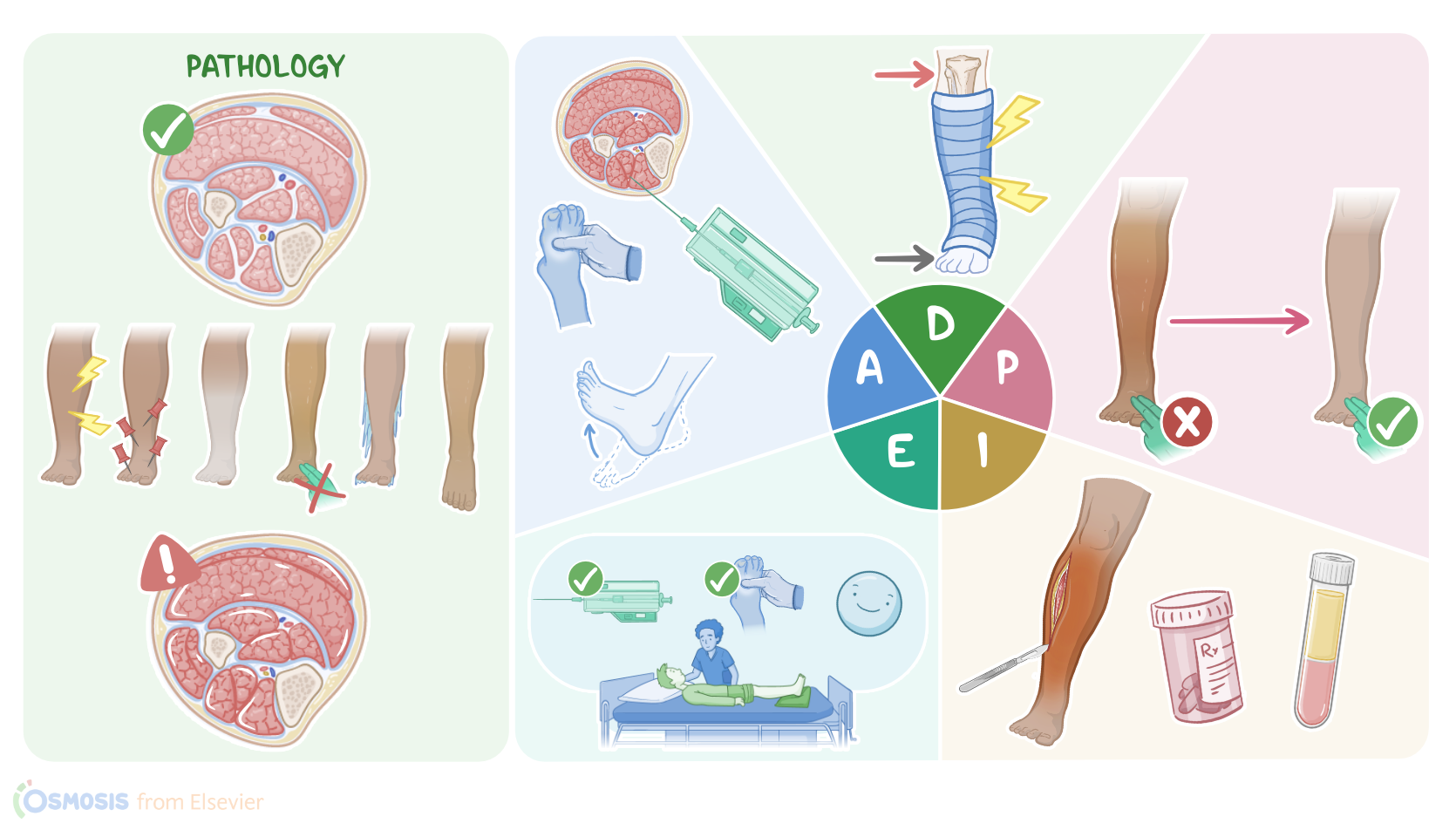
Acute compartment syndrome is a condition that occurs when the pressure in a muscle compartment rises to a level that inhibits blood flow to the muscles and nerves. The main cause of this condition is blunt trauma, but it can also occur due to exercise-induced muscle damage, burns, or surgery. If left untreated, acute compartment syndrome can lead to permanent nerve damage and muscle ischemia, and eventually necrosis.
Client Report0:00–0:43
Wang Lee is a 26 year old male client who presents to the emergency department or ED while snowboarding this morning, Mister Lee sustained a non-displaced transverse fracture in his right tibial shaft.
A cast was applied in the ED, and he was discharged home with a prescription for the opioid analgesic acetaminophen with codeine for pain.
Mr. Lee came back to the ED six hours later, stating his pain is unbearable with a rating of 10 out of 10.
He says the pain medication isn't helping at all, and it feels like there are pins and needles in his leg under the cast.
The ED team urgently begins evaluating Mr. Lee for acute compartment syndrome.
Acute compartment syndrome is a serious condition in which there's a rapid increase in the pressure within an enclosed compartment that contains muscles, nerves, and blood vessels surrounded by a layer of fibrous connective tissue called fascia.
Pathophysiology0:43–2:24
Since the fascia is not elastic, it can't stretch much, so when the pressure within these compartments rises, normal blood flow can be cut off, leading to tissue damage due to hypoxia and ischemia.
The most common cause of acute compartment syndrome is bleeding within the compartment. This typically occurs with long bone fractures like the tibia, as well as penetrating injuries.
Any limb compression, like from a crush injury or severe contusion, can also lead to acute compartment syndrome. Other causes are severe circumferential burns, which can lead to tissue edema.
Finally, another potential cause can be reperfusion injury in clients who experience prolonged tissue hypoxia, where a sudden restoration of blood supply can result in massive inflammation and edema.
Now there are also some factors that may put the client at an increased risk of acute compartment syndrome, such as experiencing severe trauma, penetrating injury, motor vehicle crash, or burn injury.
Acute compartment syndrome can also occur in clients who receive massive amounts of intravenous fluids which may extravasate and infiltrate into the tissue or those at increased risk of bleeding, such as clients with bleeding disorders such as hemophilia or those who take anticoagulation therapy like warfarin.
Finally, an important risk factor is compression from external factors such as with constrictive bandages, casts, and tight dressings.
All right. Acute compartment syndrome most commonly affects the legs.
Clinical features2:24–3:11
The typical symptoms can be remembered by the six P's. The earliest two symptoms are severe pain out of proportion to the injury and paresthesia, or a feeling of pins and needles or numbness in the affected compartment.
In addition, the affected compartment will be swollen and very stiff like a piece of wood. If not promptly treated, clients may develop the next three P's, which are pallor, pulselessness, where the distal arterial pulses become very weak or even absent, and poikilothermia, which refers to coolness of the affected area.
The last P stands for paralysis, which is rare and suggests extensive damage to both the muscles and nerves. Acute compartment syndrome can lead to serious long-term complications such as necrosis and gangrene, which can occur when the normal blood flow is not established in time.
Complications3:11–3:57
In addition, the necrotic tissue is more susceptible to become infected. Another complication is rhabdomyolysis or muscle destruction, which ultimately leads to muscle scarring and contractures that restrict movement.
Now with rhabdomyolysis, myoglobin is released from the destroyed muscle cells into the bloodstream, and it's filtered out by the kidneys.
As a consequence, rhabdomyolysis can also result in acute kidney injury. Finally, acute compartment syndrome can result in irreversible nerve damage, leading to permanent motor and sensory deficits.
Diagnosis and treatment3:57–5:21
Now when acute compartment syndrome is suspected based on history and physical exam, the next thing to do is to measure the compartment pressure using a handheld manometer.
The diagnosis is confirmed if compartment pressure is greater than 30 millimeters of mercury or when the delta pressure, which is the diastolic pressure minus compartment pressure, is lower than 30 millimeters of mercury.
In addition, imaging techniques like X-rays, CT scan, MRI, and ultrasound can help locate bone, muscle, and blood vessel injuries.
Laboratory tests are also done to monitor the client. These include a complete blood count showing elevated white blood cells and an elevated erythrocyte sedimentation rate in case of infection.
When rhabdomyolysis develops, a laboratory workup can show elevated levels of creatine kinase and myoglobin, while urinalysis can show tea-colored urine due to high levels of myoglobin.
Acute compartment syndrome needs prompt action. When the compartment syndrome is caused by some external factors like a cast, its removal can result in spontaneous recovery.
Most often though, treatment involves a surgical procedure called a fasciotomy, where the skin and fascia are cut open, relieving the pressure and reestablishing normal blood flow.
However, if the tissue is already necrotic and gangrenous, the limb should be amputated. All right, let's begin Mister Lee's assessment.
Assessment5:21–7:18
After confirming his identity, you introduce yourself as his nurse and perform hand hygiene. Immediately you notice Mister Lee is laying on the exam table, grimacing in pain.
You ask Mister Lee how he is feeling, and he replies, Terrible. I've never been in this much pain, and this feeling of pins and needles is driving me crazy.
How can I make it go away? On a scale of 0 to 10, he rated the pain in his right leg a 10.
His other vital signs include temperature 97.4 °F or 36.3 °C, heart rate 118 BPM and regular, respirations 18 breaths per minute and clear bilaterally, BP 146/82 millimeters of mercury.
And oxygen saturation 100% on room air. Moving to his lower extremities, you note his right foot appears pale and feels cooler to touch compared to his left foot.
Otherwise, his skin is warm, dry, and intact with good turgor. His left foot has capillary refill of less than 3 seconds, but his right foot has capillary refill of 5 seconds.
Because of his cast, you are unable to compare his distal lower extremity pulses. You document your assessment and notify the physician of your assessment findings.
You emphasize your concern for possible acute compartment syndrome. The physician immediately evaluates Mr.
Lee and requests you assist him with removing the cast. When the cast is removed, you note his right lower leg feels stiff like a piece of wood and appears swollen.
The physician performs dorsiflexion of Mr. Lee's right foot, and Mr.
Lee shouts, Ouch. Next, the physician measures the anterior tibial compartment pressure and reports a reading of 32 millimeters of mercury, confirming the diagnosis of acute compartment syndrome.
Nursing diagnoses7:18–7:44
OK, now that your assessment is complete and you construct nursing diagnoses for Mr. Lee, including acute pain related to tissue injury and ischemia.
Ineffective peripheral tissue perfusion related to a constrictive cast causing increased compartment pressure, risk for peripheral neurovascular dysfunction related to impaired blood flow, and readiness for enhanced knowledge related to a new diagnosis.
Planning7:44–8:10
With these diagnoses in mind, you are ready to create a care plan to guide Mr. Lee's care.
Within 4 hours, Mr. Lee will report decreased pain from his current level of 10 out of 10, have improved blood flow to his right lower extremity, and show no further signs of peripheral neurovascular dysfunction.
By the end of your shift, Mister Lee will verbalize understanding of his diagnosis of compartment syndrome and his treatment plan.
All right. With goals in place, you can implement your plan with the help of an interdisciplinary team.
Implementation8:10–9:53
Physician orders include a surgical consult in case an urgent fasciotomy is required, pain medications including opioid analgesic hydrocodone with acetaminophen, and the NSAID ibuprofen.
And labs including a complete blood count, erythrocyte sedimentation rate, myoglobin, creatine kinase, kidney function tests, and urinalysis.
You delegate vital sign monitoring and lab collection to the patient care technician requesting that you be notified immediately of changes in Mr.
Lee's vital signs. With the cast removed, Mr.
Lee reports a pain score of 8 out of 10. So you administer the ordered analgesics and request that he notifies you if his pain does not reach a tolerable level, which he states is a 5 out of 10.
To decrease swelling, you elevate his right lower extremity, but ensure it is not elevated above the heart, as this could decrease perfusion and worsen compartment syndrome.
You perform neurovascular assessments every 30 minutes knowing you should notify the physician immediately of worsening pain, numbness, tingling, cyanosis, necrosis, absent pulses, or if his leg does not improve within 4 hours of cast removal.
Throughout your shift you teach Mister Lee about compartment syndrome, how the increased pressure in his leg is causing the symptoms he is experiencing, complications he is being monitored for, such as rhabdomyolysis, what a fasciotomy is, and what symptoms would warrant the need for an urgent fasciotomy during your shift.
You document assessment findings and nursing interventions provided. Now let's evaluate the nursing interventions you've provided so far.
Evaluation9:53–11:33
4 hours into your shift, neurovascular assessments have revealed Mr. Lee is regaining normal sensation, has decreased swelling, and has equal and normal pulses, capillary refill, color, and temperature in his bilateral lower extremities.
The physician performs a repeat compartment pressure measurement and reports a reading of 8 millimeters of mercury. Mr.
Lee's latest vital signs. Our temperature 98.0 °F or 36.7 °C.
Heart rate 80 BPM. Respirations 14 breaths per minute.
BP 116/70 millimeters of mercury. Oxygen saturation 100% on room air, and pain 4 out of 10.
Lab results include erythrocyte sedimentation rate 15 millimeters per hour, myoglobin 30 nanograms per milliliter, creatine kinase, 100 international units per liter.
Creatinine 1.0 mg per deciliter, BUN 19 mg per deciliter, and urinalysis within normal limits. By the end of your shift, Mr.
Lee verbalized his understanding of compartment syndrome as well as his treatment plan. Before giving a report to the next nurse, you ensure you document all assessment findings and nursing interventions provided.
Happy to have avoided the fasciotomy, Mr. Lee is waiting to be admitted to the orthopedic unit for close monitoring and a treatment plan that will allow his fracture to properly heal.
Summary11:33–12:35
All right, as a quick recap, your client, Mister Lee was treated in the ED for acute compartment syndrome, which is when the pressure increases within a group of muscle, nerves, and blood vessels surrounded by fascia, resulting in tissue ischemia and neurovascular damage if left untreated.
Assessment findings revealed severe pain, paresthesia, and decreased perfusion to the right lower extremity. Your nursing diagnoses included acute pain, impaired tissue integrity, ineffective peripheral tissue perfusion, risk for peripheral neurovascular dysfunction, and readiness for enhanced knowledge related to a new diagnosis.
Nursing care planned and implemented involved pain management, elevating the affected extremity, frequent neurovascular assessments, and education about compartment syndrome and his treatment plan.
The care provided was evaluated and you will continue to tailor his care plan with the help of the interdisciplinary team until his transfer to the orthopedic floor.
| ACUTE COMPARTMENT SYNDROME | ||
| KEY POINTS | NOTES | |
| PATIENT REPORT |
| |
| PATHOPHYSIOLOGY |
| |
| DIAGNOSIS AND TREATMENT |
| |
| ASSESSMENT |
| |
| NURSING DIAGNOSES |
| |
| PLANNING |
| |
| IMPLEMENTATION |
| |
| EVALUATION |
| |
- "Diagnosing the Diagnostic and Statistical Manual of Mental Disorders: Fifth Edition" Routledge (2019)
- "Saunders Comprehensive Review for the NCLEX-RN Examination" Elsevier (2022)
- "Critical care nursing: Diagnosis and management (9th ed)" Elsevier (2022)
- "Harrison’s principles of internal medicine" Mcgraw Hill (2022)
- "Acute compartment syndrome" Medicine (2019)
- "Diagnosing acute compartment syndrome—where have we got to?" International Orthopaedics (2019)
- "Acute compartment syndrome. Muscle, Ligaments and Tendons Journal" MLTJ (2015)
No notes for this video yet
Try adding a note below