Amputation: Nursing
Introduction0:00–0:14
Causes0:14–0:43
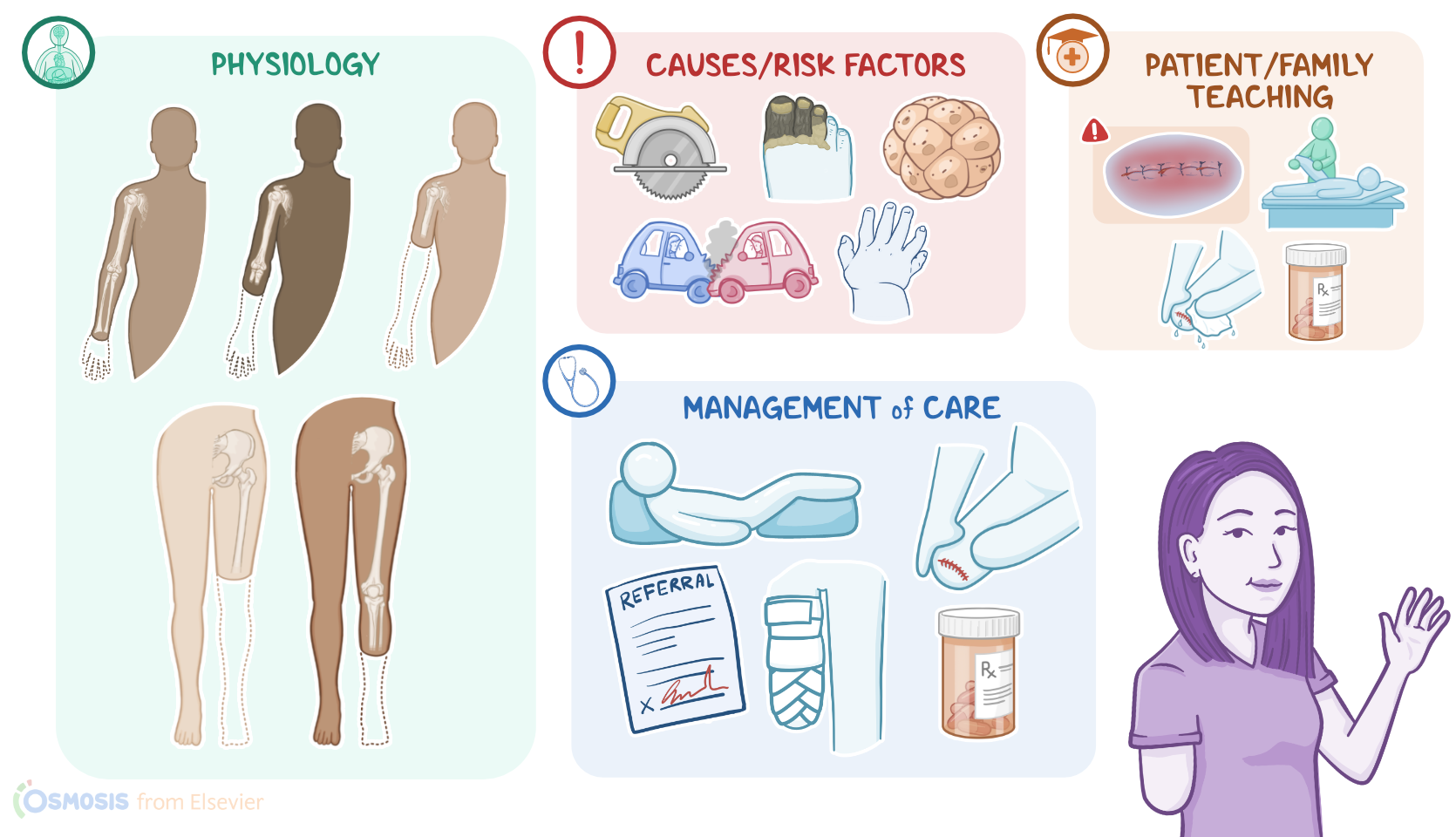
Amputation can also be performed surgically to prevent or manage a condition, such as tissue death and gangrene, which can be caused by peripheral vascular diseases or neurological conditions like diabetic neuropathy, infections like osteomyelitis, thermal injuries, cancer, and congenital limb disorders.All right, so in terms of classification, limb amputations may occur above a joint, such as the elbow, called above elbow amputation or AEA for short, or the knee, called above knee amputation, also known as, AKA; as well as below a joint, such as below elbow amputation or BEA for short, or the knee, called below knee amputation or BKA.
Classification0:43–1:15
Amputation can even happen through a joint, which is called disarticulation.Now, undergoing an amputation carries a risk for certain complications.
Complications1:15–2:36
The most common one is local or wound pain; as well as neuroma, which is a tender thickening of a nerve stump in the scar region after amputation, so upon palpation, clients experience sharp shooting pain.
Another type of pain in amputation is known as phantom limb, in which the client may perceive unpleasant sensations like tingling or even sharp pain in the limb that has been amputated.
In addition, clients may develop contractures, where the affected tissues like skin, muscles, and ligaments become stiff and fibrous, leading to restrictions of movement.
Other complications include local infections of the amputation stump, most often caused by bacteria colonizing the skin, like Staphylococcus species; and if not treated in time, local infections can lead to sepsis.
Another very serious complication from amputation is hemorrhage, which can either occur immediately if a major blood vessel is involved, or can be associated with poor wound healing; if not managed promptly, a severe hemorrhage can lead to shock.
Finally, clients undergoing amputation may experience psychological complications, such as grieving over the loss of the body part, as well as depression, and decreased self-esteem.
Management of care2:36–5:06
All right, let’s look at the nursing care you’ll provide to a client with a lower extremity amputation. Your priority nursing goals are to provide postoperative care, monitor for complications, and provide emotional support.
Begin by implementing routine postoperative interventions, and institute measures to promote comfort and healing. For the first 24 hours postoperatively, elevate the foot of the bed and support the affected extremity on pillows to further decrease swelling.
Then, after 24 hours, discontinue elevating the extremity, and begin positioning your client in a prone position two times each day for 20 to 30 minutes, to help prevent flexion contractures of the hip.
Also gently massage the skin of the residual limb towards the suture line to promote circulation, and to help prevent scar tissue from adhering to the underlying bone.Then, apply a compression bandage using a figure eight limb-wrapping technique, which will promote comfort, reduce swelling, and help mold the residual limb for prosthesis.
Remember to avoid wrapping the extremity too tightly or in a circular pattern, as these can impair circulation. Also, frequently monitor your client’s level of pain, and administer the prescribed analgesics, as needed.
Lastly, institute fall precautions, collaborate with the physical therapist to implement early mobility and strengthening exercises, and assist your client to use a trapeze bar to make position changes.
Now, be sure to keep a close eye on the surgical site for the development of complications. Assess the extremity for bleeding, infection, and for changes in color, temperature or sensation.
Immediately report if bright red bleeding occurs; if you note redness, purulent drainage or a foul odor at the incision site; if the stump becomes cold or has a bluish or purplish discoloration; or if your client develops numbness or tingling of the extremity.
Finally, promote an accepting and supportive care environment, and encourage your client and their family to express their feelings and grief over the lost limb and changes in body image.
Encourage them to look at, feel, and participate in the care of the residual limb. Lastly, ensure a referral for occupational and rehabilitation services is in place, and that counseling is available, as needed.Okay, let’s move on to client and family teaching.
General client & family teaching5:06–7:08
Begin by reviewing their plan of care, and instruct them to administer their prescribed medications exactly as directed.
Emphasize the importance of keeping all of the follow-up appointments with their healthcare providers, including their physical therapist and prosthetist-orthotist.
Encourage rehabilitation and residual limb sensitization by teaching them kneading massage. Also be sure to teach your client range of motion exercises to help maintain muscle strength and prevent contractures.
Let them know that the residual limb can be washed and gently dried two times a day after it’s healed. Advise them to monitor the suture site, and notify their healthcare provider if they notice any redness, swelling, or increased pain at the surgical site; or if there are any changes to the color or skin of the stump.Then, to help prepare them for prosthesis, teach your client how to perform progressive resistive techniques, which include gently pushing the limb against pillows and eventually progressing to using more firm surfaces.
Also teach your client how to apply a compression wrap using the figure 8 technique. Let them know this will help to shrink and mold the extremity, and that they should reapply it every 4 to 6 hours, or whenever it becomes loose.
Finally, let your client know that after 2 to 3 months they may experience phantom limb pain, which can include numbness, tingling, and muscle cramps in the body part that is no longer present.
Reassure them that this type of pain is common in amputees, and treatments are available. Encourage them to contact their healthcare provider right away if they experience phantom limb pain.All right, as a quick recap… Amputation is when an extremity is separated from the rest of the body.
Review7:08–8:02
This most often involves a limb or a part of it like a digit, but can also involve a portion of the nose or ears. Now, the causes of amputation can include trauma, peripheral vascular diseases or neurological conditions like diabetic neuropathy, infections like osteomyelitis, thermal injuries, cancer, or congenital limb disorders.
An amputation can also be performed surgically to prevent or manage a condition. Complications include pain, infections, hemorrhage, contractures, and low self-esteem.
The goal of nursing care is centered on providing postoperative care, monitoring for complications, and providing emotional support.
Client and family teaching includes learning how to manage the amputation at home, how to prepare for prosthesis, and when to contact the
| AMPUTATION | ||
| KEY POINTS | NOTES | |
| DEFINITION |
| |
| CAUSES AND RISK FACTORS |
| |
| CLASSIFICATIONS |
| |
| COMPLICATIONS |
| |
| MANAGEMENT OF CARE |
| |
| PATIENT AND FAMILY TEACHING |
| |
- "Medical-Surgical Nursing" Elsevier (2020)
- "Medical-Surgical Nursing" Mosby (2016)
- "Saunders Comprehensive Review for the NCLEX-RN Examination" Elsevier (2018)
- "Brunner & Suddarth's Textbook of Medical-surgical Nursing" Lippincott Williams & Wilkins (2009)
- "Epidemiology and Risk of Amputation in Patients With Diabetes Mellitus and Peripheral Artery Disease" Arteriosclerosis, Thrombosis, and Vascular Biology (2020)
- "Assistive technologies for pain management in people with amputation: a literature review" Military Medical Research (2018)
- "Assistive technologies for pain management in people with amputation: a literature review" Military Medical Research (2018)
No notes for this video yet
Try adding a note below