Atopic dermatitis: Nursing process (ADPIE)
Client Report0:00–0:34
Kameron Jones is a 2-year-old male who presents to your pediatric clinic accompanied by his mother. Mrs.
Yesterday, she noticed that some of those areas of skin looked red and developed cracks that began to ooze. She says Kameron has been scratching at his chest constantly, and he’s been more irritable, since the rash appeared.
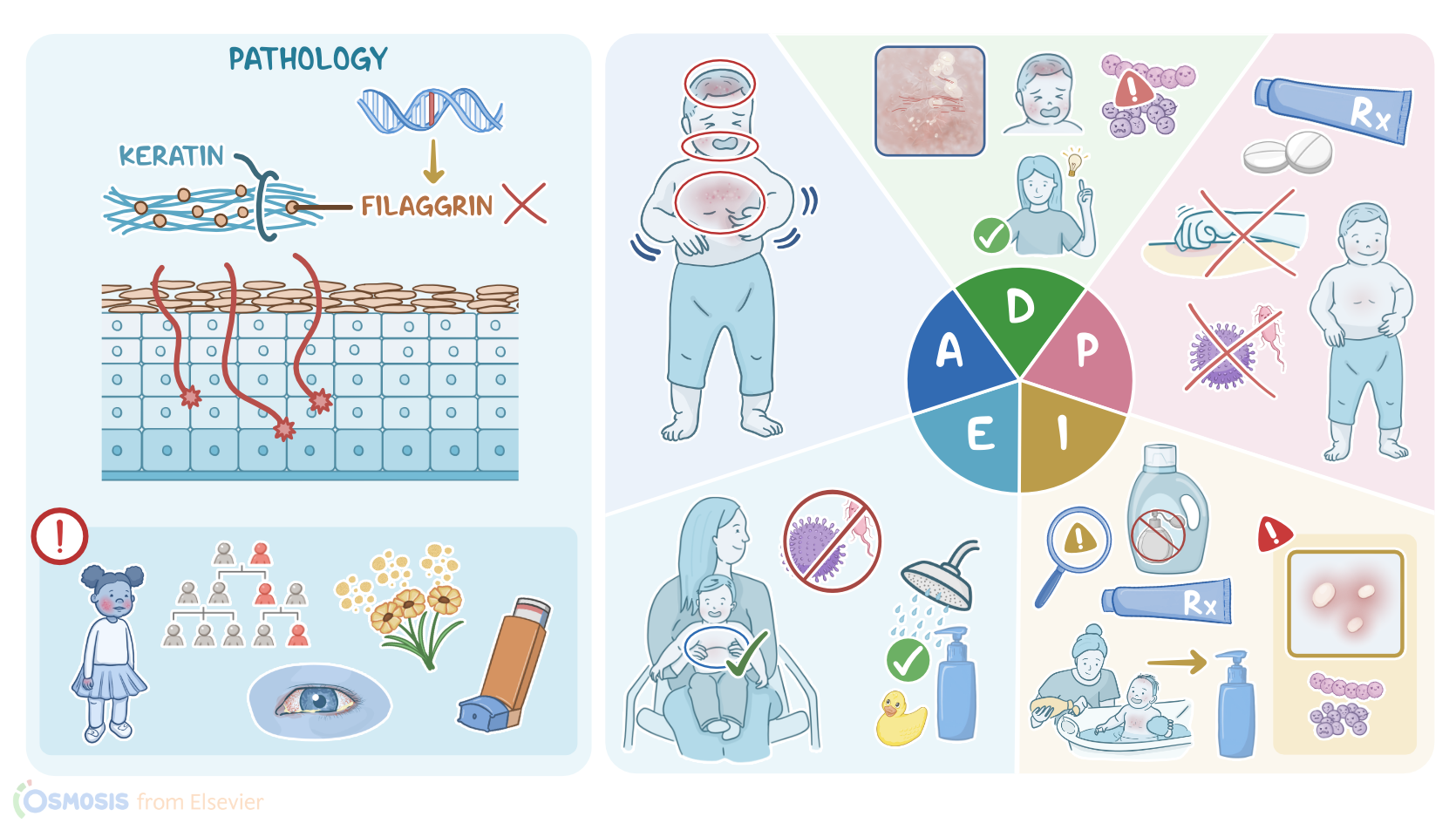
The pediatrician diagnoses atopic dermatitis, and Kameron will begin treatment today. Atopic dermatitis, also known as eczema, is a chronic inflammatory skin disease that occurs most frequently in children, ages five and under, but may also affect adults, especially those with a predisposition towards allergic diseases, including asthma, allergic rhinitis, and conjunctivitis.Now, the exact cause of atopic dermatitis is not fully understood, however it seems to be a mix of skin barrier abnormalities and dysfunction in the immune system.
Pathology0:34–3:33
In regards to skin barrier abnormalities, atopic dermatitis is associated with a mutation in the filaggrin gene. Filaggrin is a protein that binds to keratin and contributes to the formation of the skin barrier, so individuals with atopic dermatitis have a slightly porous skin barrier, which sets them up for allergens or microbes to get under the skin.
In regards to dysfunction in the immune system, atopic dermatitis is associated with atopy, which is a genetic predisposition to develop allergies due to an increased inflammatory response to triggers, such as allergens or irritant substances.
There are some risk factors for atopic dermatitis. Unfortunately, some of them are non-modifiable, including younger age, atopy, family history, and mutations in the filaggrin gene.
On the other hand, modifiable risk factors include contact with triggers, including allergens like pollen, mold, or animal dander, as well as a certain kind of soap or detergent, or an irritant like tobacco smoke.
Clients with eczema typically present with dry, scaly skin that’s very itchy, as well as patches of red, swollen, and easily irritated skin, especially on the face and scalp, but sometimes also on the insides of the elbows or the back of the knees.When scratched, these sensitive patches of skin may develop erosions, oozing, and crusting.
An important complication that may affect this disrupted skin barrier is secondary bacterial infections, especially staphylococcal and streptococcal infections, but also fungal infections, such as tinea, and viral infections, most often from herpes simplex virus.Diagnosis of atopic dermatitis is based on the client’s history and physical exam.Laboratory tests may show increased eosinophils and serum IgE levels, while allergy testing can help identify the specific allergens that should be avoided.
There is no cure for atopic dermatitis, so treatment aims at reducing the symptoms by keeping the skin hydrated with moisturizers, minimizing itching with oral antihistamines, and dampening the inflammatory reaction with topical medications, such as steroid creams like hydrocortisone or calcineurin inhibitors like tacrolimus.
Finally, clients should try to avoid exposure to triggers. Let’s get back to assess Kameron and see how he’s doing.You wash your hands, introduce yourself to him and his mother, and confirm his identity.
Assessment3:33–4:53
Kameron is sitting in his mother’s lap and appears uncomfortable as he scratches his chest through his shirt. You ask Mrs.
Jones when she first noticed the rash. She says it appeared on his chest about a week ago, and that she thought something had scratched him, but now that it’s also affecting his face and scalp.
She’s concerned it is getting worse and wonders if it is contagious. You reassure her that eczema often occurs in flares, that can be treated and that is not contagious.
Jones to pull up his shirt, and you notice a large area of his trunk is dry and irritated. The lesions have begun to weep and bleed where scratch marks are evident.
His vital signs are temporal artery temperature 98.9 F, or 37 C, heart rate 80 beats per minute and regular, respiratory rate 28 breaths per minute with clear lungs on auscultation, and his oxygen saturation is 99% on room air.
You document your assessment findings, share the information with the pediatrician, and begin to develop a care plan for Kameron.
Diagnosis4:53–5:11
Based on the assessment data you collected, your nursing diagnoses include impaired skin integrity related to inflammation; risk for infection related broken skin; impaired comfort related to pruritus; and readiness for enhanced parental knowledge related to new diagnosis.
Now that you have established some nursing diagnoses, it’s time to collaborate with Mrs. Jones and the pediatrician to plan some goals of care.
Planning5:11–5:42
By the follow up visit in two weeks, Kameron will have decreased inflammation and less dry, scaly skin; Kameron will experience less pruritus, Kameron will not feel the need to scratch as much, and there will be no evidence of infection.
Your goal for Mrs. Jones is for her to administer the prescriptions and treatments at home and to notify the pediatrician if the rash gets worse.
Implementation5:42–6:33
Next, you review the pediatrician’s orders, and implement your plan of care. You demonstrate how to clean Kameron’s rash with gentle soap and warm water, patting gently to dry.
You show her how to apply the prescribed topical steroid cream, explaining how it will help reduce inflammation and itching.
Next, you teach Mrs. Jones to apply the moisturizer immediately after bathing to help seal in the moisture.
You remind her to keep an eye out for any triggers that could be associated with a flare-up so these can be avoided, and to consider laundering Kameron’s clothes in a mild, fragrance-free detergent.
You also stress the need to seek medical attention if she notices any signs of infection, especially pustules on his skin, or if the rash becomes worse.
Lastly, you make an appointment for Kameron to return in 2 weeks. It’s been two weeks so let’s check back and see how Kameron is doing.
Evaluation6:33–7:01
The areas of inflammation have begun to recede, and Mrs. Jones says Kameron is not itching his chest as much.
You are glad to see that the scratch marks that were there 2 weeks ago have disappeared, and no signs of infection are present.
Mrs. Jones also tells you Kareron is enjoying his new bath time routine that includes a gentle massage with the moisturizer afterwards.
The treatments appear to be working well! Alright, as a quick recap … Your assigned client, Kameron Jones, was brought to the pediatrician by his mother with signs and symptoms of atopic dermatitis, or eczema, a chronic inflammatory skin disease.
Summary7:01–8:17
The goals you identified when planning included reducing inflammation and pruritus, and promoting comfort. You implemented your plan by teaching Mrs.
Jones about home care and prescribed treatments, and evaluated the effectiveness of Kameron’s plan of care. His vital signs are temporal artery temperature 98.9 degrees Fahrenheit or 37° C heart rate, 80 beats per minute and regular respiratory rate 28 breaths per minute with clear lots of auscultation and his oxygen saturation is 99% on room air.
| ATOPIC DERMATITIS | ||
| KEY POINTS | NOTES | |
| PATIENT REPORT |
| |
| PATHOPHYSIOLOGY |
| |
| DIAGNOSIS AND TREATMENT |
| |
| ASSESSMENT |
| |
| NURSING DIAGNOSES |
| |
| PLANNING |
| |
| IMPLEMENTATION |
| |
| EVALUATION |
| |
- "Ackley and Ladwig’s Nursing Diagnosis Handbook: An Evidence-Based Guide to Planning Care, 13th edition" Mosby (2022)
- "Pathophysiology of atopic dermatitis: Clinical implications" Allergy Asthma Proc (2019)
- "Harrison’s Principles of Internal Medicine, 21st edition" McGraw Hill / Medical (2022)
- "Daily Moisturization for Atopic Dermatitis: Importance, Recommendations, and Moisturizer Choices" The Journal for Nurse Practitioners (2021)
- "Molecular Mechanisms of Atopic Dermatitis Pathogenesis" Int J Mol Sci (2021)
- "Critical Care Nursing: Diagnosis and Management, 9th edition" Elsevier (2021)
- "Health Assessment for Nursing Practice, 7th edition" Elsevier (2021)
No notes for this video yet
Try adding a note below