Transcript
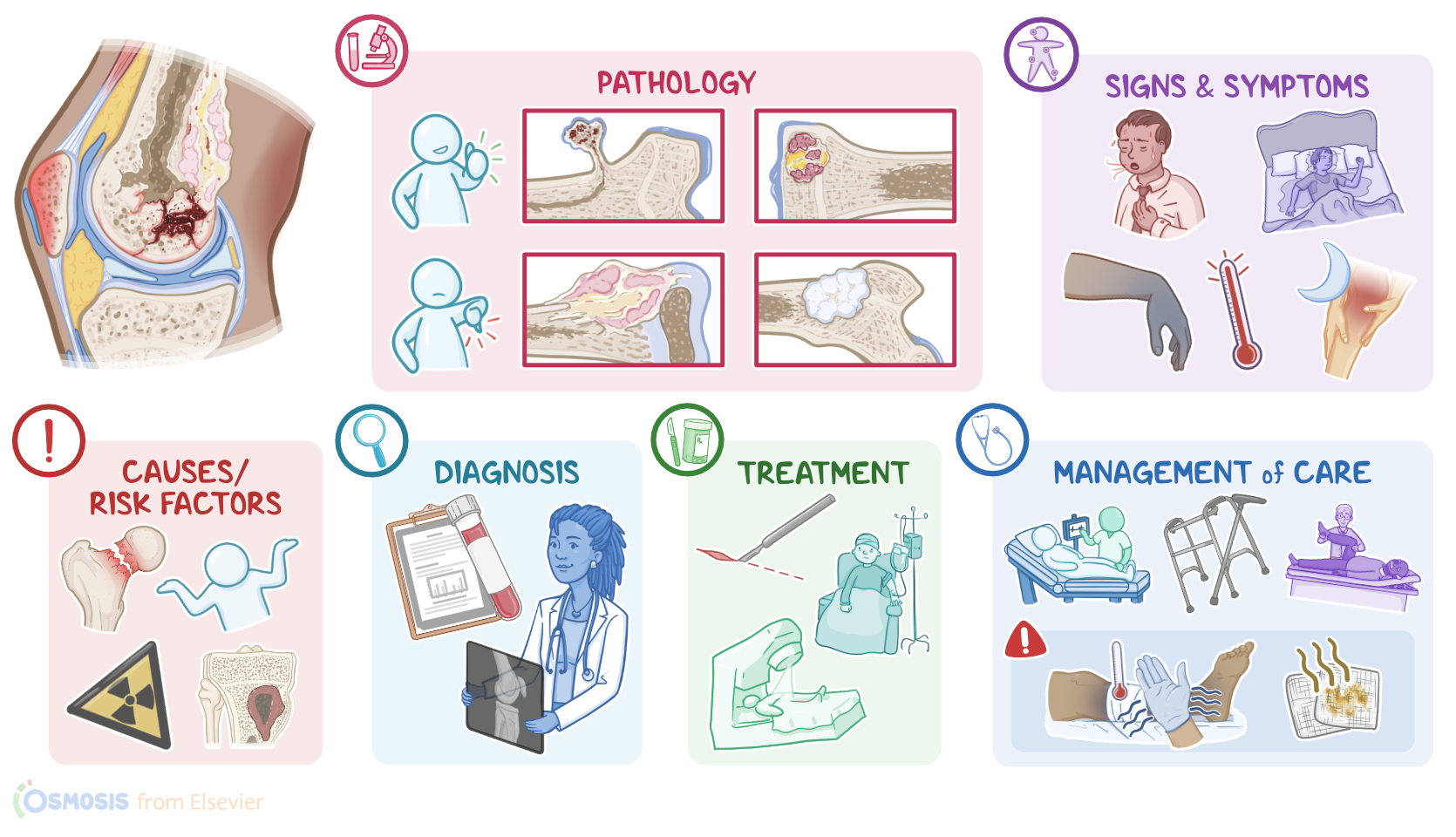
Bone tumors are abnormal growths in the bone that can be broadly classified into benign and malignant. Benign bone tumors stay localized to the bone, and include osteochondroma, giant cell tumor of bone, osteoblastoma, osteoid osteoma, and enchondroma.
In contrast, malignant bone tumors can spread to surrounding tissues and organs. They are further classified as primary malignant tumors, which originate from bone cells, and include osteosarcoma, chondrosarcoma, and Ewing sarcoma; and secondary or metastatic tumors, which originate from other sites in the body, most commonly breast, lung, or prostate; and travel to the bones via lymphatic or blood vessels.
Okay, let’s start by looking at the physiology and anatomy of the bones. Normally, the bones’ surface is covered by a dense layer of connective tissue called the periosteum, and it's where the muscles, tendons, and ligaments are attached. Beneath the periosteum, there’s a dense external layer called compact bone; and a softer internal layer called spongy or trabecular bone, which normally consists of trabeculae and pores resembling a honeycomb.
Now, looking at a long bone, like the femur, it has two epiphyses, which are at the ends that contribute to joints with other bones and are mostly made up of trabecular bone. Between the two epiphyses, is the diaphysis or bone shaft, made up mostly of cortical bone, and a central hollow space, known as the medullary cavity. Bone marrow occupies both the medullary cavity and the spaces in the spongy bone of the epiphysis, which is the site of blood cell production.
Now, in children and adolescents, there’s an additional narrow portion between the epiphysis and the diaphysis called the metaphysis, which is mostly made of trabecular bone. The metaphysis contains the growth plate, a cartilaginous tissue that actively grows during childhood. By adulthood, the growth plate has ossified and fused with the diaphysis and the epiphysis, becoming a mature bone.
Notes
| BONE TUMORS | ||
| KEY POINTS | NOTES | |
| DEFINITION |
| |
| PHYSIOLOGY |
| |
| CAUSES AND RISK FACTORS |
| |
| PATHOLOGY |
| |
| CLINICAL MANIFESTATIONS |
| |
| DIAGNOSIS |
| |
| TREATMENT |
| |
| MANAGEMENT OF CARE |
| |
| PATIENT AND FAMILY TEACHING |
| |
No notes for this video yet
Try adding a note below
Transcript
Bone tumors are abnormal growths in the bone that can be broadly classified into benign and malignant. Benign bone tumors stay localized to the bone, and include osteochondroma, giant cell tumor of bone, osteoblastoma, osteoid osteoma, and enchondroma.
In contrast, malignant bone tumors can spread to surrounding tissues and organs. They are further classified as primary malignant tumors, which originate from bone cells, and include osteosarcoma, chondrosarcoma, and Ewing sarcoma; and secondary or metastatic tumors, which originate from other sites in the body, most commonly breast, lung, or prostate; and travel to the bones via lymphatic or blood vessels.
Okay, let’s start by looking at the physiology and anatomy of the bones. Normally, the bones’ surface is covered by a dense layer of connective tissue called the periosteum, and it's where the muscles, tendons, and ligaments are attached. Beneath the periosteum, there’s a dense external layer called compact bone; and a softer internal layer called spongy or trabecular bone, which normally consists of trabeculae and pores resembling a honeycomb.
Now, looking at a long bone, like the femur, it has two epiphyses, which are at the ends that contribute to joints with other bones and are mostly made up of trabecular bone. Between the two epiphyses, is the diaphysis or bone shaft, made up mostly of cortical bone, and a central hollow space, known as the medullary cavity. Bone marrow occupies both the medullary cavity and the spaces in the spongy bone of the epiphysis, which is the site of blood cell production.
Now, in children and adolescents, there’s an additional narrow portion between the epiphysis and the diaphysis called the metaphysis, which is mostly made of trabecular bone. The metaphysis contains the growth plate, a cartilaginous tissue that actively grows during childhood. By adulthood, the growth plate has ossified and fused with the diaphysis and the epiphysis, becoming a mature bone.