Cardiac biomarkers - Creatine kinase (CK): Nursing

Last updated: January 05, 2023

Cardiac biomarkers - Creatine kinase (CK): Nursing

Cardiovascular MedSurg

Cardiovascular MedSurg

Introduction to the cardiovascular system
Anatomy of the heart
Cardiovascular system anatomy and physiology
Pressures in the cardiovascular system
Cardiac cycle
Cardiac work
Cardiac preload
Cardiac afterload
Cardiac contractility
Stroke volume, ejection fraction, and cardiac output
Cardiac excitation-contraction coupling
Baroreceptors
Electrocardiogram (ECG) - Normal sinus rhythm (NSR): Nursing
Cardiac biomarkers - Creatine kinase (CK): Nursing
Cardiac biomarkers - Troponin: Nursing
Coagulation studies - Partial thromboplastin time (PTT): Nursing
Arrhythmias - Asystole: Nursing
Arrhythmias - Atrial fibrillation (Afib): Nursing
Arrhythmias - Atrial flutter (Aflutter): Nursing
Arrhythmias - Heart blocks: Nursing
Arrhythmias - Premature atrial contractions (PACs): Nursing
Arrhythmias - Premature ventricular contractions (PVCs): Nursing
Arrhythmias - Sinus tachycardia and sinus bradycardia: Nursing
Arrhythmias - Supraventricular tachycardia (SVT): Nursing
Arrhythmias - Ventricular fibrillation (Vfib): Nursing
Arrhythmias - Ventricular tachycardia (Vtach): Nursing
Arterial embolism: Nursing
Buerger disease: Nursing
Congenital heart defects - Acyanotic: Nursing
Congenital heart defects - Cyanotic: Nursing
Cardiomyopathy: Nursing
Endocarditis: Nursing
Myocarditis: Nursing
Pericarditis: Nursing
Heart defects that decrease pulmonary blood flow - Nursing considerations & client education: Nursing
Kawasaki disease: Nursing
Raynaud phenomenon: Nursing
Shock - Anaphylactic: Nursing
Shock - Cardiogenic: Nursing
Shock - Hypovolemic: Nursing
Shock - Neurogenic: Nursing
Shock - Obstructive: Nursing
Shock - Septic: Nursing
Valvular heart disease: Nursing
Alpha-1 adrenergic blockers: Nursing pharmacology
Alpha-2 adrenergic agonists: Nursing pharmacology
Angiotensin II receptor blockers (ARBs): Nursing pharmacology
Angiotensin-converting enzyme (ACE) inhibitors: Nursing pharmacology
Antiarrhythmics: Nursing pharmacology
Anticoagulants - Direct thrombin and factor Xa inhibitors: Nursing pharmacology
Anticoagulants - Heparin: Nursing pharmacology
Anticoagulants - Warfarin: Nursing pharmacology
Antihyperlipidemics - Bile acid sequestrants and cholesterol absorption inhibitors: Nursing pharmacology
Antihyperlipidemics - Fibrates: Nursing pharmacology
Antihyperlipidemics - Miscellaneous: Nursing pharmacology
Antihyperlipidemics - Statins: Nursing pharmacology
Antiplatelet agents: Nursing pharmacology
Beta-adrenergic blockers: Nursing pharmacology
Blood products: Nursing pharmacology
Calcium-channel blockers: Nursing pharmacology
Cardiac glycosides: Nursing pharmacology
Direct-acting vasodilators: Nursing pharmacology
Diuretics - Osmotic and carbonic anhydrase inhibitors: Nursing pharmacology
Diuretics - Thiazide, thiazide-like, loop, and potassium-sparing diuretics: Nursing pharmacology
Hematopoietic growth factors: Nursing pharmacology
Hemostatics: Nursing pharmacology
Iron preparations: Nursing pharmacology
Nitrates: Nursing pharmacology
Sympathomimetic medications: Nursing pharmacology
Thrombolytics: Nursing pharmacology
Aortic aneurysm: Nursing process (ADPIE)
Coronary artery disease (CAD) and angina pectoris: Nursing process (ADPIE)
Hypertension: Nursing process (ADPIE)
Left-sided heart failure: Nursing process (ADPIE)
Myocardial infarction (MI): Nursing process (ADPIE)
Pericardial effusion and cardiac tamponade: Nursing process (ADPIE)
Peripheral arterial disease (PAD): Nursing process (ADPIE)
Peripheral venous disease (PVD): Nursing process (ADPIE)
Rheumatic heart disease: Nursing process (ADPIE)
Venous thromboembolism (VTE): Nursing process (ADPIE)
Aneurysms
Aortic valve disease
Atherosclerosis and arteriosclerosis: Pathology review
Atrial septal defect
Cardiac and vascular tumors: Pathology review
Cor pulmonale
Dyslipidemias: Pathology review
Heart failure
Heart failure: Pathology review
Mitral valve disease
Patent ductus arteriosus
Pulmonary embolism
Pulmonary hypertension
Vasculitis: Pathology review
Ventricular septal defect
Physical assessment - Heart and neck vessels: Nursing
Normal heart sounds
Abnormal heart sounds
Geriatric considerations - Cardiac: Nursing

Notes

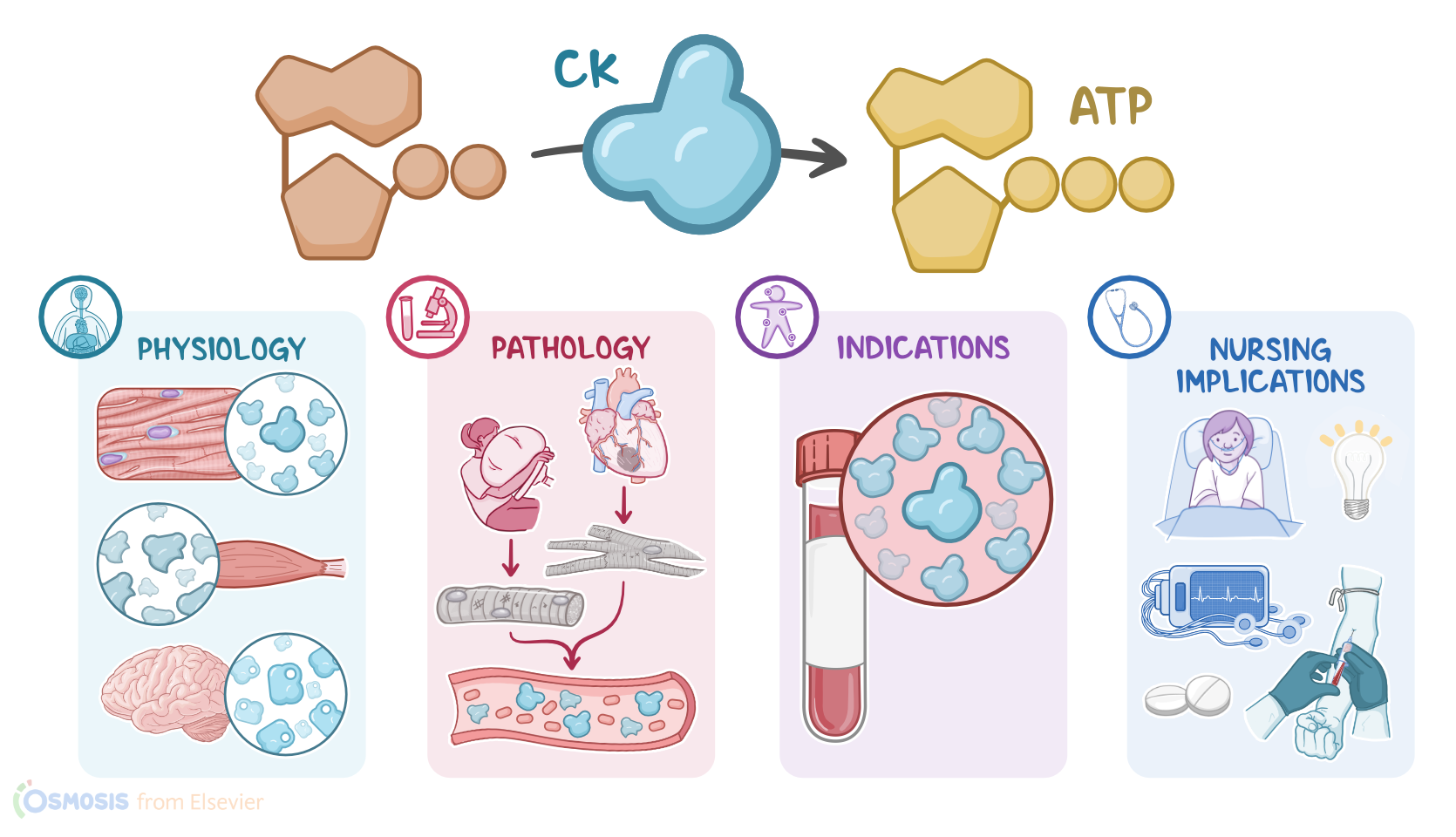
CARDIAC BIOMARKERS - CREATINE KINASE (CK)

KEY POINTS
NOTES
PHYSIOLOGY
  • Enzyme that helps create adenosine triphosphate (ATP)
  • Types
    • CK-MB
    • CK-MM
    • CK-BB

PATHOLOGY
  • Increased CK-MB
    • Damage to skeletal or cardiac muscle

INDICATIONS
  • Concern about cardiac ischemia or muscle damage

NURSING IMPLICATIONS
  • Goals of care
    • Assist with treatment
    • Prevent complications
  • Collect venous sample
  • Gently invert tube
  • Deliver promptly to lab
  • Administer prescribed medications
  • Place on continuous cardiac monitor
  • Create calm environment
  • Monitor laboratory results
  • Prepare for cardiac interventions as indicated

Transcript

Watch video only

A 71-year-old female arrives at the emergency department with reports of chest pressure and nausea. She has a history of high cholesterol and diabetes mellitus. Based on this assessment, the provider suspects acute coronary syndrome, and orders a creatine kinase level to be drawn.

Okay, creatine kinase, or CK for short, also known as creatine phosphokinase or CPK, is an enzyme that helps create adenosine triphosphate, or ATP, which is an energy source, to supply to body tissues. Now, there are three types of CK: CK-MB, found mostly in heart muscle cells, or myocytes, with small amounts found in the skeletal muscle; CK-MM, found in skeletal muscle; and CK-BB, found in the brain.

Alright, let’s focus on the cardiac biomarker, CK-MB. There are certain conditions that can cause an increased CK-MB level, most commonly any condition that causes damage to cardiac or skeletal muscle cells.

Cardiac muscle cell damage can occur with acute coronary syndrome, which is any condition that decreases blood flow to the heart muscle, such as angina or myocardial infarctions, or MI for short. Decreased blood flow causes an imbalance between myocardial oxygen demand and supply from the coronary arteries, resulting in myocardial ischemia, a depletion of ATP, and a severe reduction in the ability of the heart to contract.

At the cellular level, damage to myocytes disrupts their membranes, causing the cellular contents, including CK-MB, to be released into the bloodstream. Now, when skeletal muscle cells are damaged, it can cause a condition called rhabdomyolysis, where the damaged muscle cells release their cellular contents into the bloodstream causing damage to the heart and kidneys.

Skeletal muscle can also be damaged by crushing trauma, which causes a traumatic form of rhabdomyolysis; and muscular dystrophy, a genetic condition causing progressive muscle weakness and loss of muscle mass.

Alright, so CK-MB is usually measured when there is a concern about cardiac ischemia or muscle damage.